
“The evidence is in. The impacts are very real,” Gov. Gavin Newsom (D-CA) said about the billionaire tax, a ballot initiative state unions are trying to qualify for the November ballot. “It’s really damaging to the state.” Even a Democrat as left-wing as Newsom is aghast at the extremism and the power of Big Labor. It shows just how far out of touch and unaccountable unions have become.
Many of California’s most successful job creators agree. Google cofounders Larry Page and Sergey Brin are in the process of leaving the state, as are Facebook founder Mark Zuckerberg, Oracle Chairman Larry Ellison, former Uber CEO Travis Kalanick, and venture capitalist Peter Thiel.
The billionaire tax “will kill startups and innovation in California since a founder is illiquid while instantly on the hook for $100M,” Y Combinator CEO Garry Tan explained. “The proposed CA wealth tax is badly designed in so many ways that a simple social post cannot cover all of the massive flaws,” LinkedIn co-founder Reid Hoffman said, adding that “poorly designed taxes incentivize avoidance, capital flight, and distortions that ultimately raise less revenue.”

Newsom is outwardly confident he can defeat the billionaire tax at the ballot box this November, although it is up in polls. But even if Newsom somehow manages to win this round, California’s billionaires know the state’s unions will be back with another wealth tax soon.
The union behind the tax initiative, SEIU-United Healthcare Workers West, is ostensibly a mostly private sector union representing employees of the state’s largest healthcare providers, including Kaiser Permanente, Sutter Health, and Dignity Health. It also represents many government employees employed by Los Angeles County public hospitals and the Tri-City Medical Center.
But even private-sector union members of SEIU-United Healthcare Workers West depend entirely on one government program, Medi-Cal, the state’s Medicaid program. Medi-Cal provides health insurance for more than 14 million Californians, almost one-third of the entire state, including more than 4 million illegal immigrants.
President Donald Trump’s One Big Beautiful Bill Act cut Medicaid funding to states that provide healthcare to illegal immigrants and closed tax loopholes that states such as California used to shift Medicaid spending to federal taxpayers. This blew a multibillion-dollar hole in California’s budget, a hole the SEIU claims will cause a “healthcare collapse” in the state.
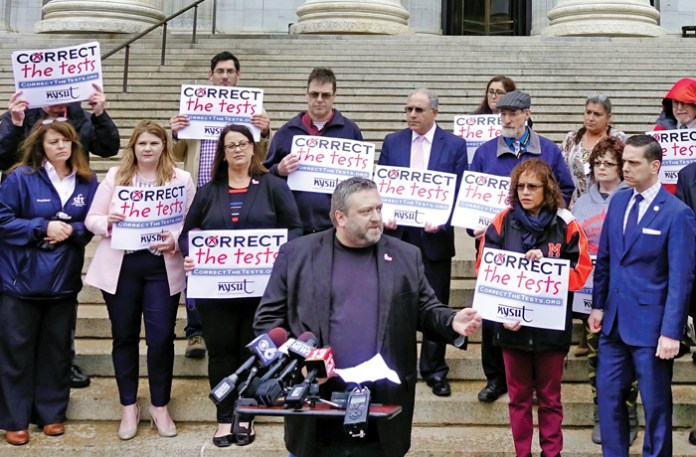
The union claims the billionaire tax is a one-time emergency response. But Californians know better. For years, government unions in the state have pushed wealth-tax proposals under one rationale after another. In 2020, the pitch was COVID relief. In 2021, it was inequality. Similar efforts followed in 2022 and 2023. The constant was not the justification. It was the unions’ determination to unlock a new permanent source of revenue from a shrinking pool of high earners. The current ballot initiative is simply the latest attempt, and the most dangerous, because it would clear the constitutional obstacle that stopped the earlier plans.
California’s total state spending has doubled in nominal terms over the past decade-plus, climbing from around $215 billion in the mid-2010s to peaks exceeding $450 today. Government unions have been a primary driver of this expansion, advocating repeated Medicaid expansions (including state-funded coverage for many immigrants) and big K-12 education spending. The state’s economy and tax base have not kept pace, leaving the choice between raising taxes and cutting spending.
California is just one example, and the clearest one, of a broader blue-state problem. Across the country, states run by Democrats and thus in the pocket of labor unions are facing the same spending pressures, and they are reaching for the same answer: higher taxes on the people and businesses already paying the most.
In Massachusetts, voters approved a 4% surtax on annual taxable income over $1 million. In Maryland, lawmakers approved a 2025 tax package projected to raise roughly $1.6 billion in fiscal 2026, including new higher-income tax brackets, a 2% capital gains surcharge, a 3% sales tax on data and information technology services, and authorization for counties to raise local income tax rates even further. Washington did much the same in 2025, adopting an additional 2.9% tax on capital gains above $1 million, higher estate taxes, broader sales taxes on selected services, and a 0.5% surcharge on gross receipts of businesses with over $250 million in revenue. The pattern is unmistakable. When Democrats fail to control government unions’ insatiable thirst for other people’s money, Big Labor just keeps coming back for more.
It wasn’t supposed to be this way. The Wagner Act of 1935, signed by President Franklin Roosevelt, specifically excluded government employees from collective bargaining privileges. In 1937, the president of the National Federation of Federal Employees asked Roosevelt to support collective bargaining for government workers, and he declined.
Roosevelt wrote in a letter responding to the National Federation of Federal Employees, “All Government employees should realize that the process of collective bargaining, as usually understood, cannot be transplanted into the public service. It has its distinct and insurmountable limitations when applied to public personnel management. The very nature and purposes of government make it impossible for administrative officials to represent fully or to bind the employer in mutual discussions with government employee organizations.”
Despite Roosevelt’s warning that the essential nature of collective bargaining for government workers was antithetical to democracy since it limited democratic control and accountability of government, President John F. Kennedy granted federal workers collective bargaining privileges in 1962 by executive fiat. New York followed suit five years later, which was then followed by a wave of deep blue states, including California and Illinois. What Roosevelt feared and explained was morally and democratically impossible is now a dominant feature of budgets and contracts.
Today, 33 states allow some type of collective bargaining for government workers, with the bluest states having the highest percentage of unionized government employees. The public sector union movement has been so successful that government union members today (7.3 million) almost outnumber private sector union members (7.4 million).
Public sector unions have also been around long enough for economists to study the impact they have on government spending. And the evidence is clear: Government unions are a major driver of government growth. That government unions drive up government spending is unarguably true. That is why they exist: to secure the highest wages and most generous healthcare and pension plans possible. It stands to reason that the more power given to government unions through collective bargaining, the more government workers will be paid and the higher costs taxpayers will have to meet.
That is exactly what we see all around us. The literature clearly demonstrates that collective bargaining for government workers drives up the pay and benefits of government workers. One particularly compelling study taking advantage of the uneven spread of collective bargaining at the local level in the 1970s and 1980s found that collective bargaining “substantively” raised not only wages and benefits for government workers (sometimes by as much as 25%), but also increased hiring.
Other studies have found that by locking in wage levels and making it difficult to fire workers, government unions make localities less financially flexible than their non-union counterparts. This means that when localities hit financial stress, as all localities sometimes do because of recessions and other economic slowdowns, those bound by government union contracts have fewer options to balance budgets. As a result, localities that are in the straitjacket of government union collective bargaining are more likely to issue new debt to get through fiscal shocks and then have to pay higher bond yields as a result. The costs are also not just fiscal. They show up in service quality, too.
That higher-paying government unions secure public sector workers through collective bargaining might perhaps be justifiable if there were any evidence that higher government pay translated into better or more efficiently delivered government services. But the opposite is the case. Government unions notoriously make the delivery of government services worse, not better.
One study found that while teachers unions are good at raising teacher pay and other education spending, they harm student education and undermine performance. Other studies have found that cities with unionized public transit systems have much higher operating costs per mile than those without.
Government unions consistently make the delivery of public goods worse because they exist to thwart management efforts to improve productivity. Take teachers unions. Collective bargaining contracts prevent schools from using objective tests to see which teachers are good and which are bad. It would be easy to see which teachers were better at raising student test scores over a year, but the unions representing teachers don’t allow that. Instead, raises and promotions are determined by seniority, which has no relation to quality. And continuing education requirements actually make teachers worse, so teachers with seniority, who are better paid, are likely to be worse at the job than their juniors.
Government unions exist to provide their members with higher pay, better benefits, and more job security. Union leaders are elected to positions of power when they deliver these goods to members. Union leaders get nothing for raising productivity, and therefore have no incentive to attempt it. Why improve the delivery of government services if taxpayers can be made to pay more for worse quality? If a city’s Public Works Department patches a pothole in three days instead of three months, union leaders get nothing. If Public Works Department employees get a raise or an extra day off, union leaders get votes for the next election.
As they grow more powerful, public sector unions not only sap government capacity to deliver services, but they also make the government less politically accountable. In many jurisdictions, government union collective bargaining contracts don’t just set wages and benefits; they also dictate working conditions and even policy. They set class-size rules, staffing formulas, hiring procedures, student-discipline frameworks, and police-accountability standards. Every policy decision made at the bargaining table and enshrined in a union contract is a decision taken away from voters. It is a usurpation of democratic authority. Officials elected to deliver positive change in education, policing, and infrastructure are all hamstrung by government union contracts.
The situation is worse in deep blue states where the Democratic Party faces no real opposition from Republicans. In purple states, voters might at least be able to vote for a candidate who will try to restrain government union power during the next contract negotiation. But in blue states where Democrats have uncontested power, government unions often control who wins Democratic Party primary elections. In a crowded field of unknown candidates, a union endorsement and the votes and volunteers that come with it are often decisive. Thus, the Democrats, notionally in charge, are in the pockets of unions and fearful of crossing them.
Government unions have great financial power. No interest group spends more on lobbying in California, Illinois, and New York than government unions. No interest group spends more on elections either. As a result of government union dominance over Democratic Party primary elections, when union leaders finally sit down at the bargaining table with elected officials, they are often “bargaining” with candidates they hand selected. It’s not a debate, but a round of mutual backslapping. The end result is a new government contract in which the union was represented at both ends of the table, and taxpayers had no voice at all.
Except, of course, taxpayers in blue states do have one final way of voicing their opposition to government unions; they can leave the badly run states altogether. Millions are doing so every year. The blue-state exodus we are seeing from California, to Illinois, New Jersey, New York, and Massachusetts is driven not only by higher taxes and housing costs, but also by the frustration voters feel at being powerless to govern themselves and incapable of affecting real change at the ballot box.
There is some measure of hope for voters in jurisdictions with government unions. The public sector union movement is shrinking. The number of government union members peaked in 2009 at 7.9 million and has been falling steadily since to just 7.3 million today. After the Tea Party revolt in 2010, several states, including Idaho, Indiana, Tennessee, and Wisconsin, restricted collective bargaining rights for most public employees, limited pay increases, and effectively reduced union power. As a result, government union membership fell.
But just as government union power can be taken away, it can also be granted.
In 2020, Democratic Gov. Ralph Northam signed legislation giving Virginia localities, including counties and cities, the ability to adopt collective bargaining agreements with public-sector employees, which had previously been banned by law. Fairfax County, once a fiscally responsible jurisdiction that ran regular surpluses, immediately entered into its first collectively bargained contract with the Fairfax Education Union. Teachers got a 7% pay raise, while taxpayers were left with a $300 million deficit.
GAMBLING HAS TURNED AMERICANS AGAINST THEIR OWN TEAMS
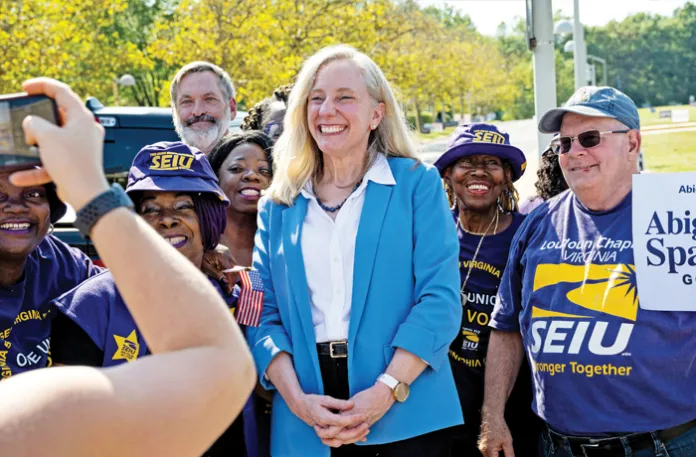
Now, Gov. Abigail Spanberger (D-VA), another left-wing Democrat who ran as a centrist, wants to force collective bargaining on all Virginia governments. If enacted, the legislation would add millions of dues-paying members to government unions, feed the Democratic Party’s political machine, and drive spending, taxing, and borrowing up across the state. There are many states just to the south and west of Virginia that do not have government union collective bargaining. They would love to see Virginia follow the path of California and New York into government union torpor, and to welcome fleeing Virginians into states that have not let unions choke them into submission.
What began as a promise to protect government workers has become a machine for protecting government itself from the people who pay for it. Public sector unions raise costs, weaken accountability, and make reform nearly impossible in the states they dominate. That is why blue state voters keep fleeing and why taxes keep rising on those who remain. If politicians will not stand up to government unions, taxpayers will keep doing the only thing left to them. They will vote with their feet, taking their families, businesses, and tax dollars to states where government still answers to voters, not unions.
Conn Carroll (@conncarroll) is commentary editor of the Washington Examiner.