
From the outside, it may seem strange that American conservatives have taken such an interest in the fate of a Central European country with a population roughly equivalent to that of New Jersey. Right-wing political leaders in Hungary, however, have spent years nurturing relationships with American conservatives through a host of fellowships, conferences, and partnerships to engender that reality.
Now, as Hungarian Prime Minister Viktor Orban faces an electoral challenge that polling suggests could remove him from power on Sunday, scores of American conservatives are pumping out messaging to drum up support for him. Such content follows expensive operations funded by the Hungarian government to build inroads with the American Right.
Hungary has significantly wound down its influence funding since Trump’s first term, and there is no evidence to suggest that it is paying for the recent surge of support it has received from American conservatives. Many American conservatives have come to believe that Orban and his Fidesz party are genuine allies in their struggle against the Left.
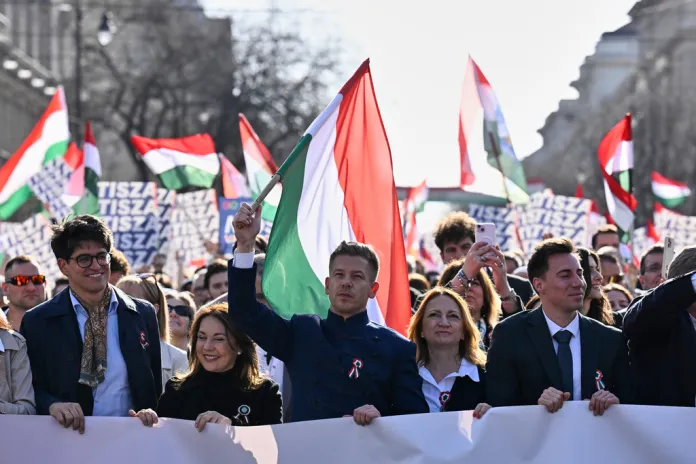
Vice President JD Vance offered a high-profile demonstration of support for Orban on Tuesday, when he traveled to Hungary to meet with Orban and address his supporters. In a speech before thousands of people in Budapest, Vance stressed the Christian faith, opposition to supranational organizations, emphasis on heritage, immigration restrictionism, and historical ties that unite American conservatives to their Hungarian counterparts.
Support for Hungary is just as strong, if not stronger, among conservative media.
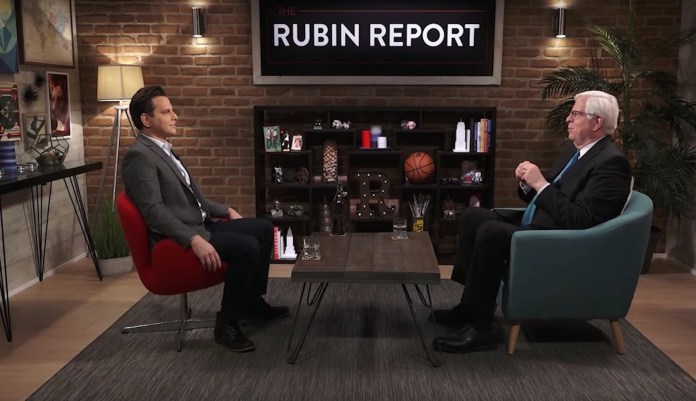
Right-wing media titan Dave Rubin, who has long had friendly relations with Hungary, published a friendly interview with Orban’s political director and co-partisan, Balazs Orban, on March 27, for instance. In the context of the looming election, Orban described Hungary’s ruling party as “the Hungarian patriots who are trying to save our people” by “not letting migrants in” and fighting “the woke ideology,” talking points that would appeal to Rubin’s audience of American conservatives.
In a similar vein, Mario Nawfal, one of the largest right-wing content creators on X, published a sympathetic interview with Orban on March 25. During the interview, which has been viewed over 2 million times, Nawfal allowed the Hungarian prime minister to portray himself as an ardent nationalist, advocate for traditional religion, close ally to President Donald Trump, and immigration hawk, all traits that would boost his image among American conservatives.
Legions of other conservative accounts have, as election day approaches in Hungary, offered praise of Orban along similar lines and stressed the importance of his regime’s survival to Western conservatism.
“Wall Street Mav,” a conservative account boasting 1.7 million followers, for instance, posted a video of Orban on March 28 in which the prime minister claims that Ukraine attempted to route money to the Democratic Party ahead of the 2024 election and that the country is attempting to do the same thing in his upcoming election. Right-wing actor and comedian Rob Schneider, meanwhile, told his 2.2 million followers that “a victory for [Orban] is a victory for Hungary.”
Their views are largely representative of conservatives online. But Hungary’s importance to the American Right isn’t confined to a few corners of the internet.
A Trump administration favorite
In addition to Vance’s visit, Trump himself has endorsed Orban’s reelection bid. Secretary of State Marco Rubio, for his part, has described U.S.-Hungary relations as having entered a “golden age,” saying that “this relationship we have here in central Europe through you is so essential and vital for our national interests in the years to come.”
The pro-Orban sentiment so common among conservatives today follows years of efforts spearheaded by the Fidesz government to popularize his model of statecraft among American conservatives. At the center of this effort was public intellectual Rod Dreher.
Dreher, who has a long history as a conservative columnist, has been open about being paid by the Hungarian government to build alliances on its behalf with U.S. conservatives.
Hungary, he told Foreign Policy in a May 2023 interview, seeks to use people like him to “provide a counter-narrative to the one that prevails in Washington and Brussels and among the American and Western European media.”
Dreher, who remains a staunch advocate of Orban, acknowledged that the infrastructure Orban was building then could continue to serve his ends even if he is ousted from power. Vance and Dreher, notably, have a close relationship, with the latter being instrumental in the former’s conversion to Catholicism.
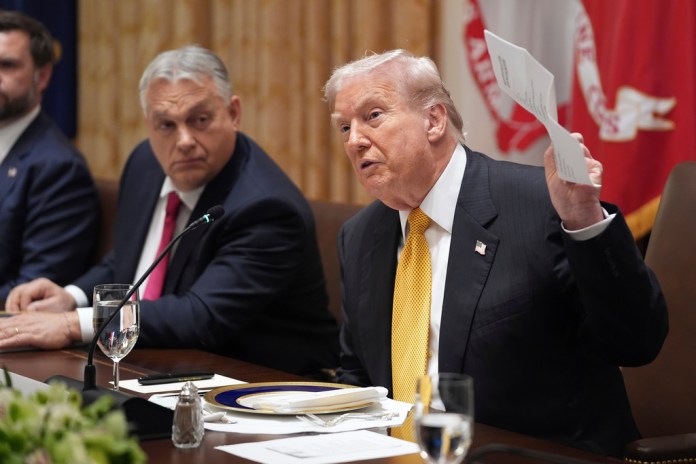
“I think one of the reasons that the Orban government is building up all these institutions using government funds and government power is because he knows he’s not going to be prime minister forever,” he said. “Fidesz is not going to be in government forever, and he wants to have some sort of deep state built that will be able to survive whoever is coming.”
Dreher takes credit for many of the initial contacts between Hungarian political operatives and heavy hitters on the American right. He, for instance, claims to have arranged Fox News host Tucker Carlson’s 2021 interview with Orban, a media event that served as an introduction to the Hungarian prime minister for many American conservatives.
What’s more, Dreher was also present alongside Rubin at a May 2023 event at the Hungarian state-backed Danube Institute. Webpages maintained by the state-backed think tank indicate that Rubin has been in contact with it since at least 2021, where he also appeared alongside Dreher, and that he has since made semi-regular appearances at the institution.
Following his introduction to Hungarian conservatives, Rubin has put out a fair amount of apologia for the Orban regime. These have included a documentary defending Orban’s Hungary from criticism, releasing multiple videos praising Hungary’s conservative credentials, and regular attendance at CPAC Hungary, a state-backed political conference held annually in Budapest. As a homosexual, Rubin has used his identity to push back against claims that Orban’s government treats the LGBT community unfairly.
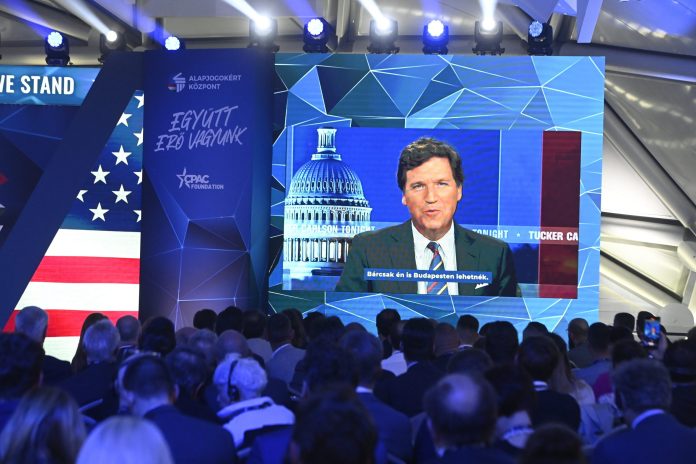
CPAC Hungary itself has emerged as a sort of transatlantic Mecca for Western conservatives, successfully getting right-wing European politicians into the same rooms as members of Congress and influential American media figures.
Dreher and Rubin did not respond to requests for comment.
Think tanks like the Danube Institute have been a key part of Hungary’s effort to influence American conservatives. In some cases, think tanks have directly paid American conservatives with the aim of influencing their peers. The state-funded Batthyany Lajos Foundation, the parent organization of the Danube Institute, for instance, paid activist Chris Rufo $35,000 for approximately a month of work in 2023 and writer Michael O’Shea $4,500 a month for his work, according to documents obtained by the Hungarian-language news outlet Atlatszo.
O’Shea was tasked with writing articles for American and European media, whereas Rufo did multimedia work.
“I spent time over there because of my love of the region,” O’Shea told the Washington Examiner. “I’m a Polish citizen and Polish-speaker, and I started studying Hungarian during COVID, which is what brought me there. I know/knew many in the expat community in Budapest, and the only thing uniting us was that nothing in particular united us.”
O’Shea noted that, while his works touches on politics, his ultimate aims aren’t moored to political parties or individual elections.
“This is my life’s work, irrespective of parties and elections,” he told the Washington Examiner. “Poland, Hungary, and Slovakia, particularly, are close to my heart, and I hope those countries are recognizable and thriving long after I’m gone, long after my great-grandchildren are gone. I don’t think of my writing as being part of the ‘American Right’ or serving any kind of political movement. Most people in the anglosphere don’t follow this region, and those who do get their opinions from a small number of people with a contemptible worldview. That’s why I have something to contribute. That’s why I do what I do.”
Rufo, like Dreher, was upfront about his work with the Hungarian government while he was doing it. In 2023, Rufo wrote a widely read piece in Compact titled “What Conservatives See in Hungary,” where he disclosed the fellowship.
Scores of other conservative Americans benefited from contracts with Batthyany Lajos Foundation and the Danube Institute over the years, most of whom were similarly tasked with producing media.
Past payments don’t necessarily translate to lasting influence. While O’Shea continues to beat the pro-Orban drum, Rufo has been largely silent on the upcoming Hungarian elections.
Rufo did not respond to a request for comment.
Old news aside, Hungarian think tanks continue to serve as a transatlantic conduit between conservatives in Washington and Budapest.
The Mathias Corvinus Collegium, a private Hungarian educational institution that the critics allege has been turned into a “breeding ground for future Fidesz-friendly elites” following over $1 billion in payments from the government.
Like the Danube Institute and the BLA, the MCC maintains a host of American visiting fellows. Among them are conservatives representing influential American think tanks such as the Manhattan Institute, the Acton Institute, and the Center for Immigration Studies, as well as roughly a dozen academics associated with American universities. Over the years, the MCC has attracted high-caliber conservative speakers such as Tucker Carlson, Jordan Peterson, Dennis Prager, Sohrab Ahmari, Heritage Foundation president Kevin Roberts, and dozens of others.
While the MCC appears to focus on building relationships with academics, many of the Danube Institute’s American visiting fellows seem to be more focused on mass media. Among current and recent visiting fellows at the institute, at least eight are English-language writers.
Content aligned with Hungary and its broader interests is common among the output of these fellows.
Sean Nottoli, a former Trump campaign official who was a Danube Institute visiting fellow in 2025, for instance, wrote a piece for the Spectator that was released during the first few days of 2026 in which he claims to have “lost 50lbs eating at McDonald’s.” The essay recounts his time in Hungary, presumably as a fellow with the Danube Institute, and attributes the weight loss to the country’s approach to food regulation.
In a more serious vein, 2025 Danube Institute visiting fellow Nathan Levine ran a Substack that occasionally made positive references to Hungary. Now, he has a senior policy role at the State Department.
It is unclear if the Danube Institute pays these visiting fellows. One 2024 contract obtained by Atlatszo, however, states that the visiting fellow in question — whose name was redacted — was being paid $4,500 a month to land articles in an array of right-wing English-language media outlets. Researchers affiliated with the network of pro-Orban think tanks regularly contribute to American media organizations, according to Atlatszo.
Atlatszo has also reported that Americans distributed across Orban’s network have been paid speaking fees, received compensation for attending conferences, and had their travel and lodging expenses taken care of to attend pro-government functions.
The Danube Institute did not respond to a request for comment.
While one portion of Orban’s quest to win the hearts and minds of American conservatives saw him bring them to his country, the other brought Hungary to them.
Hungary carried out an aggressive lobbying campaign during the first Trump administration, retaining eight lobbying firms, paying each thousands or tens of thousands of dollars per month, to gain purchase in Washington. Hungary uniformly ended these contracts before Trump left office and hasn’t spun them back up since.
Some of the contracts sought to interface with American policymakers to signal Hungary’s alignment with the Trump administration on issues like immigration and religious freedom, whereas others were designed to improve Hungary’s reputation by influencing American media.
The lobbying firm Greenberg Traurig, for instance, was paid $100,000 for its work “educating” American “opinion leaders” about Hungary. Sanitas International, meanwhile, received an undisclosed amount to build relationships with “western media and government officials” by highlighting Hungary’s “commitment to regional security” as well as “political and economic stability.”
In perhaps Hungary’s most well-known lobbying adventure, the country paid right-wing influencer David Reaboi a flat fee of $35,000 to “generate positive American media coverage of Hungary and combat negative media coverage of Hungary” and “brief journalists and engage in debate on social media.”
“I support Hungary – especially when the media and hard left NGOs attack them,” Reaboi wrote on Twitter in October 2020. “I am not here for the money.”
Ironically, that post was later disclosed to the Department of Justice as a communication he was paid to make.
Reaboi’s claim that he’s not in it for the money, however, seems to be supported by his recent behavior. Though the influencer is no longer on the books as a paid spokesperson for Hungary, he is still aggressively defending the Orban government on X.
“At a very basic level, I think it’s the fact that Orban has won repeated elections and that’s actually shown that it is possible to govern as a conservative,” Heritage Foundation senior research fellow Paul McCarthy, who specializes in European affairs, told the Washington Examiner when asked about the Hungarian prime minister’s appeal to the American Right.
“Policies which promote family formation and demographic renewal, including tax incentives, housing support, and pro-natalist policies; those are going to appeal to conservatives,” he continued. “He’s also pushed back on sort of this transnational progressive ecosystem network of NGOs, media institutions, activist groups, a lot of which are funded by Brussels and operate across borders and seek to influence domestic politics. I think that has a resonance for conservatives here who believe there’s a similar problem, and particularly foreign-funded political activity.”
McCarthy contested claims that affinity for Orban among American conservatives is a recent development, saying that he’s been on the radar of some on the right even before Trump won in 2016. He qualified this by stating that “an ecosystem takes a long time to develop.”
OPINION: TRUMP AND RUBIO CAMPAIGN FOR VIKTOR ORBAN, XI’S EUROPEAN PET
While, in McCarthy’s telling, the appreciation of American conservatives for Orban predates his government’s spending to build bridges with them, he conceded that “having this ecosystem has helped to spread conservative ideas, particularly in Europe and transatlantically.”
The Heritage Foundation, notably, inked a partnership agreement with the Danube Institute in 2022. While Heritage maintains that there was not a financial aspect to the agreement, the two organizations have held multiple events together since, further ingraining Orban’s brand of nationalism into the American conservative psyche.