
There have been numerous casualties on all sides since the joint U.S.-Israel strikes against Iran commenced in late February. Over one month later, a two-week ceasefire was struck.
Leadership in Tehran and the Islamic Revolutionary Guard Corps bore the brunt of losses for the past five weeks, but Hezbollah and other Iranian proxies had also taken some damage. Additionally, civilians were caught in the crossfire.
HEGSETH TOUTS ‘OVERWHELMING VICTORY’ IN IRAN AS MILITARY TAKES BACKSEAT DURING CEASEFIRE
Senior Iranian officials taken out
Nearly 50 senior Iranian officials have been eliminated in the targeted operation, crippling the country’s government.
Iran scrambled to appoint replacements as the nation sustained losses at the highest level.
Ayatollah Ali Khamenei and wife Mansoureh Khojasteh Bagherzadeh
Supreme Leader Ali Khamenei was the highest-ranking Iranian leader to be killed in Operation Epic Fury, the name given by President Donald Trump to the mission for targeting the clerical government. Khamenei was at his Tehran compound before his death on Feb. 28.
The Iranian supreme leader’s wife, Mansoureh Khojasteh Bagherzadeh, died sometime after sustaining wounds from the airstrikes that killed her husband. Khamenei’s daughter, grandchild, daughter-in-law, and son-in-law were also killed. His son, who is the successor, remains alive.
Ali Larijani
Ali Larijani, secretary of Iran’s National Security Council, was considered former Ayatollah Ali Khamenei’s main confidant and “right-hand man.” Before his death, he was appointed to advise Khamenei during nuclear negotiations with the U.S.
Larijani was killed in an overnight airstrike on March 17, according to the Israeli military.
With permission from the new supreme leader, Iranian President Masoud Pezeshkian appointed retired IRGC commander Mohammad Bagher Zolghadr to take Larijani’s place on March 24.
Esmaeil Khatib
Khatib, Iran’s intelligence minister, was killed in a strike in Tehran March 18. The IDF said he was responsible for arresting and killing protesters in January and “led terrorist activities against Israelis & Americans around the world.”
Majid Khademi
Maj. Gen. Majid Khademi, who served as the IRGC’s intelligence chief, was killed in an airstrike in Tehran on April 6. That was the day before the U.S. and Iran struck a deal for the temporary ceasefire.
Last June, Khademi was appointed to replace his predecessor and his deputy after they were killed in an airstrike during the 12-day war with Israel.
Gholamreza Soleimani
Gholamreza Soleimani commanded the IRGC’s Basij unit, which suppressed recent anti-government protests across Iran.
He was killed on March 17 in an overnight Israeli airstrike on a Basij combat tent, where he was stationed with other Basij commanders.
Ali Shamkhani
Commodore Ali Shamkhani, the former head of Iran’s defense council and a close adviser to Khamenei, was among the top officials killed in the initial strikes.
He was overseeing the negotiations between the United States and Iran about a potential nuclear deal. The latest round of talks concluded just before the U.S. and Israel attacked Iran.
HOW THE IRAN CONFLICT WAS LAUNCHED: ‘OPERATION EPIC FURY IS APPROVED. NO ABORTS. GOOD LUCK’
Mohammad Pakpour
Maj. Gen. Mohammad Pakpour formerly led the Islamic Revolutionary Guard Corps. He replaced the previous Guard commander, Hossein Salami, who was eliminated by Israeli forces last June.
Following his death, Pakpour has been succeeded by Brig. Gen. Ahmad Vahidi. Vahidi is under U.S. sanctions for his role in quashing nationwide protests and committing human rights violations.
Abdolrahim Mousavi
Maj. Gen. Abdolrahim Mousavi served as Iran’s armed forces chief of staff since June 2025, when his predecessor was assassinated by Israeli strikes before Operation Midnight Hammer, which targeted Iran’s nuclear program.
Mousavi is being replaced by an interim leadership council, led by Iranian President Masoud Pezeshkian.
Alireza Tangsiri
Commodore Alireza Tangsiri served as the Guard’s naval commander until his assassination on March 26. He had been in that post since 2018.
In a statement confirming the Iranian official’s death, Israeli Defense Minister Israel Katz described Tangsiri as the man “directly responsible for the terrorist operation of mining and blocking the Strait of Hormuz to shipping.”
Aziz Nasirzadeh
Brig. Gen. Aziz Nasirzadeh, the country’s defense minister, also died in the initial joint strikes. He was replaced by an acting defense minister.
Mohammad Shirazi
Brig. Gen. Mohammad Shirazi had led the supreme leader’s military office since 1989. In this role, he facilitated coordination between armed forces commanders and the supreme leader.
Hossein Jabal Amelian
Brig. Gen. Hossein Jabal Amelian oversaw Iran’s Organization of Defensive Innovation and Research, an agency responsible for developing advanced weapons. Israeli military assessment says its research entailed nuclear, biological, and chemical weapons.
Reza Mozaffari Nia
Brig. Gen. Reza Mozaffari Nia once led the SPND, contributing to nuclear weapons development.
Majid Mousavi
Brig. Gen. Majid Mousavi had commanded the Guard’s Aerospace Force since last June.
Mohsen Darrebaghi
Brig. Gen. Mohsen Darrebaghi served as a deputy for logistics and support and general staff of Iran’s armed forces.
Other notable casualties in Iran’s government include Brig. Gen. Gholamreza Rezaian, the police intelligence chief; Brig. Gen. Bahram Hosseini Motlagh, the general staff of Iran’s armed forces; Mohammad Baseri, a senior intelligence ministry official; and Salah Asadi, the head of Iran’s intelligence department.
Hezbollah leaders
Several leaders of Hezbollah, a key Iran-backed terrorist group based in Lebanon, were also hit hard by Israel. The Jewish state retaliated after Hezbollah launched aerial attacks from the Lebanese capital of Beirut.
After Hezbollah and Israel traded fire, Lebanon’s prime minister banned the terrorist group from conducting “military activities” and relegated it to political duties.
Zaid Ai Jumaa
Zaid Ali Jumaa, the head of Hezbollah’s artillery management, was killed during strikes near Beirut, Lebanon. He led the Fire Management and Support Unit, which oversaw coordination of rocket array,s artillery, mortars, and UAVs.
Mohammad Raad
Mohammad Raad, the head of Hezbollah’s parliamentary faction, died on March 2 after Israel struck Beirut.
Serving as a member of parliament for Hezbollah since 1992, Raad led the Iranian proxy’s 13-member political wing. Also, he was once a spokesperson for former Hezbollah leader Hassan Nasrallah, who died in Israeli airstrikes in September 2024.
Hussein Makled
Hussein Makled, the head of Hezbollah’s intelligence headquarters, was also killed.
The Israeli military says Makled provided Hezbollah with “intelligence assessments regarding [Israel Defense Forces] troops and the State of Israel” and “closely cooperated with senior commanders in Hezbollah who planned and advanced terror attacks against Israel and its citizens.”
Adham al Othman
Adham al Othman, the commander of the Palestinian Islamic Jihad’s military wing, was also killed in the Israeli attack in Beirut on March 2.
The Islamic Jihad made the announcement of his death, but the Israeli military did not immediately confirm the veracity of the opposing group’s claim.
Hamas leaders
Yahya Abu Labda
Hamas commander Yahya Abu Labda was killed during an Israeli strike in Gaza March 18. He was a prominent figure in development of Hamas’s precision missile project, according to the Times of Israel, and was a key official in the “procurement and transport of military equipment and weapons.”
Civilian casualties
The toll on civilians has been much greater, with Iran and Lebanon having the highest deaths in the Middle East. Civilians have also been killed in other Gulf states.
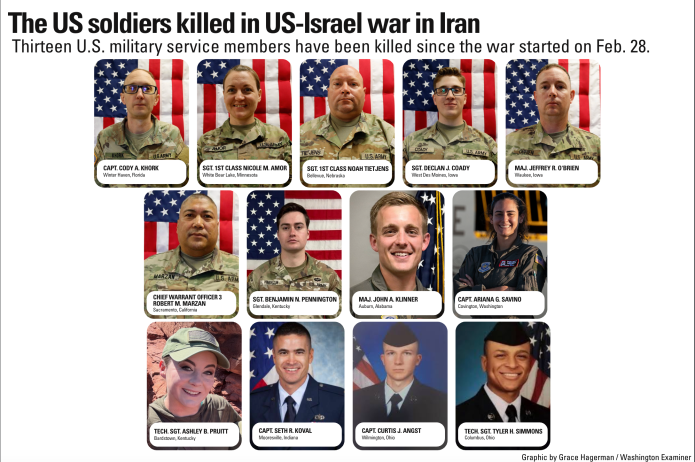
Meanwhile, at least 13 U.S. troops have been confirmed dead so far during Operation Epic Fury.
Iran
At least 2,000 people have died in Iran since the start of the war, according to Iran’s Health Ministry. Over 26,500 people have been injured, per the updated figures.
Among the deadliest incidents occurred in Minab, where an all-girls elementary school was targeted. At least 170 people, most of them likely children, were killed.
Israel
At least 26 people in Israel have died since the conflict began, and more than 7,000 others have been wounded so far.
On March 1, at least nine people were killed after Iran struck a synagogue and bomb shelter underneath the religious site in Beit Shemesh, a city about 18 miles west of Jerusalem.
At one point the following day, a funeral gathering for two of the victims was disrupted by air sirens that were triggered by explosions overhead as Israel intercepted drones and missiles. The funeral proceeded several minutes after the immediate threat was gone.
HOW GULF STATES ARE RESPONDING TO IRAN’S RETALIATORY STRIKES
Neighboring Middle Eastern states
Several Persian Gulf nations that host U.S. bases or forces are dealing with their own losses from retaliatory strikes.
In Lebanon, nearly 1,500 people have died in Israeli strikes so far. Israel continued operating in Lebanon to root out Hezbollah, hours after the ceasefire deal was made.
Bahrain, Kuwait, Oman, and Saudi Arabia all recorded deaths in the single digits following Iran’s strikes to date. In the United Arab Emirates, at least 12 people are dead. Meanwhile, Iraq has recorded over 100 deaths. Qatar and Jordan have recorded no fatalities so far. There have been significantly more wounded casualties across the region.