
After suffering severe losses in Operations Epic Fury and Roaring Lion, Iran launched a massive text message-based recruitment campaign to shore up its forces amid growing fears of a U.S. ground invasion.
Over the past week, Tehran has sent out mass text messages to the Iranian populace, urging them to join the fight against “the American-Zionist enemy’s threats against Iran’s shores, islands and borders,” the Financial Times reported. The drive was also promoted on state television and through an online portal, which claimed to have received over 5 million applicants. Specifics weren’t given, but volunteers will likely be taken into the Basij, a pro-regime paramilitary force subordinate to the Islamic Revolutionary Guard Corps.
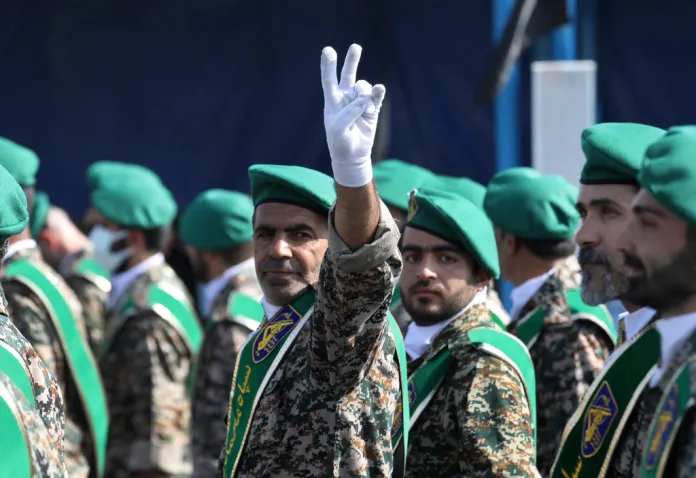
The Basij has been singled out for targeting due to its centrality in the Islamic government’s security apparatus. The group played a leading role in the January massacre of protesters, with estimates of the death toll numbering in the tens of thousands.
The recruitment drive is also notable for tapping into nationalist sentiment, rather than Islamic or revolutionary sentiment, likely cognizant of the regime’s waning popularity. Some polls have the government’s approval at around 20%. The recruitment text message explicitly called on Iranians to “defend the country’s soil.”
Iran has increasingly relied on Iranian nationalistic sentiment rather than its revolutionary Shia Islam as its ideological steam has run out. This is in part driven by the increasingly powerful Guard, which experts note has increasingly blended Shia Islam and Iranian nationalism, with an emphasis on the latter.
This trend in propaganda intensified with the 12-day war and has since reached a fever pitch. It’s found success among Iranians who aren’t as keen on the clerical government.
“If a ground war happens, I’ll go fight,” a Tehran mechanic told the Financial Times. “I prefer to die defending my homeland than die in bed.”
A 35-year-old businessman told the outlet he wouldn’t volunteer for the regime in the current phase of the war, cognizant of the brutality of the Jan. 8-9 crackdown on protesters, but that “If a ground war breaks out in Tehran, I will go to defend my homeland against American and Israeli forces.”
The number of volunteers is hard to quantify, with estimates ranging from the hundreds of thousands to the regime’s claim of tens of millions out of a population of around 90 million. The Basij played a major role in the 1980-88 Iran–Iraq War, with the poorly armed troops sustaining at times catastrophic casualties through their “human wave” assaults against Iraqi positions.
The suicidal bravery of the Basij has become iconic in Iranian culture, including that of Basij child soldiers. Basij child soldiers were ordered to charge into minefields to blow themselves up, clearing the way for more experienced troops. Mohammad Hossein Fahmideh, a 13-year-old Basij soldier who destroyed an Iraqi tank by throwing himself under it and detonating a grenade belt, is widely commemorated as a hero by the government.
The Guard has separately launched a recruitment drive targeting youths, seeking children as young as 12 to guard security checkpoints, carry out patrols, tend to the wounded, and perform other supporting tasks. A 13-year-old was recently killed in a strike on a checkpoint after he accompanied his Basij father.
After the degradation of Iran’s air defenses and military, Israeli drones flew over Tehran and began targeting Basij checkpoints set up around the city. This led many units to hide under overpasses.
Basij leaders have had to implore their members not to abandon their posts amid U.S. and Israeli targeting, with one leader posting on Telegram that Israel was “clearing the way so that by creating fear and terror, they can move operational teams across the city to the intended areas,” adding that there is “no reason” to be scared.
IRGC LEADERS TRY TO CALM FEARS AFTER ISRAELI STRIKES TARGET BASIJ CHECKPOINTS
Aside from religious and nationalistic appeals, the Basij has been kept in line through economic incentives. Basij members are given economic, educational, career, social, and prestigious benefits through their membership, giving them a concrete stake in the government.
The Guard and Basij are believed to control over half of Iran’s economy, including dominance over key industries such as oil and telecommunications.