
“April 2, 2025, will forever be remembered as the day American industry was reborn, the day America’s destiny was reclaimed, and the day that we began to make America wealthy again.”
President Donald Trump spoke those words as he imposed historic tariffs on countries all over the world. One year on, the tariffs have led to massive changes in international relations, disruptions in global trade, a momentous Supreme Court ruling, and many other far-reaching effects. The full legacy of the tariffs is yet to be known, but this Washington Examiner series will take stock of the first year. The first installment looks at the manufacturing sector and how employment has not lived up to Trump’s promises.
Manufacturing employment has fallen in the year since President Donald Trump imposed his “Liberation Day” tariffs, meaning that a chief goal of the aggressive trade agenda has not been fulfilled.
Trump and his team have touted the tariffs as a way to reshore manufacturing and increase employment in the sector. But job growth has not materialized, in part because manufacturers are paying more for inputs as a result of the tariffs.
ELIZABETH WARREN PROPOSES WEALTH TAX ON FAMILIES WITH OVER $50 MILLION
Trump announced the major new tariffs on April 2, 2025. Since that month, the United States has lost 89,000 manufacturing jobs, according to the Bureau of Labor Statistics. For all of Trump’s time in office, the number is 100,000.
“I think there’s a lot of uncertainty with the tariffs itself … companies putting capital investments on hold, especially if they source a lot of product internationally,” said Dean Burrows, president and CEO of Gear Motions, an upstate New York-based precision gear and gearbox manufacturing company.
It’s clearly not Trump’s fault that manufacturing employment has contracted. The U.S. has been losing manufacturing jobs for decades, a long-running trend that economists have generally attributed to automation and globalization.
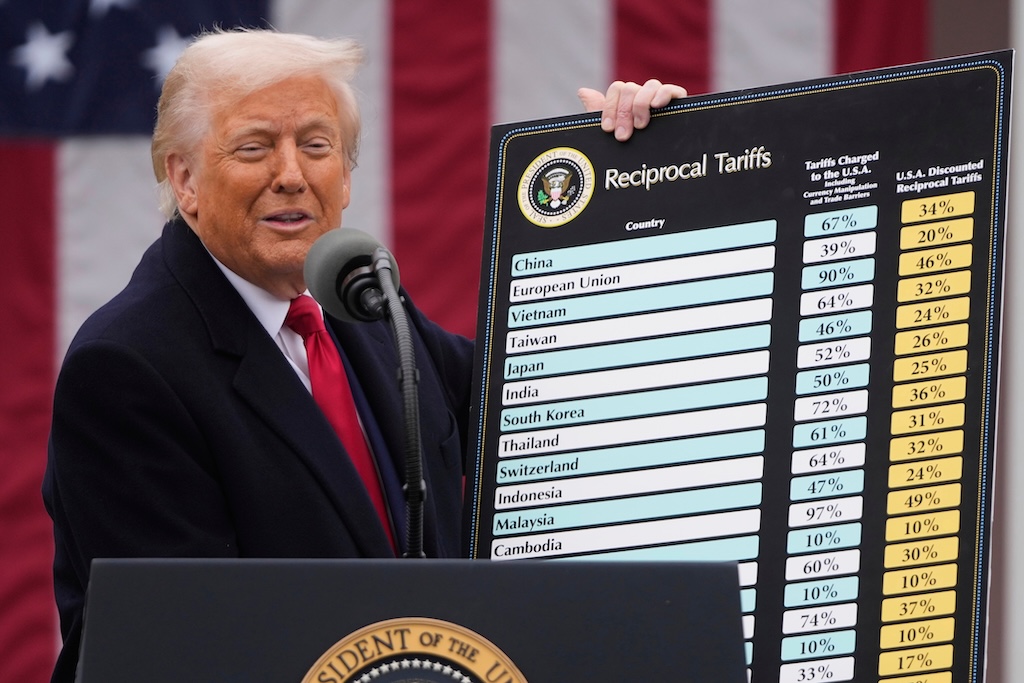
But Trump promised to reverse the trend, and the stakes are high. Surveys show that higher tariffs aren’t popular with voters.
“Jobs and factories will come roaring back into our country,” Trump said when announcing tariffs last year. “And ultimately, more production at home will mean stronger competition and lower prices for consumers.”
At least part of the pro-tariff logic is that raising the cost of goods from outside the country would give domestic manufacturers an advantage and thus encourage investment in factories.
But Trump’s tariffs have also raised the costs of inputs, paradoxically making things more challenging for manufacturing.
“I think the main thing is manufacturing is suffering from the fact that the cost of inputs has gone up, in other words, raw materials — and that’s a function of the trade wars,” Sean Higgins, a research fellow at the Competitive Enterprise Institute, told the Washington Examiner.
In perhaps the most significant example, Trump has imposed major tariffs on steel, aluminum, copper, and lumber, which are important materials in a wide range of manufactured products. So, for example, a domestic furniture maker might benefit from tariffs on imported furniture, but at the same time see that advantage disappear when higher material costs are taken into account.
Rep. Blake Moore (R-UT), a member of the House Ways and Means Committee, said that, while tariffs have allowed Trump to reach some advantageous trade deals and pursue other goals, they have raised input costs.
“Input costs are more now, input costs are higher, it’s more difficult to reshore in that situation,” Moore told the Washington Examiner. “So, that’s a factor that can hurt the ability to increase manufacturing in the U.S., and hopefully those trends can reverse themselves.”
Trump has also hurt investment by creating uncertainty about tariffs, making it difficult for businesses to plan. At times, he’s shocked markets by imposing massive tariffs, only to lower them later on. His Liberation Day tariffs were struck down by the Supreme Court, but he immediately moved to reimplement them by other means.
“Because the tariffs sort of jump or jump around, a lot of businesses don’t really know what they can charge for their products quite so much, because they don’t know what the prices are going to be six months to a year from now,” Higgins said.
The case for tariffs
The case for tariffs is that they will take time to work.
“It’s true that there’s been a slide in manufacturing numbers over the last 15 months, [but] it’s worth noting that that’s been the case for the last couple of years,” Scott Paul, president of the Alliance for American Manufacturing, told the Washington Examiner. “It also predated some of the tariff increases coming in last year.”
Paul, whose trade group includes the United Steelworkers union, said several factors might be contributing to the job declines. He said that none of the policies aimed at boosting manufacturing, whether the tariffs or the 2022 CHIPS and Science Act that provided major incentives for domestic computer chip factories, is “happening in a vacuum.”
Nick Iacovella, executive vice president at the pro-tariff Coalition for a Prosperous America, told the Washington Examiner that it is a “flawed assumption” that Trump’s tariffs alone are enough to reshore industry in the U.S.
“The last year from the Trump administration has been arguably the greatest effort by any administration in recent history to use trade policy to reshore domestic production, especially in critical sectors,” Iacovella said.
Iacovella said that it has been a “massive” effort across “very complicated industrial sectors.”
“And for anyone to be so quick to judge that they’re not doing a good job, that things haven’t happened yet, just ignores reality of how long these things take,” he said. “These new factories don’t just pop up overnight. You’re not going to open a semiconductor [fabrication plant] in a matter of months.”
Early signs of life for manufacturing?
The defenders of Trump’s tariffs also cite a few statistics that could be early signs of a manufacturing turnaround.
One is that job openings in the manufacturing sector have risen in the past few months. In other words, hiring may not yet have increased, but more vacancies are being advertised.
From just November 2025 to January, job openings in manufacturing increased by over 100,000, according to the BLS’s Job Openings and Labor Turnover Survey.
Trump defenders also argue that the pace of job losses has slowed.
Acting Council of Economic Advisers Chairman Pierre Yared said in an email that more than 200,000 manufacturing jobs were lost during former President Joe Biden’s last two years in office alone.
Yared said that the effort to revitalize manufacturing is a three-pillar approach. The first pillar is tariffs, but tax cuts and deregulation are also key to the effort, he said. Yared also pointed out that manufacturing productivity grew at its fastest rate in two decades last year under Trump.
Another sign of life for the sector is that indices of factory activity have perked up in recent months.
The Institute for Supply Management’s monthly Purchasing Managers’ Index reports, which measure whether the U.S. manufacturing sector is expanding or contracting, have also shown expansion in January and February of this year.
Nicole Wolter is the president and CEO of HM Manufacturing, a company founded in 1979 that primarily makes gears and power transmission components for aerospace, defense, and other markets.
Wolter said that part of the mismatch between openings and declining employment is that, as manufacturing evolves, there is less need for “button pushers” and greater demand for more skilled roles.
“We need real skilled, talented, labor force,” she said. “So I need someone that can program, set up machines, understands fixtures … and I think that’s where we have so many openings right now, is there’s not a lot of people with that skill set out there, and so we’re kind of crying for that type of help.”
Wolter said there was a noticeable uptick in purchase orders after Trump won reelection.
“People were purchasing machinery like there was that excitement that, OK, manufacturing is back,” she said.
DEMOCRATIC PRESIDENTIAL CONTENDERS EYE TAX CUTS TO WOO GOP VOTERS
Burrows, the New York-based manufacturer, said that while his company has been stable on staffing, it is hiring right now. He also said that one problem has been that demand for higher wages has been a hindrance in filling that gap in manufacturing job openings.
“We are finding upward pressure on wages right now, so it’s becoming more challenging to hire,” Burrows said. “We’re back kind of where we were a few years ago, where wages just continue to increase.”