
Louisiana’s Republican Senate primary is shaping into a test of whether President Donald Trump’s endorsement still decides elections or whether candidates can survive by borrowing the Trump agenda without his political backing.
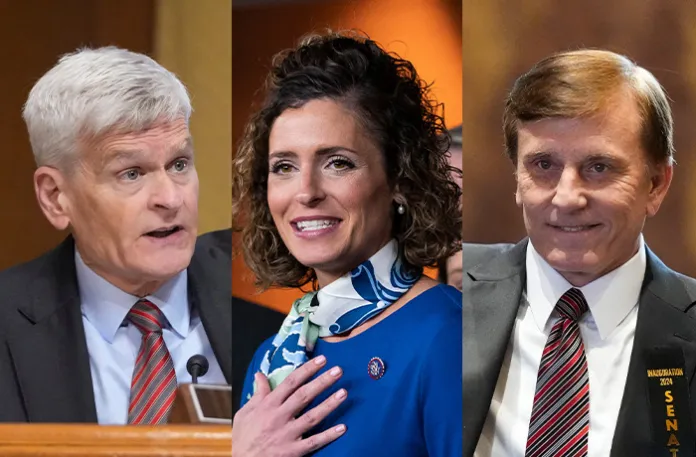
Sen. Bill Cassidy (R-LA) faces two challengers in the May 26 primary, with the possibility of a June 27 runoff if no candidate wins at least 50%: Rep. Julia Letlow (R-LA) and state Treasurer John Fleming.
Previously a staunch ally of Trump, Cassidy’s relationship with the president has run hot and cold for the last five-plus years.
Cassidy, a gastroenterologist often referred to as Dr. Cassidy around Capitol Hill, has been a senator since 2015, after six years in the House. Cassidy, 68, worked closely with Trump during the president’s first, nonconsecutive term, particularly on the GOP’s failed repeal of Obamacare. Trump endorsed Cassidy’s American Health Care Act of 2017, which failed to receive a floor vote.
When Cassidy ran for reelection in 2020, Trump heartily endorsed him, declaring he was “doing an outstanding job.”
But their relationship frayed months later amid the Senate impeachment trial after the Jan. 6, 2021, Capitol riot. Cassidy was one of only seven Republicans to vote to convict Trump. Cassidy, for his troubles, was censured by the Republican Party of his home parish. Trump later called Cassidy a “TOTAL FLAKE” who was “shunned in his own State” for disloyalty.
Cassidy attempted to mend fences with Trump over the past year. He voted for the nominations of Defense Secretary Pete Hegseth and Health and Human Services Secretary Robert F. Kennedy Jr. He championed the One Big Beautiful Bill Act and defended Trump during TV appearances.
Last fall, Cassidy said the White House promised that Trump would stay out of the 2026 GOP primary, telling USA Today the pair have a “great working relationship.”
Trump changed his mind in January, giving Letlow a preemptive endorsement for Cassidy’s seat. An official endorsement happened on March 21.
“Julia Letlow has my Complete and Total Endorsement — SHE WILL NEVER LET YOU DOWN!” wrote Trump on his Truth social network.
Two doctors and a doctorate
Trump has long favored Letlow. The pair became political allies when Letlow’s late husband, Luke Letlow, was elected to represent Louisiana’s 5th Congressional District in 2020. Luke Letlow died from complications related to COVID-19 before ever taking office. Julia Letlow ran to replace him, after a career in speech communications and academic administration — she’s one of the relatively few lawmakers on Capitol Hill with a doctoral degree. Letlow, now 45, became the first female Republican elected to Congress in Louisiana.
“The fact that she is endorsed by Trump makes her candidacy even more appealing,” observed Professor Robert E. Hogan, the chairman of the political science department at Louisiana State University.
But Trump also has more pronounced ties to Fleming.
First elected to Congress in 2008, Fleming, 74, represented Louisiana’s 4th Congressional District until 2017, when he left Congress after losing a Senate bid. Trump appointed him to a position within the Department of Health and Human Services. Fleming moved to the Commerce Department in 2019 and was a senior White House aide from March 23, 2020, to Jan. 20, 2021. Fleming was elected state treasurer of Louisiana in 2023.
Fleming, like Cassidy, a physician first elected to the House in 2008, though as a family doctor, has portrayed himself as “MAGA before MAGA was cool” in campaign videos.
Polling, so far, shows no candidate has a clear advantage.
The Cassidy, Fleming, and Letlow campaigns have all released voter surveys that show each one in the lead.
Cassidy’s campaign released one poll showing the senator with 35% support, while Letlow and Fleming were second and third. Letlow’s campaign pointed to a poll showing her leading 27% to 26% over Cassidy, with Fleming a distant third. Meanwhile, the Fleming-commissioned poll gave him 34.2% support among primary voters, with Letlow second and Cassidy third.
The Letlow and Fleming surveys mentioned that more than 20% of those surveyed were undecided.
John Couvillon, a longtime Louisiana political strategist with ties to all three candidates, predicted the race would go to a June 27 runoff featuring Cassidy and either Letlow or Fleming. “You’re not really talking about a long period of time before the balloting,” Couvillon said. “Less than two months now.”
The conflicting polls underscore uncertainty about Trump’s role in the race: Even with the president’s backing of Letlow, no candidate has consolidated the Republican field.
Despite losing Trump’s endorsement, Cassidy has leaned into the president’s agenda — betting Republican voters will prioritize policy alignment over personal loyalty. The incumbent’s first TV ad expressed his support of tax cuts, a larger child tax credit, and no taxes on tips — all issues that Trump has also championed.
The strategy is not surprising to Louisiana political observers, who noted that Cassidy can’t rely on the general electorate to win. The state recently changed its “jungle primary” system, where all candidates run against each other.
“He is trying to win a semi-closed primary that allows only Republican registered voters and ‘No-Party ’-registered voters to participate,” Hogan said.
Hogan does not expect Cassidy to win, saying his political career is in extreme danger despite a massive campaign war chest.
“Normally, in Louisiana, that would not even draw a challenge,” he said. “Julie Letlow saw blood in the water. And now she’s going after him. He’s in trouble.”
Debate about debates
All three campaigns are attempting to come up with a debate schedule.
Cassidy has said he wants a trio of televised debates. Letlow has countered with a statewide radio debate hosted by Louisiana talk show host Moon Griffon, who refers to Cassidy as “Psycho Bill.” Fleming said he’ll participate in any debate.
Debates, in any format, are expected to be key, according to Louisiana analysts.
“For any of the major candidates to refuse to debate would be seen as a sign of weakness by Louisiana voters,” observed Robert Collins, a public policy professor at Dillard University, in New Orleans. “They will debate.”
Despite the current debate about debates, Letlow appears to be acting like she’s the front-runner. Collins said that gives her an advantage over the other candidates.
“As a rule, candidates want to debate when they sense they are behind and need to shake up the race, whereas candidates who believe they are ahead do not care to debate,” he said.
SENATORS DISCUSS HOW TO PUT OFF SOCIAL SECURITY BANKRUPTCY — WHAT TO KNOW
Whoever wins the May 16 Republican primary and expected runoff will likely win the general election in deep-red Louisiana.
With no serious Democratic opposition, the primary may not just decide Louisiana’s next senator — it could signal whether Trump’s endorsement still settles Republican fights, or whether candidates have learned to win without it.
Taylor Millard is a freelance journalist who lives in Virginia. Follow him on X @TaylorMillard.