
While in North Carolina with my parents, I watched from afar as the George Floyd riots played out — first in Minneapolis and then as they spread to Washington, D.C.
I decided I was not going back as long as the riots continued. I worried that my apartment building, which had businesses on the first floor, would be attacked by looters. I was in no shape to sleep while lying in bed scared of the violence unfolding downtown.
Governors activated 17,000 National Guard members in 23 states and sent them in to help. The Border Patrol assigned 350 of its agents to the front lines in Washington, which I had never seen before. So much was happening at once.
In Portland, Oregon, rioters fought federal police day after day, week after week, and eventually month after month, attempting to take over and burn down a federal courthouse downtown. It was the first time many Americans heard of antifa.
The violence in Washington, as well as in Portland, where I had been downtown many times in high school, became personal to me. I knew those buildings. Rioters attacked police with explosives and machetes. Some people vandalized buildings to the point that the first-floor exteriors were nearly unrecognizable.
More than 140 Department of Homeland Security and other federal police officers were injured defending the courthouse in Portland. Some of them were Border Patrol tactical agents whom I knew from my work on the southern border. It felt personal. These weren’t just any police — they were agents I had seen in dozens of trips to their hometowns, sent to defend a federal building in Portland without help from local and state authorities.
George Floyd had become a household name, but for me, it was a complicated acquaintance. Due to the timing of the attack on me in April 2020 and Floyd’s death in May 2020, and all of my intensive therapy, my mind saved an image of Floyd’s face as that of the man who attacked me. I still do not understand it.
Every time I saw Floyd’s face on TV or in an online story, I would get nervous. It felt as though I had just seen the face of the man who hurt me on the street. I would consciously tell myself, “That is not the man who hurt me,” and know that it was true, but his picture made me tense.

Back in North Carolina, my parents tried to distract me from my anxiety when we weren’t working. Because the state’s pandemic protocols were so lax, we would go to local shopping centers and hang out there or watch movies or work on puzzles at home.
While living with my parents, they kept the mood light. They knew the news could upset me, so they tried to keep conversations and TV fun. Dad loved and still loves to go out to Starbucks for coffee, and I would join him for matcha from time to time.
My parents and I would walk around an outdoor shopping center in town and look in store windows, buy treats and hang out in Barnes and Noble, and walk around the many parks in the area. We would go out to dinner at Cava or another fast casual restaurant. We would walk around the Harris Teeter grocery store and debate whether the subs or the pizza were the better meal for that night. I went to church with them on Sundays when I was able to get out of bed. They really did their best to keep me in good spirits while also understanding that they did not fully grasp what was going on in my head. They were always willing to listen when I wanted to talk.
I did not believe that my mind could heal and stabilize until the world around me became a more quiet and peaceful place — and my assailant was off the streets and the court proceedings were done.
All the while, everything around me continued to get worse. The 2020 election was a few months away. The rhetoric around the presidential race was amping up, as well as the idea of our democracy coming under attack. These were normal talking points (maybe not totally normal), but in my state of mind at the time, they seemed to be reasons to panic.
One morning, I was in a particularly bad spot mentally. My father asked me to follow him outside. After I did so, he said to look up at the sky and my surroundings. I looked up at the sky, then around at the many trees, the parking lot of neighbors’ cars, the apartment buildings, and a dog being walked by its owner. He asked what was out of place or wrong or showed danger. I said that I did not recognize anything that fit those descriptions.
“Anna,” Dad said, “if you didn’t watch the news or read the headlines, you would have no idea that we are in a pandemic. You would have no idea about the looting, the riots, the protests, or the conspiracies about the pandemic. You would just know that it‘s a beautiful day and everything is fine. So when you get scared, just look outside and remember that if you did not know any different, everything would seem fine — because it is fine.”
That anecdote has stuck with me. Every once in a while, I’ll tell myself that line when the news gets to be too much, when mass shootings seem to be happening left and right, when a member of either political party makes a terrifying claim, or when things feel overwhelming. It always brings me back to my reality.
Police contacted me in early summer to say that they found a match to the DNA taken from the clothes I wore the day of the attack. They named the man whom they believed had attacked me. He was homeless and lived very close to my apartment building. That was great news. We had a name. He would not get away in the long term. There would officially be a prosecution. The police would now work to arrest him.
While at my parents’ home, my editor, Keith, assigned me a story on whether crime in Washington was up or down in the first few months of the pandemic. I thought it would be an easy assignment. As a homeland security reporter, I worked with federal, state, and local law enforcement daily. I knew how to find police statistics. I had looked up crime stats for Washington in mid-2019 as I was looking to move from upper Georgetown to a more central part of town.
I had pulled up Washington’s Metropolitan Police Department website and read about different types of crime — homicide, sex abuse, assault with a dangerous weapon, robbery, burglary, motor vehicle theft, theft from auto, arson, and other types of offenses.
In 2019, the map showed block-by-block details of the crimes, total and by category, that had been tracked around Capitol Hill and the H Street neighborhood where I was looking at apartments. I toured apartment buildings in that area and used the crime data to choose one that was reportedly safer than others.
I selected Station House Apartments on 2nd Street NE. I opened the Metropolitan Police Department’s crime map to see the data on crimes reported since March. It showed that crime was, in fact, down significantly. I began to work on my story comparing pre-COVID trends with more recent data. I was impressed that the data from such recent arrests was already on the map.
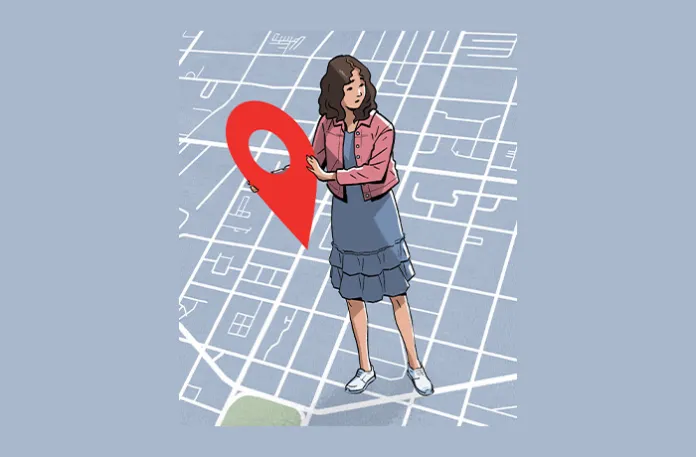
While working on the story about crime levels in Washington, I decided to look up my case on the map. Back then, the D.C. police map showed pins where crimes actually took place. They now color-code certain blocks or neighborhoods so it is more ambiguous.
I fed my details into the D.C. police crime stats filters: April 2020, sex abuse, with or without a weapon. My brow furrowed as the results popped up on the screen. No pin was placed at the location where I had been attacked. I wondered if they forgot to include my crime on the map.
I looked at the map on the other side of the street: Station House, where I lived. No pin there either. Perhaps they had put a pin at the address on my driver’s license. I checked, but there was no pin. What about my previous address? Again, no. No pin at my office or anywhere else as I frantically clicked on other dropped pins and read their descriptions. None was for the crime committed against me.
In Washington, it is possible to have four of almost the same address because the city is divided into quadrants, so there could be a 100 K Street NE, 100 K Street NW, 100 K Street SE, and 100 K Street SW.
Perhaps the police input the wrong quadrant, so I looked up all the equivalent locations but came back empty. I sat back in my chair, confused. My first and only thought that day was that the police were behind schedule and had not gotten around to posting my crime on the map. I was disappointed, but figured government bureaucracy was the holdup in updating the city crime map.
I emailed MPD. I explained that I was a national reporter and also a sex abuse victim and shared the details of my incident. I also mentioned that the U.S. Attorney’s Office planned to prosecute the case.
I did not get a response that day or for days afterward, which was unusual given that in all other professional contacts with MPD, I heard back within a day or two at most. A week went by, but I still had not heard from the police, so I followed up.
It was not until two weeks after my initial inquiry that MPD wrote back. The official stated in an email that my incident had not been forgotten. It had been purposely excluded from the crime stats. It was not a mistake. He explained that only first-degree offenses were included on the crime map.
I had not considered that they would have chosen not to include it. I jumped out of my chair and walked over to the closet where I kept a binder of documents that the police and U.S. Attorney’s Office had mailed me since April. I had to see what degree of sex abuse my attacker had been charged with: sex abuse in the third degree.
Did this attack not matter? I had never heard that all arrests and charges were not included on a police crime map. My case was not insignificant — the U.S. Attorney’s Office was bringing charges on my behalf!
It also occurred to me that if the D.C. police were not including all crimes on the map, then my belief that I was picking the safest city block when I moved a year earlier was baseless. It was not amenities or floor plans that landed me at my new apartment building. It was the same crime stats page that I was now learning was based on half-truths.
The police officer had stated that even second-degree sex abuse victims were not counted. But there would be far more lesser-degree victims than first-degree. To not include all degrees of sex abuse on the map was to ignore a huge bloc of people. And to treat those victims as if what happened to them was not significant enough to place a dot on a map invalidated their suffering.
It communicated that the misery they had been through — not just in the crime they suffered, but also the aftermath — was not important and not worthy of mention, even though the Department of Justice prosecuted and the D.C. police department responded.
By not including me and countless other sex abuse victims in the crime stats, they took away our voice. Victims seldom speak out for many reasons — people will not believe them, they want proof, they do not care, or they are simply distracted. That crime stats page is often the only voice for victims. It speaks for us and says, “Something happened to someone where this pin was dropped — and it matters.” The police decided we don’t count. The D.C. police might as well have emailed me back saying, “Anna, it wasn’t that bad. It’s not a big deal. Calm down. You’re fine. At least you weren’t raped.”
Where did they think the sexual assault against me was headed when the attack was interrupted and I was rescued? Was I supposed to apologize that I was saved that day and spared from worse? The police department in the nation’s capital had invalidated the crime against me — a resident and a victim — even though it was their job to help. If a sexual assault did not count a few blocks from the U.S. Capitol, then where in America should it count?
My takeaway was that Washington’s police and elected local leaders who came up with the idea not to count all felonies simply did not care about the impact of not including the stats on all victims.
Was I the only one who knew this? Had I just uncovered something significant? The system was rigged against regular people like me, and no one was talking about it. I was embarrassed not to have known about this, given my work with law enforcement. Why was no one talking about this? Had other victims of crime in D.C. realized this?
Coming to this realization that the stats were rigged by leaving out dozens, hundreds, maybe even thousands of sex abuse incidents in D.C. every year — not to mention other types of felonies — felt like a stab in the back. I vowed to expose it one day, but I also wanted this chapter of my life to be over. Who would care that my attack and others were not in the police stats? For now, it was just another grievance that I had to accept and find a way to live with.
The system was not meant to help me but to silence me. If the police had a choice, I wondered if they would even want my case prosecuted or would consider it meaningless since it was not a first-degree assault.
HOW MARKWAYNE MULLIN WOULD LEAD DHS DIFFERENTLY FROM KRISTI NOEM
Victims are not numbers. We are people, just like every officer, every prosecutor, and every judge.
As far as why the crime stats were covered up, I tried to rationalize it and come up with a positive reason for it. I could not think of anything. I could only assume one thing: Crime in D.C. was covered up to make the city look safer than it is. It was a tourist Mecca. High crime levels downtown were not good for the city or the administration. It projected the appearance that even the president could not control his own backyard.
Anna Giaritelli is the homeland security reporter for the Washington Examiner. She is the author of Under Assault: A Crime Reporter’s True Story of Overcoming Sexual Trauma and Exposing Injustice (Freiling Agency), from which this article is excerpted.