
Hulu’s Paradise, currently wrapping up a fine second season after an Emmy-nominated first, is the most spoilable show on TV. Try as he might, even the conscientious critic can’t avoid untying its frilliest bow. For about 45 minutes, creator Dan Fogelman’s (This Is Us) latest effort appears to be a standard-issue political thriller, varieties of which appear on streaming services almost weekly. But look up. Isn’t there something strange about that wan, insubstantial sky?
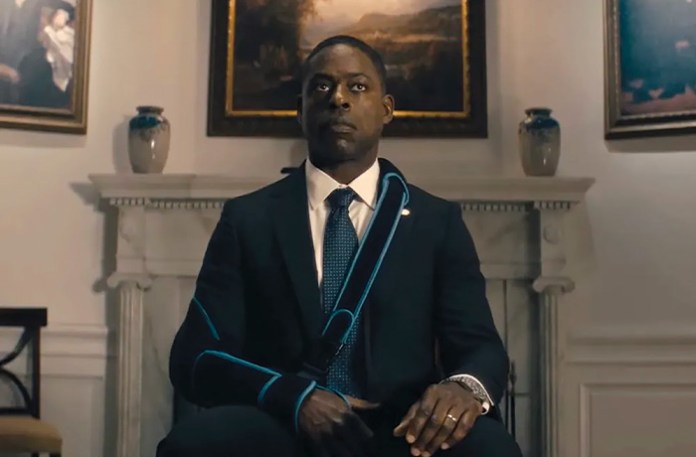
As its pilot episode eventually reveals, Paradise is set not in the world we know but in a postapocalyptic future. Driven underground by an Antarctic supervolcano and tsunami, 25,000 Americans have fashioned a new kind of city, one powered by nuclear reactors and lit with a massive artificial sun. U.S. President Cal Bradford (James Marsden) has survived but spends his days as a backslapping mascot, real authority having settled elsewhere. Nevertheless, Cal has enemies. When, in episode one, Secret Service agent Xavier Collins (Sterling K. Brown) finds the president’s dead body, he must solve a crime that threatens to shake the city to its subterranean core.
The suspects are many. Chief among the billionaires who designed and run the hideaway is Samantha “Sinatra” Redmond (Julianne Nicholson), a grieving mother whose loss of a child fuels her maniacal desire for purpose and control. Among Paradise’s enduring mysteries is the nature of “Alex,” Sinatra’s project deep beneath the city’s lanes. Might time travel be involved? And what, in any case, could a bumbling politician have done to thwart the closet dictator’s secret plans?
Other doubtful characters existed in Cal’s orbit, as well. Played by journeyman actor Jon Beavers, special agent Billy Pace is a walking alarm bell, a former mercenary entrusted with access to the city’s elite. Pace’s girlfriend and colleague Jane Driscoll (Nicole Brydon Bloom) has the studied affect of a psychopath. Let her into even a fake Oval Office at your peril. Perhaps the likeliest killer is Nicole Robinson (Krys Marshall), a presidential bodyguard conducting an affair with her charge. Or maybe Xavier himself is the guilty man. Some narrative trickery would be required, but isn’t Paradise exactly the series to pull off such a move?
Despite the show’s high-concept backstory and setting, its first season often unfolds like a classic whodunnit. Hidden motives come to light, and troubled consciences signal our failure to keep the old world’s conflicts out of the new. Yet, Paradise is also a moving chronicler of social dissolution, a realist’s answer to easy “contingency plan” clichés. Take, for instance, a flashback sequence in which doomed White House staffers turn on one another with guns. If the world is ending in half an hour, no mere designated-survivors list is going to keep me off that plane.
Paradise is at its best during such backward glances. The episode just mentioned, season one’s “The Day,” is a harrowing examination of intertwining anarchy and war, as nations nuke their enemies following civilization’s collapse. Season two’s premiere, “Graceland,” is one of the strongest hours of television in years, a bottle episode in which a previously unintroduced figure waits out the catastrophe in Elvis’s Memphis home. That character, Annie Clay (a superb Shailene Woodley), is one of several additions to the series’s sophomore run. Ironically, Paradise is overpeopled. Among the show’s many accomplishments, however, is its assimilation of new ideas. Science fiction, politics, the paranormal, unrequited love: All have a place in an ever-expanding narrative frame.
Before watching Hulu’s turn at the plow, I would have said that the postapocalyptic genre was worn out, brought low by 50 seasons of The Walking Dead and the disastrous 2025 return of HBO’s The Last of Us. (Admit it: You were cheering for the zombies.) It is faint praise to say that Paradise is better than either of those shows. Yet, the series is also superior to worthier efforts: Apple TV’s Silo, say, or HBO’s Station Eleven. To be sure, top-notch casting helps. Paradise’s leads have been brilliantly assembled. What ultimately sets Fogelman’s production apart, however, is the complexity of its moral vision. Sinatra and her ilk may be tyrants, but they are nevertheless fully formed human beings from the start. Even their cruelest judgments may be correct.
‘SCARPETTA’S’ CRIMINAL CLICHES
Something similar plays out in the character of Xavier, the series’s protagonist and Sterling K. Brown’s best role since his turn as Christopher Darden in The People v. O.J. Simpson. As he did in that show, Brown buries fury beneath layers of politesse, releasing the former only when pushed beyond the limits of restraint. Over the course of Paradise’s two seasons, Xavier is first charming, then ruthless, then brutal, an evolution that unfolds in the service of righteous causes. The show’s newest episodes, for example, see Xavier roaming the country to find his missing wife. How many men must give their lives to bring about a reunion is a secondary concern.
To put it another way, Paradise is a show about the bonds that hold us together at the point of suffering and death. Nearly every character believes those ties must be secured at any cost. They’re right, of course: Love will surely prevail in the end. The question is whose.
Graham Hillard is the TV critic for the Washington Examiner magazine and editor at the James G. Martin Center for Academic Renewal.