
For those of us who prefer our movie stars to recite lines of dialogue rather than left-wing talking points, the 1972 Academy Awards represented something of a high point. That year, Ben Johnson won Best Supporting Actor for his incomparable performance as Sam the Lion, the weathered old cowboy in The Last Picture Show.
At the end of his speech, Johnson said, “Now what I’m about to say probably will stir up a lot of conversation around the country. There’s something I’d like to leave in everyone’s minds throughout the world.” Although Johnson was best known as a member of John Ford’s stock company — and thus an undoubted political conservative — at that moment, he held the audience in the palm of his hand. What was he going to talk about? Vietnam? Nixon? Finally, he spoke: “This couldn’t have happened to a nicer feller.” That was what was going to “stir up” everybody — it was a joke.
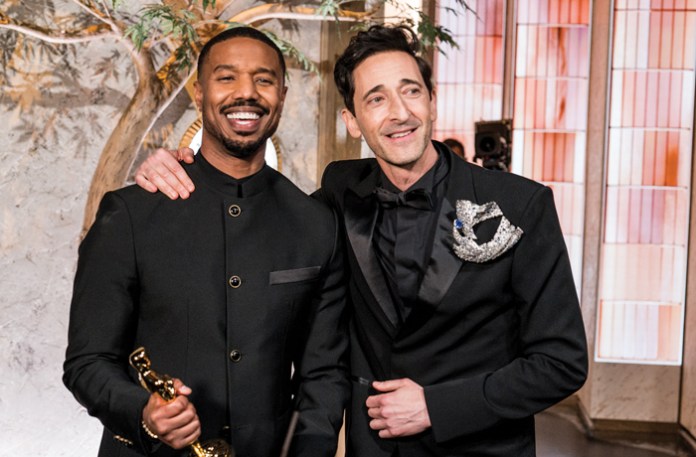
Although this year’s edition of the Oscars, which aired on ABC on March 15, was hardly in the class of the 1972 installment, there was at least one moment that recalled Johnson’s witty, graceful sendup of stars commandeering the ceremony to climb atop their soapbox. In presenting the Best Actor winners, Adrien Brody perfectly, if perhaps unconsciously, echoed Johnson’s remarks from more than 50 years earlier.
“I do have something very important to say,” said Brody, who, last year, said plenty of what he regarded as “important” stuff when he won Best Actor for The Brutalist. This time, though, the “important” thing he had to say was simply this: “And the nominees for lead actor are . . .” The joke was the high point of the night.
In case you weren’t watching, Michael B. Jordan won for Ryan Coogler’s Sinners. And, indeed, there is reason to suppose that many, many people were not watching the Oscars this year. Notwithstanding Brody’s invigorating if fleetingly observed sense of humor, the evening was littered with presenters and honorees alike making veiled, passive-aggressive references to the Trump administration and its real or imagined evils. Of course, some speakers simply blurted out what was on their mind. In the latter category was presenter Jimmy Kimmel, who, in an act of exaggeration that would be Swiftian if intentional, equated the free speech policies of North Korea with those of, um, CBS.
Traditionally, Oscars hosts have been at their best when puncturing the pretensions of the stars in attendance, but for the most part, host Conan O’Brien bought into their sense of their own righteousness. At one point, O’Brien, with a straight face, said that movies are meant to advance the ideals of “global artistry” (whatever that means), patience, resilience, and optimism — words that no one, ever, would use to describe Best Picture nominees F1, Frankenstein, or Marty Supreme. Movies are not about advancing the United Nations charter. The good ones merely mean to entertain.
Watching the Oscars on an annual basis, one starts to wonder how many times in an evening — how many times in a lifetime — one can listen to multimillionaire movie stars make appeals to world peace and the social justice issue du jour. That is why, for all the political naivete on display, the prevailing mood of the evening was one less of conviction, however misdirected, than exhaustion.
On the whole, O’Brien had no innovations to offer. He even replicated former host Billy Crystal’s signature joke of depositing his likeness in footage from nominated films, but this gambit worked better when the movies being parodied were famous. It was funny when Crystal showed up “in” Titanic, but when audiences saw O’Brien “interacting” with the cast of Hamnet, some might wonder, “What, again, is Hamnet?” This year, the obligatory extended clips from the Best Picture nominees that were threaded throughout the evening had a certain utilitarian logic: While some movies, like Sinners or Marty Supreme, were very popular, how many people had heard of Sentimental Value or Train Dreams before that night?
O’Brien tried mightily to be topical. He rightly chided Netflix CEO Ted Sarandos for being unfamiliar with the inside of a theater, but his routine about what the Oscars will look like when they start streaming on YouTube (as they will be beginning in 2029) was less than persuasive. We saw imaginary clips of the Oscars being interrupted by boring, aggressive ads on YouTube, which would have been funnier if the bit had not itself been preceded by boring, aggressive ads on ABC. (We get it, we get it: Burger King says they have improved their Whopper sandwich.)
Later, O’Brien touted a fake company tasked with reformatting movies for smaller and smaller handheld devices, but the joke missed the mark. The reason why viewing movies on such screens is wrong is not because the movies are lopped off but because they are too tiny in that format to register at all.
The one substantive innovation turned out to be a complete bust: the incorporation of an all-new prize for Best Casting into the ceremony. While most of the other categories honor actual work accomplished — an actor who has given a performance, an editor who has cut scenes together, a writer who has penned a script — this new award seeks to honor those who make suggestions. No one would deny that casting is an important part of a movie, but who really believes that casting directors choose casts independent of directors and executives? Surely there exists a knack for identifying talent, but where does this end? Should we hand out Oscars to agents who successfully lobby on behalf of their clients? How about studio bosses who greenlight a winning film — surely they had something to do with the film, too? The winner of Best Casting was One Battle After Another’s Cassandra Kulukundis, who said to her director, Paul Thomas Anderson, in the audience, “I have one before you, which is also crazy.” Truer words were never spoken, although Anderson would have plenty of statuettes before the evening was finished.
It all felt so dully familiar. The annual Oscars sport of gently making fun of certain arcane categories, such as Best Documentary Short, continued unabated, and the time-honored tradition of cutting off speeches was in full force. The latter was particularly regrettable, though, since so many presenters were seemingly encouraged to do their shtick at interminable length, including Best Costume and Best Makeup and Hairstyling co-presenters Anna Wintour and Anne Hathaway, and, most cringingly, the cast of the movie Bridesmaids, which was recognized for its 15th anniversary despite winning exactly zero Oscars way back when.
As noted, One Battle After Another was showered with statuettes, including Best Picture, Director, and Adapted Screenplay. It is hard to begrudge Oscars voters for wanting to recognize such a fulsomely realized, knottily plotted, expressively styled film, though it is notable that it was not the only such film so nominated: Marty Supreme, starring Timothee Chalamet, is equally big and bold, but it had the disadvantage of being essentially apolitical while One Battle is, explicitly, a paean to the continued relevance and everlasting nobleness of characters who are essentially radical left-wing maniacs. To his credit, Anderson, long overlooked for Oscars, used his Best Picture acceptance speech to honor the great films of the past, including the almost incomprehensibly astonishing quintet of Best Picture nominees for the year 1975: Nashville, Jaws, Barry Lyndon, Dog Day Afternoon, and One Flew Over the Cuckoo’s Nest. This, more than the rather treacly spectacle of Barbra Streisand serenading the late Robert Redford, was the film history high point of the night.
Better than Anderson’s speech, though, was that of one of his actors, Sean Penn, who won Best Supporting Actor but gave no speech since he was nowhere in sight. In the immortal words of presenter Kieran Culkin: “Sean Penn couldn’t be here this evening, or didn’t want to, so I’ll be accepting the award on his behalf.”
See, even Sean Penn didn’t want to be at the Oscars this year.
Peter Tonguette is the film critic for the Washington Examiner magazine.