
An Israeli airstrike on the world’s largest natural gas field in South Pars, Iran, has raised fears of escalatory attacks on energy infrastructure across the Middle East.
The Wednesday strike on South Pars marked the first U.S.-Israeli attack on Iranian energy production infrastructure of the war, and triggered a series of retaliatory strikes on Gulf oil and gas infrastructure. Despite reports that the strike was conducted in coordination with Washington, President Donald Trump said Jerusalem had acted unilaterally, and urged Iran not to retaliate further against Gulf energy infrastructure. He then threatened to destroy the field if Iran continued with its retaliation.
“NO MORE ATTACKS WILL BE MADE BY ISRAEL pertaining to this extremely important and valuable South Pars Field unless Iran unwisely decides to attack a very innocent, in this case, Qatar – In which instance the United States of America, with or without the help or consent of Israel, will massively blow up the entirety of the South Pars Gas Field at an amount of strength and power that Iran has never seen or witnessed before,” Trump wrote in a post on Truth Social.
Here’s everything to know about the important natural gas field in southern Iran:
Why is South Pars important?
Iran has the second-largest natural gas reserves in the world, at roughly 34 trillion cubic meters, according to EBSCO, with most of it in the South Pars natural gas field. The field is jointly owned by Qatar, but is of greater significance to Iran given its international isolation and reliance on its energy industry.
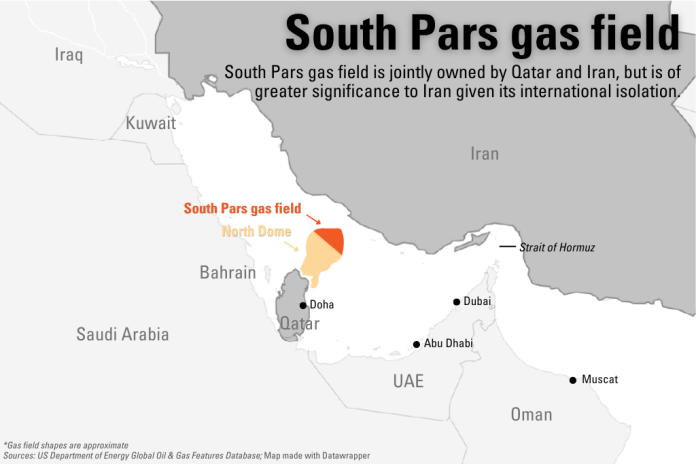
Iran is heavily reliant on its natural gas for domestic consumption, with 86% of its electricity generation coming from this source as of 2023. Roughly 80% of this natural gas comes from South Pars, meaning that every public service and economic activity directly stems from the field.
In other words, Iran’s energy grid is almost completely reliant on South Pars, and any harm to it would drive the entire country to a halt.
Why did Israel attack it, and why is Trump threatening it?
Operations Epic Fury and Roaring Lion’s primary objectives have been destroying Iran’s military and military infrastructure, killing its military and political leadership, and destroying its nuclear program. The U.S. and Israel had almost entirely refrained from attacking Iran’s energy infrastructure. A previous strike on oil storage facilities outside Tehran on March 8 by the Israeli air force angered Washington, which forbade any further attacks on Iran’s energy infrastructure unless direct approval was given.
The Wednesday strike on South Pars was limited in scope, only hitting a small portion. The air supremacy enjoyed by the U.S. and Israel suggests that the limited scope was intentional, with the strike likely being a warning. The strike was most likely intended to pressure Tehran to back off from its blockade of the Strait of Hormuz, its greatest leverage.
The strike had the immediate opposite effect, with Iran expanding its strikes on critical energy infrastructure in Saudi Arabia, the United Arab Emirates, and Qatar. One of the most critical strikes was against a liquefied natural gas facility at Ras Laffan Industrial City in Qatar, which QatarEnergy said caused “extensive damage.”
Roughly one-fifth of all global LNG comes from Qatar, meaning attacks on its infrastructure would have near-immediate global ramifications. Wood Mackenzie, a leading energy analysis firm, said the Iranian attacks “fundamentally alters the global gas market outlook,” greatly extending the expected disruptions.
“Market expectations had been for a short disruption, with a controlled restart restoring supply to pre-conflict levels by mid-2026. That outlook now appears increasingly unlikely,” Kristy Kramer, head of LNG strategy and market development at Wood Mackenzie, said. “A more prolonged outage would further tighten the global supply and keep prices elevated for longer.”
Asia and Europe have an outsize reliance on Qatari LNG, with the latter particularly reliant due to its efforts to switch away from Russian energy.
The resulting increase and fears of a future rise in energy prices helped trigger Trump’s stern response. The destruction of the South Pars field would be catastrophic for Iran, with Washington banking that the mere prospect would draw down further attacks on Gulf energy infrastructure.
What would happen if the gas field were destroyed?
If Trump were to follow through on his threat to destroy Iran’s South Pars field completely, the result would be nothing short of catastrophic for Iran.
Given 86% of Iran’s energy grid relies on natural gas, the sudden destruction of this energy source would present an unparalleled situation in modern times — the sudden deprivation of power from a country of over 90 million people. Particularly given the difficulties of communication in Iran, given U.S.-Israeli cyberattacks, constant airstrikes, and precautions to avoid assassinations, it would be logistically impossible to switch the power system to another source of energy quickly while in wartime conditions.
The country would quickly experience nationwide blackouts. Hospitals would cease operating, transportation would grind to a halt, communications would be cut off, and water treatment and desalination plants would stop operations. Some regions would be cut off from easy access to food and water, potentially triggering one of the worst humanitarian crises in recent memory.
ISRAEL HITS WORLD’S LARGEST NATURAL GAS FIELD IN IRAN, ESCALATING ENERGY INFRASTRUCTURE STRIKES
Worse yet, Iran would have no easy or quick way to repair the infrastructure destroyed at the field. The complexity of operations means the destruction of the entire field could take years to repair after the war. The economy would grind to a halt and would take even longer to repair.
This potential catastrophe makes Trump’s threatened strike more unlikely, especially as it would drive Iranian public sentiment heavily against the U.S. and Israel. The alliance is partially reliant on public dissatisfaction with the regime, with Israel shifting operations in recent days to targeting Tehran’s security apparatus in an effort to encourage an uprising.