
Nine suspected members of a Texas antifa cell were found guilty on Friday in the nation’s first-ever federal case to bring terrorism charges against alleged antifa operatives.
Though the convictions varied depending on the defendant, none will be walking free.
The jury trial, which lasted three weeks, was widely seen as a test of the Justice Department’s first courtroom attempt to treat criminal actors who organize behind an antifa ideology as a terrorist group after President Donald Trump designated antifa as a domestic terrorist threat.
Charges and verdict
The cell’s alleged ringleader, Benjamin Hanil Song, alongside jointly charged co-conspirators Zachary Jared Evetts, Savanna Sue Batten, Maricela Rueda, Elizabeth Andrea Soto, Ines Houston Soto, Daniel Rolando Sanchez-Estrada, Cameron James Arnold, and Bradford Winston Morris, were convicted on a slew of wide-ranging crimes connected to a July 2025 attack on an Immigration and Customs Enforcement facility in Alvarado, Texas.
The verdict was mixed, but the defendants were convicted on a majority of the 65 total counts.
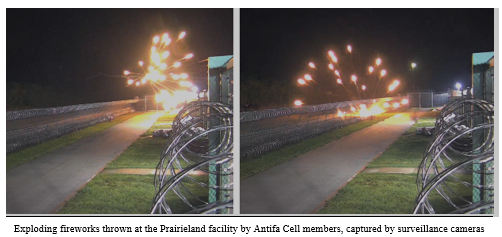
Arnold, Evetts, Song, Batten, Morris, Rueda, Elizabeth Soto, and Ines Soto were convicted of rioting, “with the intent to commit an act of violence, involving conduct such as shooting and throwing fireworks and explosives, slashing tires on a government vehicle, spraying graffiti on property and vehicles, destroying a closed circuit camera, shooting at officers, and dressing in black bloc.”
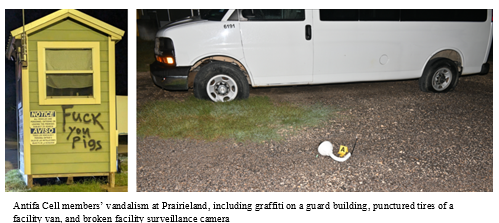
All of the same defendants except Batten were convicted of conspiracy to use and carry an explosive, the use and carry of an explosive, and providing material support to terrorists, including property, services, training, communications equipment, weapons, explosives, manpower, and transportation.
Song, Arnold, Evetts, Morris, and Rueda were additionally charged with attempting to murder federal officers and discharging a firearm in furtherance of a violent crime
According to the charging documents, two security guards were lured outside by the sound of explosives into the line of fire, and an Alvarado Police Department officer who was at the scene answering a disturbance call was shot in the neck but survived.
Song, however, was the only one convicted on the attempted murder and firearm charges, while the rest were acquitted.
TEXAS ANTIFA TERRORISM CASE: CONFESSIONS MOUNT AS TRUMP DOJ CLINCHES MORE CONVICTIONS
Rueda and her husband, Sanchez-Estrada, were convicted of conspiracy to conceal documents and other items that would have implicated Rueda in the ICE shooting.
Sanchez-Estrada was separately convicted of corruptly concealing incriminating records by removing a box allegedly containing “numerous Antifa materials, such as insurrection planning, anti-law enforcement, anti-government, and anti-immigration enforcement documents and propaganda” from his residence with the intent to impede its use in criminal proceedings.
For the attempted murder conviction, Song faces a maximum penalty of life imprisonment. Batten, Elizabeth Soto, and Ines Soto each face anywhere from a minimum of 10 years to 50 years maximum in federal prison. Sanchez-Estrada faces up to 20 years behind bars on each count of concealed documents.
The sole count of providing material support to terrorists carries a maximum 15-year prison sentence.
A precedent-setting case
While the nine suspects were tried together, the jury had to decide each defendant’s guilt or innocence individually.
The defense denied throughout the trial that the suspects are members of an organized crime cell, let alone an antifa one, as their convicted co-conspirators previously admitted in exchange for reduced prison sentences.
CONFESSIONS FROM TEXAS ANTIFA CELL OPERATIVES COULD PULL BACK CURTAIN
At times, the defense emphasized that mere association is not inherently criminal and accused the prosecution of criminalizing dissent.
“In America, we don’t prosecute people for being in association with other people,” one of the defense attorneys told jurors during opening arguments, saying that his client “was there for the sole purpose of expressing her political beliefs, and in America, we don’t punish people for that.”
The highly anticipated case outcome could set a legal precedent, shaping the Trump administration’s playbook for targeting left-wing violence.
Over the course of the trial, prosecutors argued that the suspects launched a large-scale assassination attempt on the immigration officers who were guarding the Prairieland Detention Center.
Meanwhile, the defense maintained that the late-night event was only meant to be a so-called “noise demonstration,” not an armed uprising.
‘PEACEFUL PROTEST’ NARRATIVE AT CENTER OF ANTIFA TERRORISM TRIAL
“They wanted the detainees to riot,” prosecutors countered during closing arguments. “They were talking liberation.”
One of the admitted antifa associates, who testified as part of a plea deal, told jurors that Song suggested storming the facility and breaking the detainees out while the shooting served as cover fire, although the group overwhelmingly disagreed and abandoned that plan.
The defendants insisted at trial that they were there igniting fireworks that night simply as a show of solidarity for the illegal immigrants detained inside, rather than setting a trap to draw out law enforcement.
The defense notably chose not to present evidence or call on any witnesses. A member of the legal team said the defendants trusted the jury and did not want the case to drag on.
Defense attorney Ben Florey, whose client pleaded out, said the decision to abruptly rest without putting forth witnesses was strategic.
“To put their witnesses, their clients on the witness stand would open them up for cross-examination by the government,” Florey told NPR North Texas. “They decided that’s not a good idea.”
However, the defense’s closing arguments called into question the reliability of the prosecution’s cooperating witness, Nathan Josiah Baumann, who was found close to the scene of the shooting and ultimately pleaded guilty last year.
Baumann testified that Evetts joined him in vandalizing the vehicles parked in the facility’s adjacent lot and breaking a surveillance camera. As arguments wrapped up, the defense contended that Baumann’s testimony could not be trusted because he admitted to falsely blaming someone else when they were apprehended.
“The government sponsored this liar as their witness,” said Brian Bouffard, one of Evetts’s attorneys.
Another defense attorney added, “The government is asking you to put protesters in prison as terrorists,” telling jurors, “This has never happened before. And you are the only people on this Earth that can stop it.”
Antifa mobilizes in support of comrades on trial
Ahead of jury deliberations, supporters of the defendants staged a protest on Wednesday afternoon outside the courthouse, with the apparent purpose of swaying the jury’s decision.
The DFW Support Committee, an antifa-allied bail fund formed to finance the group’s legal defense, promoted the protest as “our final say so before the jury deliberates.”
After the verdict was read, the DFW Support Committee issued a statement saying, “We are heartbroken at the results. This is only the beginning. We will continue to fight the remaining charges until every defendant is home.”
Friday’s verdict followed a mistrial declared earlier in the case during an initial round of jury selection over a defense attorney’s “politically charged” outfit choice and questioning style of the jury pool.
Judge Mark Pittman, a Trump appointee, dismissed the prospective jurors at the time, finding that they could have been influenced or intimidated by the lawyer’s line of questioning centered on the constitutional right to protest as well as her accompanying attire, which displayed political messaging about civil rights.
Pittman, who had already admonished another defense lawyer for bringing an authorized poster board that juxtaposed scenes of seemingly peaceful protest with a fiery riot, suggested that the defense was trying to equate its side of the case with the civil rights movement.
CONVICTED CO-CONSPIRATORS SPILL INSIDER INTEL ON ANTIFA AT TEXAS TERRORISM TRIAL
During jury deliberations, the panel requested transcripts of the testimony from the cooperating witnesses against the defendants and asked for a definition of the term “organize” as it applies in the federal riot charging statute.
Pittman, however, said he could not tell them anything more than what was in the jury instructions.