
When the Supreme Court struck down the core pillar of President Donald Trump’s tariff program, it immediately reshaped the political landscape in Michigan, a battleground state whose economy is tightly intertwined with neighboring Canada.
In February, the justices ruled 6-3 that the president lacked broad authority to impose tariffs without congressional approval, concluding that such powers rest with Congress. The decision came as the 2026 midterm elections are heating up during Trump’s second nonconsecutive term.
Michigan has grown more electorally competitive over the past decade as Republicans and Democrats compete for working-class voters. Once considered a reliably blue state, Michigan voted for Trump in two of the last three presidential elections. Of the state’s 13 House members, seven are Republicans, and six are Democrats.
Sen. Gary Peters (D-MI) surprised state and national party leaders by announcing early last year that he would retire after the 2026 elections. Gov. Gretchen Whitmer (D-MI) is term-limited. The rare convergence of open Senate and House seats adds to the 2026 political drama already underway in Michigan. And since Republicans hold a six-seat lead in the state House, and Democrats a one-seat edge in the state Senate, the Wolverine State is a major target for both parties this fall.
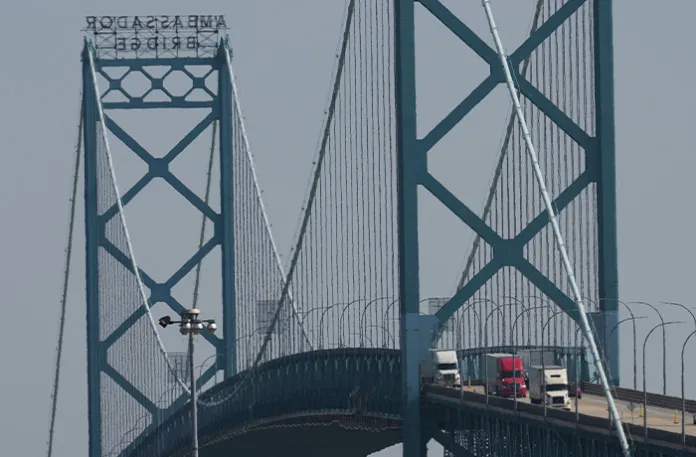
Straddling the United States-Canada border, the economies of Michigan and Ontario enjoy a symbiotic relationship. Canada, Michigan’s largest export market, received $21.2 billion in goods last year, according to the U.S. International Trade Administration. The relationship is perhaps most visible at the Ambassador Bridge, between Detroit and Windsor, which accounts for approximately 25% of all merchandise trade between the two countries.
Those ties were strained when Trump returned to the White House last year. Tariffs rose to 5.8% over the past year, according to a Bank of Canada report issued in January. The increase came before Trump threatened to impose tariffs as high as 100% on Canadian goods over concerns about the country’s growing trade relationship with China.
Meanwhile, Statistics Canada reported that about 10 million fewer Canadians traveled to the United States last year. Visits to Michigan alone fell roughly 30% from 2024 to 2025.
Tariffs hit Michigan’s auto industry — which is led by the Detroit Three of General Motors, Ford, and Stellantis — hard last year. GM said tariffs cost it $4.5 billion, while Ford projected roughly $1 billion in tariff-related losses. Stellantis, the parent company of Jeep and Chrysler, estimated it saw a net tariff impact of $1.7 billion. Company officials warn the total could rise to $1.86 billion this year.
Michigan automakers rely heavily on Detroit-to-Windsor supply chains, with parts crossing the border multiple times during production.
“Even with the tariffs authorized via emergency powers struck down, people in Michigan have to live with other enacted tariffs and new replacement tariffs,” said James Hohman, director of fiscal policy at Mackinac Center for Public Policy, a Michigan-based free-market think tank. “More people saw increased prices and threats to production than felt protected by the tariffs.”
Hohman, in an interview, said tariffs affect both affordability and the direction of the economy, making them one of the most important issues for the state.
“Tariffs remain an issue,” Hohman declared. “Economic conditions matter a lot, and everyone gets to experience how things are going and have a feeling about it.”
The tariff debate may have its greatest political impact in the race to replace the retiring Peters, who was first elected to the Senate in 2014 after six years as a House member.
When Rep. Haley Stevens (D-MI) announced her Senate campaign, she directly mentioned tariffs and their impact on Michigan. That was a smart strategy because Stevens worked on the automaker rescue program during President Barack Obama’s administration, said David Dulio, a political science professor at Oakland University.
“Any concerns over tariffs hitting the auto industry [and] the relief that might come to the auto industry, Haley Stevens is likely to do that,” Dulio said.
Other Democratic Senate candidates have mentioned tariffs to a lesser extent.
Abdul El-Sayed, a progressive populist, mentioned tariff-related cost increases as part of an affordability push. State Sen. Mallory McMorrow has mentioned government cuts and tariffs, though her focus is more on fighting the Trump administration, culture wars, and calling for new leadership in Washington.
Whoever wins the Democratic Senate primary will face Republican Mike Rogers, a longtime Trump ally running unopposed in the GOP primary. Rogers, a House member from 2001 to 2015 who narrowly lost to Sen. Elissa Slotkin (D-MI) in 2024, has also made affordability an issue by taking positions similar to the president’s.
Dulio predicted that Rogers, chairman of the House Intelligence Committee for the final four years of his congressional tenure, will also focus on national security in the 2026 Senate race, particularly since he was an FBI agent before running for office in Michigan.
“That’s a big issue that could take away from tariffs and their domestic impact,” Dulio said.
But Dulio predicted tariffs may not be a major factor in Michigan’s gubernatorial race.
The leading candidates in those races, Rep. John James (R-MI) for the Republicans, and Secretary of State Jocelyn Benson for Democrats, have not mentioned tariffs in their platforms so far.
James has given attention to parents’ rights and transparency following the COVID-19 pandemic. He has also called for ethics reform. For Benson, the focus is on housing, affordability, healthcare, and energy costs.
The wild card in the governor’s race is Mike Duggan, a former Detroit mayor running as an independent. Duggan has made education reform and nonpartisan politics the key planks of his campaign.
“Duggan is making his campaign all about very sort of kitchen table issues, basic competence of government and … the buzzword of affordability, is going to be front and center in that race,” Dulio observed.
That could give Republicans more of an advantage in November, as they look to take the governor’s mansion after being out of power for eight years.
FOR THE LOVE OF THE GAME, FOR THE LOVE OF COUNTRY
Not everyone believes the GOP can escape the election without some sort of tariff backlash.
“Voters tend to punish the party in power over economic trends, and tariffs have hurt many and helped few,” warned Hohman, of the Mackinac Center.
Taylor Millard is a freelance journalist who lives in Virginia. Follow him on X @TaylorMillard.