
Maggie Gyllenhaal’s invigoratingly loopy new horror comedy The Bride! overcomes preachiness with sheer stylishness. Although she works overtime to wring #MeToo-ready self-righteousness from the classic she is remaking (James Whale’s 1935 monster movie Bride of Frankenstein), Gyllenhaal turns out to be far less adept at feminist propaganda than she is at overseeing eye-catching photography and bracingly original sets, music, and costumes. That the movie succeeds in spite of itself is an encouragement in two ways: that aggressively off-kilter projects still have a route to the big screen, and that genuinely talented filmmakers, like Gyllenhaal, can get out of their own way.
While most remakes either blatantly rehash their source material or blandly contemporize it, Gyllenhaal announces from the first frame that she has something different on tap: The film opens in black-and-white with Jessie Buckley as a spectral incarnation of Mary Shelley, the English author of the novel Frankenstein; or, The Modern Prometheus. True to the film’s feminist orientation, this Shelley seems to have a chip on her shoulder: despite having written one of the widely agreed-upon masterpieces of the horror genre, she seems to feel that she never quite told the story she wanted to. It is in the actualization of that story — which, in reality, is entirely of Gyllenhaal’s own concoction — that the movie comes alive. In the movie’s fuzzy metaphysics, Shelley wills herself into the consciousness of a character named Ida (also played by Buckley), a young woman angling for survival in 1930s Chicago — a colorful, dangerous world of bawdy lotharios and lethal gangsters. The gambit that Shelley somehow comes to possess her fictional creation is sustained, as Ida alternates between a very American dialect and a more high-toned British accent. This, not her work in Hamnet (2025), is the part Buckley ought to be Oscar-nominated for.
No less imaginative is the importation of the story from Europe to midcentury America. This allows the film to include among its sights rollicking nightclubs, decadent parties, and grand movie palaces, though Gyllenhaal intentionally incorporates elements that are not appropriate to the ’30s setting: one scene shows moviegoers transfixed by 3D, a technology that did not attain ubiquity until a decade or so later. Yet the film’s freewheeling maximalism is one of its greatest pleasures: Gyllenhaal pours into her blender not only time periods, but tones, acting styles, and genres.
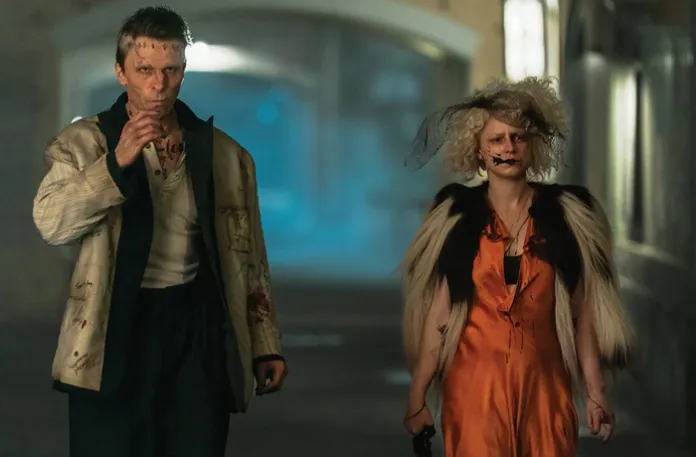
The Bride! begins fast and furiously when Ida runs afoul of a Chicago Mafioso called Lupino (Zlatko Buric) — the film’s depiction of the mob has something of the farcical, frenetic quality of Some Like It Hot (1959). Ida meets her end after being pushed down a flight of stairs. In a movie where the violence is quick but intense, her head is slammed, and her limbs become mangled, but since this is a derivation of the Frankenstein series, we know that she only appears to be among the dead. Enter Christian Bale, who plays Frank — the once-deceased creature reconstituted by an unseen Dr. Frankenstein — in the long and honorable tradition of hulking but strangely sweet depictions of the monster. Bale is at times as menacing as Boris Karloff in the original monster movies, and he is often as funny as Peter Boyle in Mel Brooks’s Young Frankenstein (1974), but to these performances, he adds a particularly plangent naivete. It’s one of Bale’s most sensitive performances, strange though as it sounds to say.
To evade detection, or out of simple self-consciousness about his appearance, Frank loses himself in the dark of the movies. He is a devotee of a supercilious star of frothy black-and-white comedy-musicals, Ronnie Reed (Jake Gyllenhaal, the filmmaker’s brother). His knowledge of classic cinema is encyclopedic, and only the stone-hearted could not laugh at Bale’s accent, which renders “Ginger” (as in Ginger Rogers) as “Gingah.”
Despite the solace he takes in the silver screen, though, this Frank is afflicted with the same condition as all previous film Frankensteins: the dull, persistent pain of loneliness. He prevails upon Dr. Euphronious (Annette Bening) to excavate a deceased female, revivify her with the aid of electricity, and anoint her his wife, or wife-to-be, or something similar. This is within the powers of Dr. Euphronious, who represents one of the film’s most striking continuities with Bride of Frankenstein in her mad-scientist-like eccentricity.
Ida thus becomes Frank’s bride, helpmeet, helpmate, lady, and/or wife — to name the litany of titles with which she identifies herself. Undoubtedly, Maggie Gyllenhaal means Frank’s resuscitation of Ida to represent a further exploitation of a heroine who, undeniably, received rough treatment during her actual pre-undead state. Certainly, Gyllenhaal intends for Ida’s identification of herself as a “bride” or “helpmeet” to be ironic. Yet the film is susceptible to the appeal of its leads: simply put, we want Frank and the Bride to be a couple, especially after they are compelled to evade law enforcement midway through. Plus, the movie is simply too goofy and good-natured for any of its feminist agitation to land. One passage depicts the Bonnie-and-Clyde-like notoriety of Frank and the Bride, leading ordinary women to adopt her wild hairdo and goth makeup (including what are evidently meant to be burns on her mouth and tongue from all that electricity). But it’s not at all clear that the women imitating the Bride are doing so because they are future Betty Friedan acolytes or merely because the Bride looks cool. I think it’s the latter.
FILM — NIGHTMARISH CRINGE: A REVIEW OF ‘DREAMS’
Gyllenhaal would have been wise to drop any sociopolitical notions she had about the story and instead embrace it as an opportunity for extravagant weirdness, for which she has a gift. In one extraordinary sequence, Frank comes into contact with his hero, the movie star Ronnie Reed, and after a less-than-satisfactory interaction, he expresses his feelings by dancing like a man possessed to “Puttin’ on the Ritz.” Yes, it’s a direct lift from Young Frankenstein, but as staged by Gyllenhaal, it becomes a mass dance number in which the Bride and dozens of others join Frank as though they are incapable of not moving to the music. It’s a bit like the “Day-O” scene in Beetlejuice (1988). And, playing a detective and his secretary attempting to ascertain the Bride’s whereabouts, Peter Sarsgaard and Penelope Cruz have just the right note of offhand oddness that suggests neither is taking the movie too seriously.
Audiences alert to signs of creeping wokeness will find plenty of irritants throughout The Bride!, but those willing to separate the wheat from the chaff will find, underneath Gyllenhaal’s failed messaging, a movie of considerable creativity. An indie actress to remember in films like Donnie Darko (2001), Adaptation (2002), and Crazy Heart (2009), Gyllenhaal made her directorial debut in 2021 with The Lost Daughter. That small-scale drama was a world away from the extravagances of The Bride!, but when I interviewed the actress-turned filmmaker for a magazine piece back then, I took note of her appreciative references to adventuresome directors like Nicolas Roeg and to profoundly odd and unnerving movies like Roman Polanski’s The Tenant (1976). Despite some of her solemn intentions, with The Bride!, she has delivered a film worthy of those bizarro predecessors.
Peter Tonguette is the film critic for the Washington Examiner magazine.