
China is distraught as it watches Iran collapse but is not willing to risk further weakening its position by backing the Islamic regime’s spray-and-pray counter-offensive.
China, long considered the Islamic Republic’s most valuable patron and protector, has done little but complain about “international law” since its pet project in the Middle East was bombarded by Operation Epic Fury.
“We support Iran in safeguarding its sovereignty, security, territorial integrity, and national dignity and in upholding its legitimate and lawful rights and interests,” Chinese Foreign Affairs Ministry spokeswoman Mao Ning said at a Friday press conference.
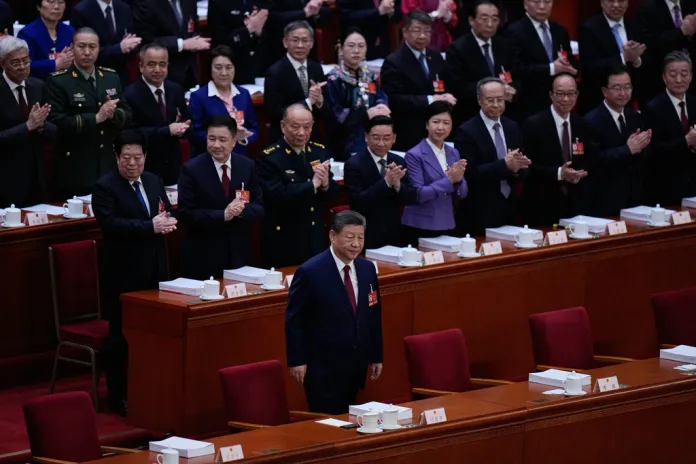
“China always advocates resolving issues through political and diplomatic means,” Ning said. “We call for an immediate stop to the military actions to prevent the conflict from spreading and spilling over and avoid further escalation of the situation.”
China has even expressed opposition to Iran’s scattershot response to the strikes, which have killed citizens of Israel, Kuwait, the United Arab Emirates, and other neighbors.
Foreign Minister Wang Yi affirmed to UAE Foreign Minister Sheikh Abdullah bin Zayed Al Nahyan this week that “the red line of protecting civilians must not be crossed and non-military targets, including energy, economic and civilian facilities, should not be attacked.”
The reasons for this cautious response are many, ranging from the precarious diplomatic implications of the conflict, disruptions to its energy security, and the embarrassing implications of allowing an ally to be destroyed.
“China has to maintain good relations with Saudi Arabia, with the UAE, with Turkey, all these other countries around there,” a former U.S. diplomat with decades of experience with China told the Washington Examiner. “They kind of overplayed, and misplayed, their hand diplomatically with Iran.”
The Chinese Communist Party has long cooperated with the Iranian regime, providing the Islamic Republic with crucial technologies for civic and military use in exchange for cheap energy.
The Foundation for Defense of Democracies asserts that “Beijing has long supported Iran with chemical precursors for propellants used in the regime’s ballistic missile arsenal, sophisticated surveillance equipment, and advanced sensor systems.”
Iran has provided China with abundant, cheap oil exports in return — materially refined and legally laundered through the CCP’s countless offshore “teapot refineries.”
“In 2025, China purchased an average of 1.38 million barrels per day of Iranian oil, accounting for 13.4% of China’s total oil imported by sea,” the International Centre for Defence and Security reports. “If the US is able to affect the destination of Iran’s oil exports (as it has with Venezuela’s), over a tenth of Chinese crude imports are at serious risk.”

“U.S. action in Iran is likely to create strategic headaches for China, as any disruption to Iranian oil exports would directly affect a country that remains one of Tehran’s largest energy customers,” a Taiwanese diplomatic source familiar with the situation told the Washington Examiner.
More broadly, half of China’s crude oil imports and almost a third of its liquified natural gas imports are transported through the Strait of Hormuz, which has been shut down by the conflict.
“Xi Jinping’s hundred things that he wakes up and is worried about — it’s keeping the economy on the tracks,” the former diplomat told the Washington Examiner. “Energy is just … I can’t overstate how important it is to every part of that economy. And so if you start removing access and cost to that energy, it’s a big deal because then that starts to spiral into domestic industries and unemployment and problems internally.”
Sphere of influence badly damaged
Iran’s collapse is a black mark against China’s sales pitch to the international community that its sphere of influence can provide safety and stability outside the West.
Chinese relations with the Islamic Republic accelerated in 2021 with the signing of their 25-year Cooperation Program, which escalated the level of economic and defense cooperation between the countries.
By 2025, Iran joined the BRICS alliance — an international organization founded by Brazil, Russia, India, China, and South Africa as a counterweight to NATO expansion.
Iran, floated by Russia and China, quickly became a flagship example of how U.S. hegemony could soon give way to a “multipolar world.”
When U.S. and Israeli missiles rained down on Tehran, killing dozens of its highest-ranking officials and signaling that the conflict would be drastically asymmetrical, Chinese-provided security infrastructure could not rise to the occasion, and the myth of declining U.S. leverage evaporated.
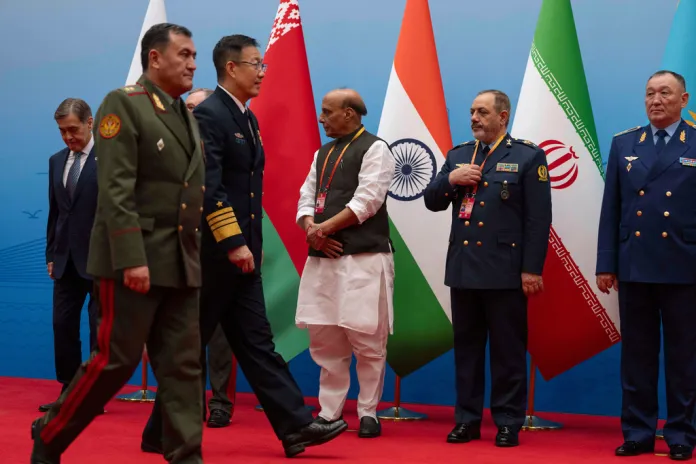
“Clearly the Chinese infrastructure did not work. And I think that that raises alarm bells in Beijing,” the former diplomat said. “BRICS, that whole construct and this ‘multi-polar world’ — the tagline that China has always tried to put out — it’s just showing how thin it is. This is an opportunity to eliminate BRICS.”
WHITE HOUSE DOWNPLAYS RUSSIAN ASSISTANCE FOR IRAN: ‘IT CLEARLY IS NOT MAKING A DIFFERENCE’
Calling bluff on Taiwan
Operation Epic Fury, combined with the successful capture of Venezuelan President Nicolas Maduro, also throws into question China’s belief that they can invade the neighboring islands of Taiwan — a goal they have been explicitly preparing to undertake for years.
At the National People’s Congress this week, Premier Li Qiang issued a government work report that suggested an escalation in saber-rattling against the island territory, which self-conceptualizes as sovereign but is claimed by Beijing.
Where last year the Chinese Communist Party had committed itself to “resolutely oppose separatist activities aimed at ‘Taiwan independence’ and external interference,” the report published this week affirmed that China will “resolutely combat separatist forces.”
The U.S. maintains a policy of “strategic ambiguity” regarding how it would respond to a hypothetical invasion, a bluff that China seemed increasingly willing to call. Trump’s increasing willingness to use overwhelming military force to pursue American interests abroad throws that calculus into question.
Trump-Xi visit looms
China finds itself in an uncomfortable position as it prepares for a bilateral summit between paramount leader Xi Jinping and President Donald Trump in April.
“Trump and Xi are going to meet next month and it’s almost like Trump has all of these cards — it’s leverage and so it’s going to be a very interesting meeting between the two of them where Trump is going to say, ‘OK, here’s the situation. We got to work this out,’” the former diplomat told the Washington Examiner.
Trump might just be ambitious enough to snatch another card for his hand before they meet, claiming on Friday that “Cuba is gonna fall pretty soon” and that the regime officials “want to make a deal so badly.”
China has worked assiduously to keep fellow communist nation Cuba afloat for decades amid crippling trade sanctions and embargoes led by the U.S. — but the latest round of penalties from Washington has left the island struggling to keep the lights on and unable to maintain basic civil services such as garbage collection.