
The joint Israel-U.S. war against Iran could complicate fledgling plans to end American financial aid to the Jewish state over the next decade. Since Feb. 28, the allies have coordinated military actions against the Shia Islamic theocracy, targeting its leadership, nuclear and ballistic missile program, and armed forces.
Given the Iran war, Israeli Prime Minister Benjamin Netanyahu may need to rethink his plans to wean Israel off American military aid. That plan is already generating both surprise and skepticism and will certainly be debated even more intensely in the corridors of power in Washington and Jerusalem amid the Iran campaign’s aftermath. Which, in its early days, saw Israeli strikes kill Iran’s supreme leader, Ayatollah Ali Khamenei.
The military aid debate has been long-simmering and has picked up intensity even before the Iran war. In a Jan. 9 interview with the Economist, Netanyahu said he wants Israel to “taper off” American military aid within 10 years.
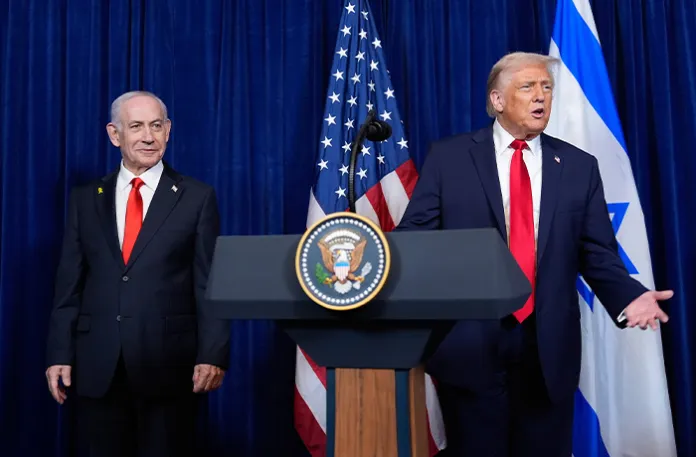
“We deeply appreciate the military aid America has given us over the years, but we’ve come of age, and we’ve developed incredible capabilities,” the prime minister said he told President Donald Trump.
While Israel has achieved remarkable success since its founding in 1948, the multifront war has strained its economy and necessitated a sharp increase in military spending. Given Israel’s security needs and even greater reliance on U.S. military assistance during the post-Oct. 7, 2023, war, many are questioning the announcement’s timing and feasibility.
Why now?
There are several likely explanations for Israel’s planned shift away from U.S. aid, a program that began in earnest after the country’s 1979 peace treaty with Egypt, and which over the past decade has taken on a mostly military-building focus.
There’s Israel’s waning popularity among some U.S. lawmakers, and the fact that the 10-year, $38 billion aid package for Israeli defense brokered by former President Barack Obama’s administration will expire in two years and will soon be renegotiated. Another factor could also be the November midterm elections.
Just a day before Israel and the U.S. struck Iran, a Gallup poll found that 41% of Americans sympathize more with the Palestinians, while 36% sympathize more with the Israelis. A year ago, 46% favored Israelis while 33% favored Palestinians.
Even many of Israel’s longtime American political allies, including some Republicans, see supporting Israel as an Election Day liability.
“I think we’ve seen that the Democratic Party is full of anti-Israel politicians, and it should be understood that Donald Trump is not going to be president forever,” said Max Abrahms, a professor of political science at Northeastern University, referring to the Trump administration’s strong support for Israel. “It is wise” for Israel to become more militarily self-sufficient, Abrahms said. Doing so “would blunt the criticism that the U.S. disproportionately supports Israeli security.”
Even among Republicans, especially in “America First” circles, foreign aid, even to Israel, is politically less popular than it used to be. Already in August 2025, a Quinnipiac University survey found that 75% of Democrats were against providing additional military aid for Israel at that time, while 56% of Republicans supported additional spending. This was the lowest level of support since the war started between Israel and several of its adversaries after the Oct. 7 Hamas-led attacks from Gaza, which killed about 1,200 people. Another 251 were taken hostage.
Still, the timing of Netanyahu’s statement caught Israeli foreign policy professionals such as former Ambassador to Germany Jeremy Issacharoff off guard. Issacharoff, former deputy director-general of Israel’s Foreign Ministry and a veteran of the Israeli Embassy in Washington, said he understands the shifting political landscape but questioned the timing of Netanyahu’s planned shift away from U.S. aid.
“We have just been through 2 1/2 years of a multifront war, and I would imagine that it has taken a great deal out of our military stocks,” said Issacharoff, now a private citizen. In his view, Netanyahu’s unilateral decision, which was made before the Iran war and before the security breaches of Oct. 7 have been investigated and seems premature and ill-advised.
“The American-Israel attack on Iran could lead to major changes in the region,” Issacharoff said. “Strategically, they could be beneficial, or they could create more security challenges. I would only make this decision once the security situation becomes much clearer.
Issacharoff speculated that Netanyahu’s statement was an attempt to take control of the narrative before Washington makes its own decisions about future aid.
“Maybe Netanyahu thinks Trump will cut aid anyway, and this way, it will look like the decision is not forced on Israel,” he said.
Can Israel wean itself off US aid?
While Netanyahu’s vow to become largely financially independent by 2036 is what many Americans and Israelis want to hear, there are obstacles to overcome.
Long viewed as America’s most loyal ally, Israel began to receive U.S. military aid in the late 1970s. Under the 2016 Memorandum of Understanding, the United States pledged $38 billion in military aid — $33 billion in foreign military financing grants plus $5 billion in missile defense appropriations — to Israel over 10 years, subject to congressional approval.
Since Oct. 7, Congress has allocated additional emergency military assistance, further raising Israel’s dependence on the U.S. Under the Obama-era MOU, Israel must pump the vast majority, and soon all, of that money back into the U.S. military sector either by purchasing or co-developing American-made weapons.
In a year when Israel is not actively at war, U.S. military aid typically constitutes about 1% of Israel’s economy — a manageable sum. Since Oct. 7 but before the Iran conflict, the U.S. added another $16-$22 billion in military support.
“That’s a much bigger part of the Israeli economy, which is already under stress,” said Jonathan Rynhold, a senior researcher at Bar-Ilan University’s Begin-Sadat Center for Strategic Studies. “It took Britain 25 years to recover from World War II. From this perspective, the idea of independence is an illusion. Going forward, given the need to expect the unexpected in the Middle East, it would not be prudent to rush to renounce financial aid from the US.”
Dan Diker, president of the Jerusalem Center for Security and Foreign Affairs, believes that Israel must become more militarily independent because American aid can be unreliable. He cited Obama-era efforts to, at times, keep Israel at arm’s length and a shift by former President Joe Biden, who was in office when the Oct. 7 attacks happened, from his initial staunch support, with military, intelligence, and diplomatic backing. Within months, the relationship faced tension over the scale of civilian casualties in Gaza, leading to occasional delays in specific bomb shipments and intense behind-the-scenes pressure regarding humanitarian conditions, per news reports at the time.
“What we saw under the Biden and Obama administrations were worrying indications that America could stop supplying for political reasons,” Diker said. Even though Biden remained largely supportive during the Gaza campaign, “when it came to Israel attacking Hamas in Rafah, the political threats to withhold weaponry critical to Israel increased.”
Former Israeli Ambassador to the U.S. Michael Oren cited another issue: The aid packages Israel has received over the decades have increasingly focused on bolstering Israel’s defensive capabilities but not its offensive readiness – a problem highlighted by the Iran war.
In addition to increasing the U.S. government’s leverage over Israel, Oren told the Times of Israel, the shift has “contributed to a change of our military culture, which was profound and immensely harmful” to Israel’s security.
The ‘special relationship’
Beyond the question of feasibility, reduced U.S. aid would inevitably change the dynamic of what many call the “unique” or “special relationship” between the two allies, and Washington’s ability to influence Israeli policy. It is no secret that the pressure exerted by Trump on Israel, Hamas, and Qatar facilitated the fragile ceasefire that led to the release of all Israeli hostages and more than 2,000 Palestinian prisoners.
Nor is the relationship a one-way street, Diker said. As the Iran war has demonstrated, “Israel provides a tremendous amount of human intelligence, and its [research and development] goes back into American military bank accounts. We add to and improve American technology. America gets more than its fair share out of this relationship.”
Issacharoff said Israel’s “proven battle experience” is invaluable to the U.S. and that “military cooperation involves a tremendous exchange of expertise.” Regardless of whether Israel remains financially reliant on the U.S., “it’s important to keep that sense of intimacy between countries and security establishments.”
Even if Israel is somehow able to wean itself off financial dependence entirely, “it will always rely on the U.S., at least at the United Nations Security Council,” particularly on “the American veto” of anti-Israel resolutions, Rynhold said.
Ultimately, both Netanyahu and Trump may be working toward the model put forth by the Heritage Foundation last year. Called “U.S.-Israel Strategy: From Special Relationship to Strategic Partnership 2029-2047,” it envisions a shift away from direct financial aid to Israel toward military research and projects that are co-funded by both countries.
WORLD LEADERS STRESS DIPLOMATIC RESOLUTION AFTER US-ISRAEL STRIKES ON IRAN
Over time, Diker said, if the Middle East becomes less volatile, Israel may form new alliances.
“If the Iranian regime is destroyed and becomes more democratic, the balance may shift from strictly the U.S. to other allies in the Middle East,” he said. But Israel “will always be America’s ally.”
Michele Chabin (@MicheleChabin1) is a journalist whose work has appeared in Cosmopolitan, the Forward, Religion News Service, Science, USA Today, U.S. News & World Report, and the Washington Post.