
Not every San Franciscan is a fan of Mayor Daniel Lurie‘s prolific online presence. The day after Immigration and Customs Enforcement agents clashed with activists trying to disrupt deportations outside San Francisco’s immigration court, Lurie broke news on his Instagram account that Pop Mart, the maker of Labubu plush dolls, was opening a store at the city’s beleaguered Union Square.
“It’s troublingly dystopian to see this video about Labubus from you while your constituents are being kidnapped by federal agents, and those who are trying to stop that from happening are being brutalized,” reads a comment from an account called Concerned City & County of San Francisco Workers reacting to Lurie’s Instagram reel. “Is this what you want your legacy to be?”
The answer appears to be yes.
“Now I can see firsthand what my kids have been talking about with Labubus,” Lurie explained with his signature earnest-dad-energy. “It’s all the craze around the world, and now it’s coming to San Francisco. Let’s go, San Francisco!”
“Let’s go, San Francisco!” has made Lurie an effective messaging force for the city online.
In addition to celebrating big, brand-name stores filling vacant storefronts at the city’s iconic shopping venues, Lurie’s Instagram account is filled with pop-ins at local mom-and-pop restaurants and stores. “That’s really nice for the neighbors and for the businesses,” Amy Cleary of the Golden Gate Restaurant Association told a local newspaper. “The mayor knows we exist. The mayor cares.”
The pop-ins are a conscious media strategy for the mayor. “These restaurants, these small businesses, they deserve our support,” Lurie said. “I want to be a cheerleader. I am going to tell people how great our city is.”
That is exactly what Lurie has been doing every day since he defeated his predecessor, London Breed, in the November 2024 election: cheerleading San Francisco’s success. And it is working.
Crime is down, including a 45% decrease in robbery with a firearm and a 43% decrease in car break-ins. Homelessness is down, including an 85% decrease in tents since 2020. Tourism is up, including a 9% increase in revenue per hotel room, a 7% jump in travelers coming through San Francisco International Airport, and a 60% increase in convention-related room nights. BART and Muni ridership are also up, as is attendance at home games of Major League Baseball’s San Francisco Giants.
San Francisco residents are loving it. According to polling done for the San Francisco Chamber of Commerce in February, 64% of voters say San Francisco is now headed in the right direction compared to just 43% last year and 22% the year before that.
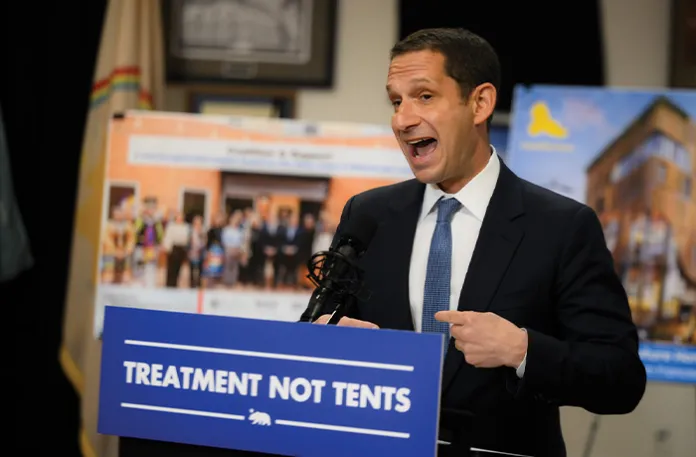
While it is true that some of San Francisco’s turnaround started under Breed — soft-on-crime District Attorney Chesa Boudin was recalled in 2022 — Lurie has instituted strong policies to keep that momentum going, facing down some of the powerful interest groups that caused San Francisco’s decline.
“Our progressive values sort of overtook common sense,” Lurie told ABC News’s This Week when asked what caused San Francisco’s earlier decline. “We lost our way as a city. I think we got away from the basics of government. Now, today, if you come to San Francisco to commit a crime, we’re going to catch you, and we’re going to prosecute you.”
Lurie has instituted several programs to crack down on crime in the city, including his Breaking the Cycle initiative, which uses law enforcement pressure, actually arresting people and prosecuting them, to clean up homeless camps and reclaim public spaces. Open-air drug markets are no longer tolerated under the Lurie regime. To keep streets clean, police are encouraged to charge drug users with even minor offenses such as loitering, drug paraphernalia possession, and public camping.
“We kept putting people with addiction into shelter, into housing, with no support,” Lurie said of the city’s past policies. “We’ve changed our approach on that here in San Francisco this past year. We’re no longer just handing out drug supplies and letting people kill themselves on the street.”
Lurie is hiring more police. His Rebuilding the Ranks initiative accelerated hiring of new officers, added recruitment incentives, and created a Reserve Officer Program for recently retired officers who could still contribute to the force.

Lurie’s role models are not the left-wing heroes of the modern Democratic Party. He is not looking to emulate socialists such as Chicago Mayor Brandon Johnson or New York Mayor Zohran Mamdani. His models are centrist, law-and-order Democrats such as former Mayors Michael Bloomberg and Dianne Feinstein.
Feinstein was a famously hands-on mayor of San Francisco who, like Lurie, walked the streets and talked with constituents. Bloomberg notoriously sought to make New York’s government more accountable through data-driven performance metrics, mayoral control of schools, transparency dashboards, and results-focused management. He also confronted unions by pushing pension and benefit reforms, refusing raises without concessions, and allowing contracts to expire.
Lurie has followed that playbook. To balance San Francisco’s budget, he instituted a hiring freeze on his first day in office. He followed that with the elimination of 1,400 positions that were unfilled. Public sector unions strenuously opposed both actions. But unlike most Democrats in the state, Lurie is not a career politician, and he did not respond like one. He does not depend on union endorsements to win elections — indeed, he did not receive any. He ignored the unions, balanced the budget by eliminating government jobs, and now San Francisco taxpayers are better off for it.
Lurie has also made cooperation with the business community a key part of his revitalization plan. His initiatives include PermitSF, a sweeping effort to streamline and digitize permitting, cutting red tape for small businesses and speeding openings with a new online portal and targeted legislative changes. His Vacant to Vibrant program is turning empty storefronts into pop-ups and permanent tenants, activating corridors downtown and reducing retail vacancies. Lurie has helped marshal more than $60 million through the Downtown Development Corporation, with major contributions from firms such as Google and OpenAI, to support clean and safe operations, public space programming, and small-business assistance aimed at building a true 24/7 downtown where people live, work, play, and learn.
“I am pro-small business,” Lurie told This Week. “I am pro-bringing conventions back to San Francisco. I’m pro-big business being here in San Francisco, and my demand of the business community is get involved in our city, get involved in our public schools, and in our arts and culture.”
Lurie sees the business community in San Francisco as a partner to cooperate with, not an enemy to conquer.
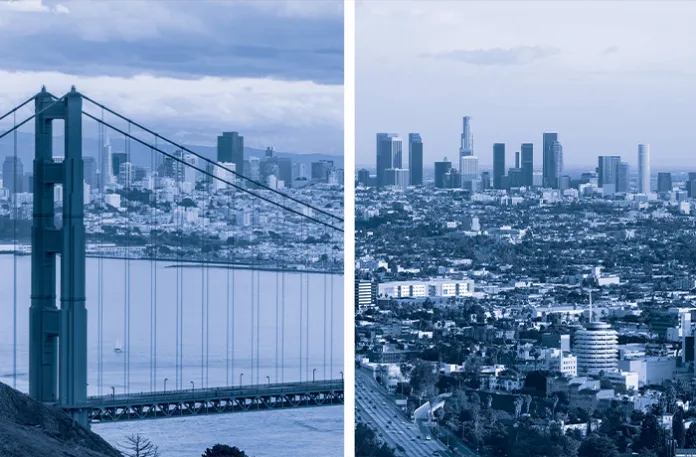
Contrast San Francisco’s turnaround with the mess that is Los Angeles.
Crime is down in Los Angeles, but not as much as it is in San Francisco. Three-fifths of Los Angeles residents still identify places in their area as “unsafe.” Despite sporadic city cleanups, many homeless encampments persist across the city. Tourism is down, with international flights to Los Angeles International Airport 8% lower and foot traffic on Hollywood Boulevard down 50%. Vacancies in downtown Los Angeles have not bounced back from years of decline and are now among the worst in the nation.
Los Angeles voters are feeling the malaise. An overwhelming 73% of residents believe the city is heading in the wrong direction, and 71% believe the local government needs “major reform.” Mayor Karen Bass is everything Lurie is not. She is a career politician, entirely beholden to public sector unions and antagonistic to business. She has also proven herself incompetent. She botched preparation for fire season in 2025, famously allowing the Santa Ynez Reservoir in California above the Pacific Palisades to be drained before the fire, but she was also away in Africa when the fires hit. Her government doctored the after-action report on the fires, and she has completely failed to help residents rebuild.
Whereas Lurie stood firm and balanced San Francisco’s books by cutting government jobs, Bass at first proposed cuts, then backed down under pressure from government unions — she depends on their endorsements to win the Democratic Party primary for reelection, so they have her in their pocket. After being forced to retreat in disorder, she turned around and gave those same government unions a $1 billion raise.
On crime and homelessness, whereas Lurie embraced the Supreme Court’s Grants Pass v. Johnson decision and used it to crack down on homeless encampments, Bass criticized the ruling and continued to embrace the failed approach of providing extra services for drug abusers, which keeps billions of dollars flowing to the homelessness nonprofit industrial complex but does nothing to clean the streets or make them safer or help the putative beneficiaries.
Even if businessman Rick Caruso had beaten Bass in the 2022 mayoral election, he would still have faced a city council far more left-wing than the one Lurie has to deal with. No fewer than three of the Los Angeles City Council’s 15 members belong to the Democratic Socialists of America, compared to just one on San Francisco’s 11-member council. The Los Angeles City Council is far more dominated by organized labor than San Francisco’s. Unions are routinely the biggest spenders in Los Angeles elections, with no real unified business interest to balance their power.
THE IRAN STRIKE IS ABOUT WEAKENING CHINA
Contrast Los Angeles’s union dominance with San Francisco, where Silicon Valley tech interests have organized into a well-funded political moderating force. Groups such as GrowSF poured millions of dollars into the 2024 mayoral election and produced voter guides for other races, and it spends millions on ballot measures, often opposed by organized labor.
Lurie is a generational talent, and his personal impact on San Francisco should not be underestimated. But ultimately, both Lurie and Bass are products of their political environments. Right now, thanks to the moderating influence of Silicon Valley, San Francisco seems capable of escaping total control by organized labor. Unfortunately for Southern Californians, that does not seem to be true of Los Angeles.
Conn Carroll is the commentary editor of the Washington Examiner.