
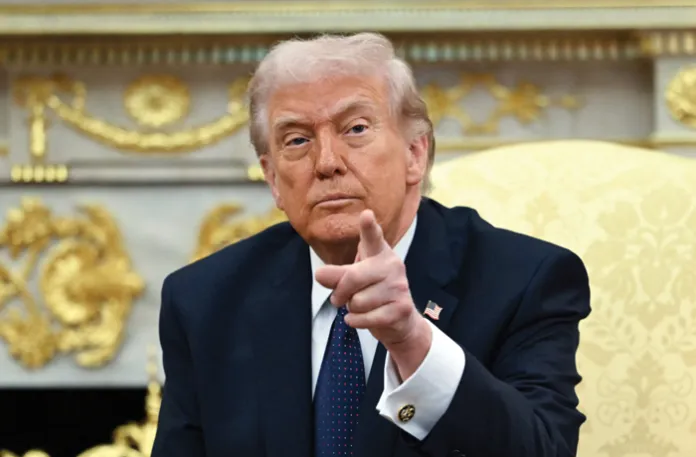
The most revolutionary force in the Middle East is President Donald Trump.
America and its ally Israel, achieving unparalleled levels of military and intelligence integration, have decapitated the Iranian terrorist regime, devastated its command structures, destroyed its weapons, and sunk a substantial proportion of its navy — they’re “at the bottom of the sea,” Trump said pithily on March 2. More will follow them into the deep.
These successes, if they can be secured, will stunningly transform the world’s most turbulent region, radically change great power thinking, and improve the lives of millions of people.
“This really is Trump,” said Mark Dubowitz, CEO of the Foundation for Defense of Democracies. To say so does not deprecate Israel’s role in Operation Epic Fury. Indeed, it requires it and honors it. Israel is the most potent nation of the Middle East, and it has flown about as many attack missions as the United States. The Jewish state has become less a junior partner than a coequal regional ally. Its strength and its improved relations with Arab and perhaps eventually Persian neighbors could undergird American strategy worldwide for decades.
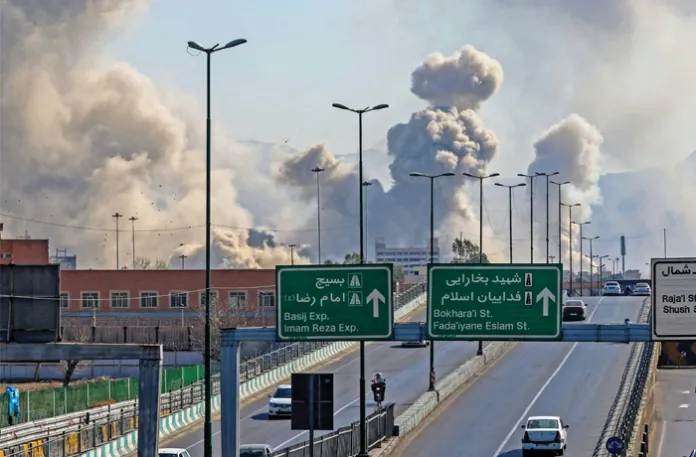
As capable as Israel is, it could not have undertaken an attack so ambitious in scale without Trump’s blessing. Nor could the operation have carried the potential of toppling the Islamic Republic without American participation and leadership. A president willing to take actions from which his predecessors flinched has been indispensable. It has created the possibility of big and lasting change.
To consider what has happened beyond military achievement, look at the outbreak of jubilation around the world upon news that Ayatollah Ali Khamenei had been killed, along with dozens of the brutes who helped him run his tyranny.
Unless you have fallen into the intellectual rut of using Trump’s every action as an occasion for caviling and deprecation, you will see that these events herald a dawn of hope for people who have suffered generations of vicious Islamist repression. But it is not only Iranians who have reason to cheer. A better Middle East offers relief to all people whose lives and moral consciences have been afflicted by Tehran-initiated and Tehran-financed terrorism.
Not least among these should be the inhabitants of our own country, which has been singled out for half a century as the “Great Satan.” Thousands of Americans have been killed and maimed by Iranian proxy terrorism. If Iran is rendered incapable of threatening us in the future, Epic Fury will be understood as clearly in the national interest.
Both Epic Fury and Midnight Hammer, which badly damaged Iran’s nuclear program last June, signaled the end of a long epoch during which Washington shied away from confronting the ayatollahs. The clerics have always promised “Death to America,” and they kept their word by killing our citizens and soldiers. Trump said in his televised speech on Feb. 28, “We’re not going to put up with it any longer.” Amen to that.
Appeasement, weakness, and retreat started with President Jimmy Carter’s failure in 1980 to rescue 444 American hostages taken by Iranian revolutionaries in the U.S. Embassy in Tehran. Failure continued in the region even under President Ronald Reagan, who, while winning the Cold War, nevertheless backed out of the Middle East when Iran’s proxy, Hezbollah, killed 241 U.S. Marines with a massive bomb in Beirut in 1983.
The nadir was reached with former President Barack Obama, whom the ayatollah wrapped around his little finger with a fraudulent deal and promises repeatedly broken to limit Iran’s nuclear ambitions. America’s humiliation was made even sweeter for our enemies because Obama sent them planeloads of cash into the bargain. It was eye-opening and ironic this month to see Ben Rhodes, the architect of Obama’s capitulation, criticize Epic Fury on grounds of cost, writing, “Among all the risks, one certainty is that U.S. taxpayers are spending tens of billions of dollars on something they overwhelmingly oppose.” The last American retreat from the region was the rout in Afghanistan engineered by former President Joe Biden.
Epic Fury and Midnight Hammer are intended to end the melancholy, long, withdrawing roar of America’s Middle East failure. Instead of seeing weakness and groveling apology, the world now sees American decisiveness and strength, technical military brilliance, and a solid alliance with a close, competent, and potent ally.
A young Iranian exile in Australia expressed the hope that what the world is watching might be “our Berlin Wall moment.” This is allowable and not altogether fanciful idealism. The U.S. has suffered too many reverses and disappointments in the region to expect the best, let alone to assume a sudden and complete remaking of the Middle East’s strategic landscape. But neither is contemplating such an outcome a fantasy. And the reason it is now possible to think that the extraordinary might become reality is that Trump and Israeli Prime Minister Benjamin Netanyahu saw that the goal was attainable. They had the daring to attempt it.
Whatever else is achieved, the extinguishment of the supreme leader and his most senior lieutenants and the weakening of their clerical regime is a pure good. Does anyone believe that what will replace them will be worse than what’s been there for half a century? Whether what emerges in Iran is a normal and respectable country or another cabal of ideologues and murderers, it is hard to imagine that it will be a deterioration from what we’ve endured since 1979.
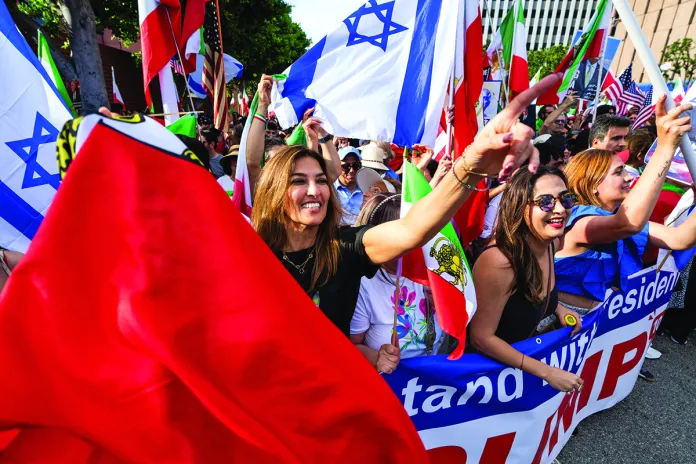
The weekend’s extraordinary developments brought hope to crowds from Washington to Vancouver and Los Angeles, and from Damascus to Tokyo and Melbourne. People flooded into the streets to wave American and Israeli flags in jubilation. These banners flew alongside the prerevolutionary flag of Iran, on which the imperial lion is emblazoned in the middle rather than today’s Islamist script, the cry of muezzin and terrorists alike: “Allahu Akbar.”
In London, Iranians marched to Golders Green to thank its predominantly Jewish residents for Israel’s military action. Iranians danced in the streets with Jews — there can surely be few more heartwarming sights in international relations, and few clearer signs that something huge may be happening. One should not, of course, fall for the Panglossian temptation of assuming that all is about to come right in the Middle East, but the U.S.-Israeli action offers hope for solid change and perhaps for something bigger.
Monday-morning quarterbacks in the U.S. carped and contradicted each other to condemn Trump’s military strike, saying variously that it was a “regime change” war of the sort Trump had promised to avoid, it was illegal for lacking congressional authority, unjustified because there had been no imminent threat, and lacked a strategy to build a stable Iranian state once the fighting was over. After only two days of hostilities, both House Minority Leader Hakeem Jeffries (D-NY) and Senate Minority Leader Chuck Schumer (D-NY) started referring to it ridiculously as an “endless war.”
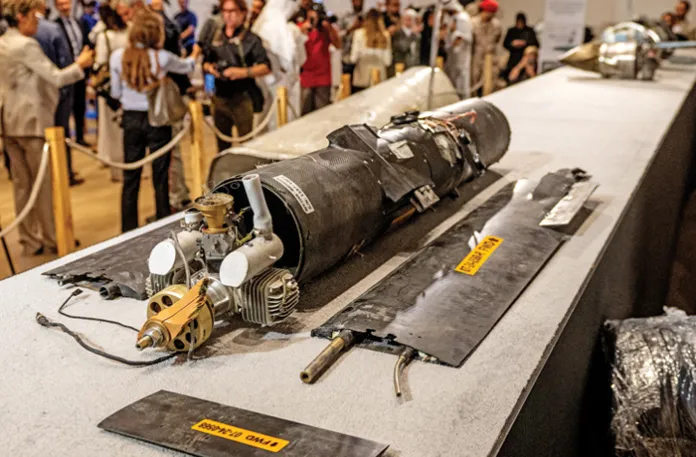
Administration officials were characterized as “walking back” the president’s explanations for the attack. But this analysis does not bear scrutiny. Trump said the overarching aim was to “defend the American people by eliminating imminent threats from the Iranian regime.” He went on to explain that the threats came from Iran’s nuclear weapons program, its ballistic missiles, its navy, and its terrorist proxies. All would, he said, be neutralized.
Rep. Jason Crow (D-CO) told CNN baldly that Trump and his officials are lying, and his evidence for this assertion relied on the fact that he differs from them on the meaning of an “imminent” threat. Because Iran was building missiles, had enriched enough uranium to make 11 nuclear bombs, has a policy of “Death to America,” and was refusing to stop its weapons program, it’s reasonable to argue, as Trump did, that the threat was imminent and that he has the right as chief executive to take action to avert it.
No official said regime change was a goal, although all of them acknowledged that if the clerical tyranny fell as a result of military action, that would be a welcome outcome. If one’s aim is to knock out threats posed by nuclear weapons, missiles, warships, and terrorists, it makes sense not just to destroy the hardware but also to kill the men ordering them to be built and deployed. There is no contradiction.
Trump’s words on regime change were these: “To the great, proud people of Iran, I say tonight that the hour of your freedom is at hand. Stay sheltered. Don’t leave your home. It’s very dangerous outside. Bombs will be dropping everywhere. When we are finished, take over your government. It will be yours to take. This will be, probably, your only chance for generations.”
He could hardly have been clearer or more explicit that the U.S. would end its military action without putting a new government in place. That task would be for Iranians to achieve themselves. Yes, Iran’s current despots would be killed, but no, America would not stay and attempt to build a liberal democracy, as it sought so disastrously to do in Iraq. That would be up to the people of the country once America was “finished.”
Trump’s message was, of course, not only or even primarily directed toward Iranians. It was for Americans to hear and understand. It told his fellow citizens that the epoch of appeasement was over and that the ayatollahs would be hit hard when they threatened Americans. But the U.S. would not send ground troops to occupy the country, nor insert an army of civilian administrators to run it.
So what happens when America has “finished?” The best-case outcome is that the Iranian people will indeed take over. The best case also includes strategic realignment across the entire Middle East. This has been made more likely by Iran’s illogical response to the U.S.-Israeli attack. It lashed out by firing missiles into Saudi Arabia, Jordan, Qatar, Kuwait, the United Arab Emirates, Oman, and Bahrain. These Arab states, which responded with military force, have long understood that Iran is the primary regional threat. Now, the mullahs have done everything possible to confirm that this is the case.
In an extraordinary act of self-sabotage, Iran even fired a missile at Turkey, where President Recep Tayyip Erdogan, a member of the Muslim Brotherhood, has been one of the Islamic Republic’s few friends in the region. Alienating Turkey is more than a little odd, for Erdogan has no interest in a pro-American secular Iran. Turkey, with its Islamist leader playing power games in the Levant and the crossroads of NATO and the Middle East, is the most troubling wild card in a future that sees the U.S. and Israel try to pull nations in the region together in a broad Abrahamic alliance.
Yet, with the Islamic Republic of Iran weak and perhaps crumbling, there is stronger reason now than ever to hope that more Arab states, most importantly Saudi Arabia, will move quickly to join the UAE, Morocco, Bahrain, and Sudan in the Abraham Accords, which Trump set in place during his first term and which normalized relations with Israel. Crown Prince Mohammed bin Salman, the de facto ruler of Saudi Arabia, lobbied Trump for weeks to attack Iran, and, behind the scenes, the Saudis are assuring Washington that they will normalize relations with Israel and integrate security and strategy with the Jewish state.
Thus, massive change is coming to the Middle East even if the Islamic Republic does not crumble. The new dispensation will involve deep cooperation between the richest, most capable, and most respectable nations in the region, which, with the U.S., will impose a new level of stability backed by a willingness to use force if rogue states threaten our people and shared interests.
Nor is that the whole picture of shifting alliances in the wake of Epic Fury. America’s developing regional alliance with Israel and modernizing Arab states is matched by a rapid shift in European alliances, where Trump is turning toward Germany and Poland as stauncher partners than Britain and France. Trump is furious that these more traditional allies refused to allow the U.S. to use sovereign military bases for offensive operations against Iran.
U.K. Prime Minister Keir Starmer’s government has reached new depths of fecklessness since the latest Iran conflict began by declaring that it would effectively hobble its ally and take no part in Epic Fury. Britain’s and France’s betrayal has become a systemic problem, as their left-of-center governments appease domestic Muslim voters who are increasingly extreme in their Islamism, hate Jews, and have become a vital voting bloc.
Trump has won his battle to force Europe to rearm itself and rely less on the U.S. NATO nations have committed to pay 5% of GDP on defense, up from 2%. Even though there is some fudging of the higher number, Europe will certainly spend more and shoulder the burden of making the eastern edge of the Atlantic more self-reliant. French President Emanuel Macron has announced that he will increase France’s nuclear arsenal to defend the continent.
So this is what is visible in the fog of the future. The U.S. can reduce its military commitments in Europe, while maintaining alliances there. At the same time, it should be able to lean more heavily on a growing alliance with Israel and moderate Arab states in the Middle East.
That, in turn, could allow America to do what every president since Bill Clinton has said is necessary — pivot to Asia. It is there that our most powerful rival and foe, China, is building its strength. It is there that America’s leadership of the free world is most needed.
TRUMP MAKES PATRIOTISM A BATTLEFIELD IN THE MIDTERM ELECTIONS
Military operations against Venezuela and now Iran have cut two of China’s oil arteries. If Epic Fury allows America to neutralize the Middle East’s biggest threat, Iran, and delegate stability in the region more into the hands of coalescing Israeli and Arab allies, it will let the greatest power on Earth focus on the biggest danger of all.
It would be wonderful if Iranians were soon to be free. If that happens, it would be a delightful consequence of a bigger plan. But Operation Epic Fury is not another war about nation-building in the Middle East. It is about defending Americans and free peoples everywhere, and about protecting America’s position as the leader of the free world.
Hugo Gurdon (@hgurdon) is the editorial director of the Washington Examiner.