
With Iran lobbing suicide drones and ballistic missiles at every military base and apartment complex from Muscat to Tel Aviv, the most important question facing the Middle East is: What does this mean for the Bahrain Grand Prix?
OK, OK, Formula 1 racing is perhaps not the greatest concern facing the world right now, but the war in Iran is certainly a concern for the league. The five red lights are set to go out to start the race at Sakhir, Bahrain — just a stone’s throw across the island nation from the headquarters of the U.S. Navy’s Fifth Fleet — in mid-April. One week later, drivers are supposed to put rubber compound to the road in Saudi Arabia. So far, Iran has attacked the territories of five countries that host grands prix, with the Islamic Republic reportedly launching drone strikes on Azerbaijan hours before this magazine went to press.
This war is already a crisis for many of the world’s luxury sports. As I write, Golf Digest reports that eight LIV golfers are stranded in Dubai, trying to get to the relative safety of Oman so they can catch a flight to make tee time at a tournament in Hong Kong. So far, the Saudi Pro League is pressing on with soccer matches; reports that Al-Nassr’s Cristiano Ronaldo fled the kingdom this week turned out to be false, but he apparently does have a bad hammy.
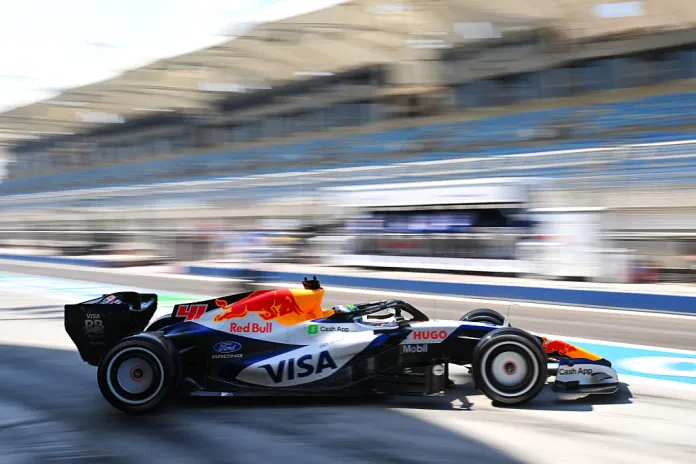
This is not the first time that war has threatened motor racing. In 1939, Corps Leader Adolf Huhnlein of the National Socialist Motor Corps declared Hermann Lang to be the winner of a European Championship season that was truncated when the National Socialist Panzer Corps went through the Danzig chicane into Poland.
More recently, the 2022 Saudi Grand Prix looked a bit touch-and-go when the Iranian-backed Houthis in Yemen fired a ballistic missile at an oil depot 12 miles from the track in Jeddah during a Friday practice. Four-time world champion Max Verstappen had to be told over the radio that his car was not on fire after he smelled the smoke in the cockpit.
That incident didn’t warrant a mention on that year’s season of Netflix’s sports series Formula 1: Drive to Survive. Based on the new season, which was released on Feb. 27, I suspect the streaming documentarians behind the show will find a way to gloss over “Operation Epic Fury,” too.
For one thing, these issues are “sensitive” in the Arab monarchies of the Persian Gulf, where filming a bit of seasonal flooding, let alone a foreign drone attack, risks a heavy fine or imprisonment. But perhaps more than any previous season of Drive to Survive, the new series covering the 2025 championship revealed the price that Netflix’s producers pay for authorized access.
If there is a sports-documentary equivalent of war, it was the ousting of Christian Horner as CEO of Red Bull Racing last year. Just before the season started, Red Bull revealed it had launched an “independent investigation” of Horner for alleged inappropriate behavior toward a female employee. One day after Red Bull’s investigator cleared Horner, hundreds of journalists around the world received an email with the subject line “Christian Horner investigation evidence” and a link to purported WhatsApp messages between Horner and his accuser.
Horner has refused to comment on the messages, which included provocative questions about underwear and a description of what the Daily Mail helpfully euphemized as a “solo sex act.” Horner denies any wrongdoing.
After Horner was fired last July with a severance of over $100 million, Red Bull launched another investigation into whether his de facto boss, Helmut Marko, leaked the messages as part of a power struggle with Horner.
Some of this was teased in the first episode of the previous season of Drive to Survive, which was released just as the scandal broke. But not a word about it appears in Season 8, which depicts Horner’s fall from power after 20 years and six Constructors’ Championships with Red Bull as the result of Verstappen being pouty about some bad races.
That may be because the legal case is still playing out in British courts, whose injunctive powers over the press rival those of any Arab potentate. But I suspect that it’s also because the producers of Drive to Survive have clear limits on just how revealing they’re allowed to be, and the powers-that-be in the world of F1 racing are more controlling than ever about where they place those limits.
The earliest seasons of Drive to Survive were charming because they followed a mix of awful teams struggling for whatever points and popular attention they could get, and Horner at Red Bull playing a WWE-style cartoon villain of a racing executive.
The not-so-secret of what makes WWE work, however, is kayfabe, the metafictional code of honor that its performers always treat the events in the ring as real. The best moments of Season 8 of Drive to Survive follow the people in F1 who have too much money and ego to be bothered by something as beneath them as Netflix cameras. Alpine F1 principal Flavio Briatore looks visibly bored meeting U.K. Prime Minister Keir Starmer, an admittedly relatable reaction, and is hilariously serious about the poster he keeps in his house depicting himself as superhero Batman, Italian patriot Giuseppe Garibaldi, revolutionary Che Guevara, and other men of action.
Other stars of the show are more self-conscious. In one montage, Williams principal James Vowles gives engineers such riveting pep talks as “just need to move quicker,” and “it’s good, but the ambition needs to be much bigger.” One nameless engineer helpfully replies, “trying to find a bit more performance.”
I don’t expect shows such as this to reveal trade secrets, but it struck me that one of two things must be true: Either the job of an F1 racing principal really is just to tell everyone constantly to go faster without crashing, or it’s a job whose talents are ultimately impossible to depict on screen.
MAGAZINE: CONTROVERSY IN THE COURTEOUS WORLD OF CURLING
The front-office scheming is less interesting and less fully told than ever, but the racing is still gorgeously shot. For a very casual F1 fan such as myself, Drive to Survive remains the best way to watch all the races I slept through on Sunday mornings before football.
This season closes with Lando Norris weeping tears of joy as he wins his first world championship, as fireworks explode over Abu Dhabi. Hopefully, that’s all that’s exploding over Abu Dhabi soon, or there will be a lot less driving to do this year.
Andrew Bernard is a correspondent for the Jewish News Syndicate.