
After the United States and Israel’s blistering opening strikes against Iran, Tehran turned the conflict into a regional conflict, firing drone and missile salvos at key facilities across and beyond the Middle East.
In the aftermath of the joint U.S.-Israeli strike on Saturday morning, Iran fired drones and missiles at no fewer than 10 countries: Bahrain, the United Arab Emirates, Qatar, Oman, Saudi Arabia, Iraq, Jordan, Kuwait, Israel, and Cyprus. On Monday, the State Department’s assistant secretary for consular affairs, Mora Namdar, urged U.S. citizens to depart the Middle East immediately.
STATE DEPARTMENT URGES AMERICANS TO LEAVE MIDDLE EAST IMMEDIATELY OVER ‘SERIOUS’ SAFETY RISKS
Iran has fired more than 500 missiles and over 1,000 drones at the Gulf States since Saturday morning. The UAE has been the worst hit, being targeted in the first 24 hours with almost as many drones and missiles as Israel.
Though the Gulf countries all host U.S. troops, Iran seems to have largely targeted civilian and infrastructure targets. Six U.S. troops have been killed across the Middle East in Tehran’s retaliation, compared to well over 1,000 Iranians.
In a Tuesday statement, the UAE Ministry of Defense reported that Iran had launched 186 ballistic missiles toward the Gulf country, nearly half of all ballistic missiles fired at the Arab states. Of these, 172 were intercepted, 13 fell into the sea, and one made contact. It reported another 812 Iranian drones fired at the UAE — the vast majority of all drones fired at the Arab states — of which 755 were intercepted, with 57 making it through.
Through direct impacts and falling debris, the UAE reported three people killed and 68 wounded. The casualties reflected the UAE’s massive migrant worker population, with those killed being identified as Pakistani, Nepalese, and Bangladeshi. Those injured were identified as Emirati, Egyptian, Ethiopian, Filipino, Pakistani, Iranian, Indian, Bangladeshi, Sri Lankan, Azerbaijani, Yemeni, Ugandan, Eritrean, Lebanese, and Afghan.
“The Ministry strongly condemned this military targeting, considering it a blatant aggression and a flagrant violation of national sovereignty and international law, and that the country reserves its full right to respond to this escalation and take all necessary measures to protect its territory, people, and residents, ensuring the preservation of its sovereignty, security, and stability, and safeguarding its national interests and capabilities,” the UAE MOD statement read.
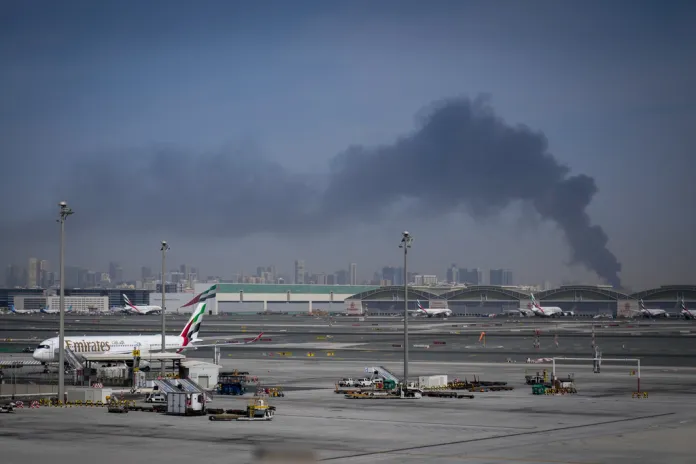
Among the targets hit was Dubai International Airport, filling the terminal with smoke. Social media footage showed Shahed drones making contact with luxury hotels.
The country also cracked down on the sharing of information over social media. Dubai’s Police threatened prison time of at least two years and fines of over $50,000 for “spreading rumors.”
“Sharing rumors, false information, or any content that contradicts official announcements or that may cause public panic or threaten public safety, order, or health is prohibited,” Dubai Police said on social media.
Kuwait, Bahrain, and Qatar were the next worst hit. Qatar’s Ministry of Defense reported on Tuesday that it had been targeted by 101 ballistic missiles, 98 of which were intercepted, 39 drones, 24 of which were intercepted, and three cruise missiles, all of which were intercepted. It also claimed to have shot down two Iranian SU-24 fighters.
Bahrain, though struck by comparatively fewer drones and missiles than its neighbors, suffered some of the most significant hits, including to U.S. military facilities. The island nation serves as the headquarters of the U.S. Fifth Fleet.
Unlike its neighbors, Bahrain didn’t provide figures for the total number of missiles and drones fired at them, only revealing how many had been intercepted: 70 missiles and 76 drones. The General Command of the Bahrain Defence Force tacitly admitted to some making it through, saying the “sustained and brutal terrorist aggression has caused material damage to civilian properties and infrastructure.”
Kuwait’s Ministry of Defense reported that 178 missiles and 384 drones had targeted the country, but claimed all had been intercepted. Possibly from falling debris, the MOD said 27 Kuwaiti soldiers had been injured.
Saudi Arabia suffered some of the fewest but most effective attacks. Iranian drones were able to hit the U.S. Embassy in Riyadh three times on Tuesday — twice in the first wave and once in the second. Iran also devastated one of the largest oil refineries in the world, hitting Aramco’s Ras Tanura refinery on Monday. The attack became the only one denied by Tehran, instead accusing Israel of launching a “false flag” operation.
The missiles and drones that made it through the air defense often hit critical infrastructure. Amazon Web Services announced on Sunday that three of its data centers in the UAE and Bahrain were hit by Iranian drones. The facilities were knocked offline, affecting some global applications.
“In the UAE, two of our facilities were directly struck, while in Bahrain, a drone strike in close proximity to one of our facilities caused physical impacts to our infrastructure,” it said. “These strikes have caused structural damage, disrupted power delivery to our infrastructure, and in some cases required fire suppression activities that resulted in additional water damage.”
On Tuesday, the U.S., Bahrain, UAE, Saudi Arabia, Qatar, Kuwait, and Jordan issued a joint statement strongly condemning Iran’s actions and hinting at possible retaliation, but stopped short of pledging a military response. On Tuesday, Qatar slapped down reporting that it carried out an attack on Iran. Instead, a spokesman for the prime minister of Qatar said it was “exercising its legitimate right to self-defense and deterring Iranian aggression against its territories.”
The State of Qatar did not participate in the conflict with Iran; instead, it is exercising its legitimate right to self-defense and deterring Iranian aggression against its territories.
“The actions of the Islamic Republic represent a serious escalation that violates the sovereignty of multiple states and threatens regional stability. The targeting of civilians and countries not involved in hostilities constitutes reckless and destabilising behaviour,” the statement read. “We stand united in defending our citizens, sovereignty, and territory, and reaffirm our right to self-defence in the face of these attacks.”
The Iranian assault on the Gulf countries apparently came as a shock to Washington, with President Donald Trump telling CNN on Monday that it was “the biggest surprise” of the conflict so far.
“We were surprised,” Trump said. “We told them, ‘We’ve got this,’ and now they want to fight. And they’re aggressively fighting. They were going to be very little involved, and now they insist on being involved.”
He specifically noted the surprise at the apparent choices of civilian targets.
The Iranians, he said, “shot into a hotel, they shot into an apartment house. It just made them angry. They love us, but they were watching. There was no reason for them to be involved.”
According to the Wall Street Journal, the Gulf States were targeted because Tehran was betting on making their situation intolerable, pushing them to use their influence in the Trump administration to force an end to the campaign. The actual effect has been the opposite, with the infuriated Arab leaders floating the idea of joining the conflict outright.
Several Gulf leaders targeted by Iran have been making desperate personal appeals to Russian President Vladimir Putin, who is in a unique position due to his friendly relations with both Israel, the Arab world, and Iran. Russia has grown much closer to Iran in recent years due to its isolation over its war in Ukraine, but its strategic partnership doesn’t extend to security guarantees during armed conflicts.
US DECIMATES IRANIAN BASE IN STRAIT OF HORMUZ AS IRGC SAYS SHIPPING LANE CLOSED
“Putin will certainly make every effort to contribute to at least a slight easing of tensions,” Kremlin spokesman Dmitry Peskov told reporters on Tuesday.
“Yesterday’s discussions with virtually all of his interlocutors focused on Putin conveying his deep concern about the strikes on their infrastructure to our colleagues in Iran, taking advantage of the dialogue we maintain with the Iranian leadership,” he added, referring to Arab leaders’ personal phone calls and appeals to Putin.