
Administration officials are scrambling to sell members of Congress on President Donald Trump’s military operations in Iran ahead of bipartisan attempts to limit his war powers in the Middle East without approval from lawmakers.
The Senate and House are set to vote on so-called war powers resolutions this week to require congressional approval for additional military action, outcomes that could present embarrassing setbacks for the president in the middle of armed conflict with Iran.
The GOP-controlled chambers narrowly avoided passage of a Venezuela war powers resolution in January after U.S. forces toppled the regime of former dictator Nicolás Maduro, causing some Republicans to break ranks. This time, lawmakers anxiously await all-members classified briefings with senior administration officials set for Tuesday to learn more about long-term objectives and whether the conflict could last longer than the five-week time frame Trump has laid out.
Sen. Thom Tillis (R-NC), who is not seeking reelection in November, told the Washington Examiner he was undecided but that his position would be “largely based” on what is learned in the briefing and the administration’s plans moving forward after a joint U.S.-Israel operation over the weekend killed Iranian Supreme Leader Ayatollah Ali Khamenei.
“If it’s Venezuela — done, out by the end of week — [it] may be one thing, because you’d be passing a war powers resolution after the conflict’s over,” Tillis said. “If there’s an intent to be there longer term, then clearly Congress has a role to play in that.”
Sens. Susan Collins (R-ME), Todd Young (R-IN), and Lisa Murkowski (R-AK) were among the five GOP senators to initially vote to advance a Venezuela war powers resolution in January. All three declined to comment on their positions.
Sen. Josh Hawley (R-MO) is also one of the five who initially supported the Venezuela measure but later flipped his vote on final passage, like Young. He believes the administration was in compliance with the War Powers Act as there were boots on the ground at the time, and signaled he’d therefore not support the measure against Iran.
“[If] that’d be a different story, then I think authorization would be required for that, but I think they’re in compliance,” Hawley said.
Sen. John Curtis (R-UT) has at times staked out more centrist positions and been willing to criticize the president. Still, he indicated he may have considered supporting the resolution before Trump’s strikes against Iran, but told the Washington Examiner it would be “disastrous to stop now.”
“No matter what you say about starting, it would be a whole lot worse to stop in the middle,” Curtis added to reporters. “You’re just going to leave and let Iran do whatever it wants and retaliate and do all those things? That’s not an option. You leave servicemen there and in danger?”
Most Democrats are united in favor of a war powers measure, though Sen. John Fetterman (D-PA) plans to vote against it. And even if enough Republicans in either chamber would side with Democrats, neither could muster veto-proof majorities to override Trump.
The administration’s justification that preemptive action was warranted was based on the belief that the U.S. faced an “imminent threat” because of an impending attack from Israel against Iran that would have caused Iran to strike U.S. forces and allies in the region. Senior officials, including Secretary of State Marco Rubio, briefed select members of Congress on Monday during a classified briefing and will return to Capitol Hill on Tuesday for an all-members classified briefing ahead of the war powers votes.
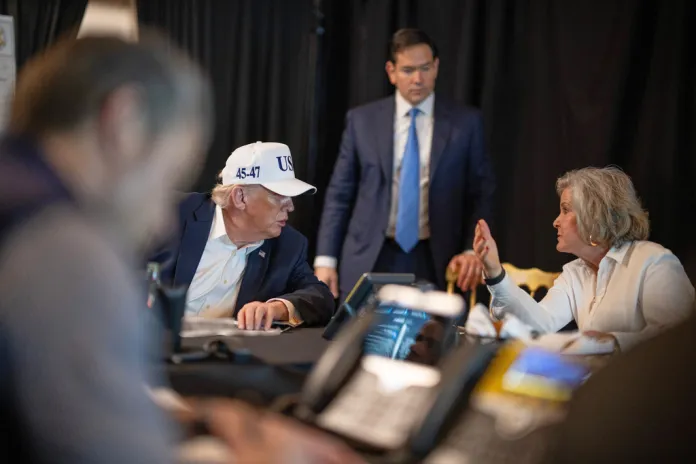
“The president made [a] very wise decision,” Rubio said. “We knew that there was going to be an Israeli action. We knew that that would precipitate an attack against American forces, and we knew that if we didn’t preemptively go after them before they launched those attacks, we would suffer higher casualties.”
Sen. Tim Kaine (D-VA), who along with Sen. Rand Paul (R-KY) is leading the Senate version of the war powers resolution, described Rubio’s rationale as insufficient.
“That is what’s called a pretext, not an imminent threat,” Kaine said. “Our foreign policy is not determined by what some other nation does; it should be determined by our own national interest.”
TRUMP SUGGESTS IRAN WAR COULD CONTINUE FOR WEEKS AS US SUFFERS FIRST CASUALTIES AND OIL PRICES SURGE
In his latest remarks on the subject, Trump wrote in a Truth Social post Monday evening that Democrats were “complaining bitterly about the very necessary and important attack.”
“What most people understand is that they are only complaining BECAUSE I DID IT and, if I didn’t do it, they would be screaming — Why didn’t ‘TRUMP’ attack Iran, he should do it, IMMEDIATELY?” Trump posted. “These people are SICK, CRAZY, and DEMENTED, but America, despite them all, is now BIGGER, BETTER, AND STRONGER THAN EVER BEFORE.”