
There have been numerous casualties on all sides since the joint U.S.-Israel strikes against Iran commenced over the weekend, with more lives expected to be lost as the campaign continues.
The Islamic regime’s leadership is currently bearing the brunt of losses, but Hezbollah has also taken some damage. Additionally, civilians have been caught in the crossfire.
DAN CAINE SAYS ADDITIONAL FIREPOWER HEADED TO MIDDLE EAST AND HEDGES OPERATION TIMELINE
Senior Iranian officials taken out
Between 30 and 50 Iranian officials were eliminated in the targeted operation, crippling the country’s government.
Iran is scrambling to appoint replacements as it sustains losses at the highest level.
Ayatollah Ali Khamenei and wife Mansoureh Khojasteh Bagherzadeh
Supreme Leader Ali Khamenei was the highest-ranking Iranian leader to be killed in “Operation Epic Fury,” the name given by President Donald Trump to the mission for targeting the clerical government. Khamenei was at his Tehran compound before his death on Saturday.
The Iranian supreme leader’s wife, Mansoureh Khojasteh Bagherzadeh, died sometime after sustaining wounds from the airstrikes that killed her husband. Khamenei’s daughter, grandchild, daughter-in-law, and son-in-law were also killed. His son, who is seen as a possible successor, remains alive.
Ali Shamkhani
Commodore Ali Shamkhani, the former head of Iran’s defense council and a close adviser to Khamenei, was among the top officials killed in the Saturday strikes.
He was overseeing the negotiations between the United States and Iran about a potential nuclear deal. The latest round of talks concluded late last week, just before the U.S. and Israel attacked Iran.
HOW THE IRAN CONFLICT WAS LAUNCHED: ‘OPERATION EPIC FURY IS APPROVED. NO ABORTS. GOOD LUCK’
Mohammad Pakpour
Maj. Gen. Mohammad Pakpour formerly led the Islamic Revolutionary Guard Corps. He replaced the previous IRGC commander, Hossein Salami, who was eliminated by Israeli forces last June.
Following his death, Pakpour has been succeeded by Brig. Gen. Ahmad Vahidi. The appointment was made on Sunday. Vahidi is under U.S. sanctions for his role in quashing nationwide protests and committing human rights violations.
Abdolrahim Mousavi
Maj. Gen. Abdolrahim Mousavi served as Iran’s armed forces chief of staff since June 2025, when his predecessor was assassinated by Israeli strikes before “Operation Midnight Hammer,” which targeted Iran’s nuclear program.
Mousavi is being replaced by an interim leadership council, led by Iranian President Masoud Pezeshkian.
Aziz Nasirzadeh
Brig. Gen. Aziz Nasirzadeh, the country’s defense minister, also died in the initial joint strikes.
He was replaced by an acting defense minister on Monday.
Mohammad Shirazi
Brig. Gen. Mohammad Shirazi had led the supreme leader’s military office since 1989.
In this role, he facilitated coordination between armed forces commanders and the supreme leader.
Hossein Jabal Amelian
Brig. Gen. Hossein Jabal Amelian oversaw Iran’s Organization of Defensive Innovation and Research, an agency responsible for developing advanced weapons.
Israeli military assessment says its research entailed nuclear, biological, and chemical weapons.
Reza Mozaffari Nia
Brig. Gen. Reza Mozaffari Nia once led the SPND, contributing to nuclear weapons development.
Majid Mousavi
Brig. Gen. Majid Mousavi had commanded the IRGC’s Aerospace Force since last June.
Mohsen Darrebaghi
Brig. Gen. Mohsen Darrebaghi served as a deputy for logistics and support and general staff of Iran’s armed forces.
Other notable casualties in Iran’s government include Brig. Gen. Gholamreza Rezaian, the police intelligence chief; Brig. Gen. Bahram Hosseini Motlagh, the general staff of Iran’s armed forces; Mohammad Baseri, a senior intelligence ministry official; and Salah Asadi, the head of Iran’s intelligence department.
Hezbollah leaders
Several leaders of Hezbollah, a key Iran-backed terrorist group based in Lebanon, were also hit hard by Israel. The Jewish state retaliated after Hezbollah launched aerial attacks from the Lebanese capital of Beirut.
After Hezbollah and Israel traded fire, Lebanon’s prime minister banned the terrorist group from conducting “military activities” and relegated it to political duties.
Mohammad Raad
Mohammad Raad, the head of Hezbollah’s parliamentary faction, died on Monday after Israel struck Beirut.
Serving as a member of parliament for Hezbollah since 1992, Raad led the Iranian proxy’s 13-member political wing. Also, he was once a spokesperson for former Hezbollah leader Hassan Nasrallah, who died in Israeli airstrikes in September 2024.
Hussein Makled
Hussein Makled, the head of Hezbollah’s intelligence headquarters, was also killed.
The Israeli military says Makled provided Hezbollah with “intelligence assessments regarding [Israel Defense Forces] troops and the State of Israel” and “closely cooperated with senior commanders in Hezbollah who planned and advanced terror attacks against Israel and its citizens.”
Adham al Othman
Adham al Othman, the commander of the Palestinian Islamic Jihad’s military wing, was also killed in the Israeli attack in Beirut on Monday.
The Islamic Jihad made the announcement of his death, but the Israeli military did not immediately confirm the veracity of the opposing group’s claim.
Civilian casualties
Preliminary figures show Iran with the highest number of recorded deaths since the strikes began, but civilians in other nations also have been killed.
Meanwhile, at least four U.S. troops have died so far during Operation Epic Fury.
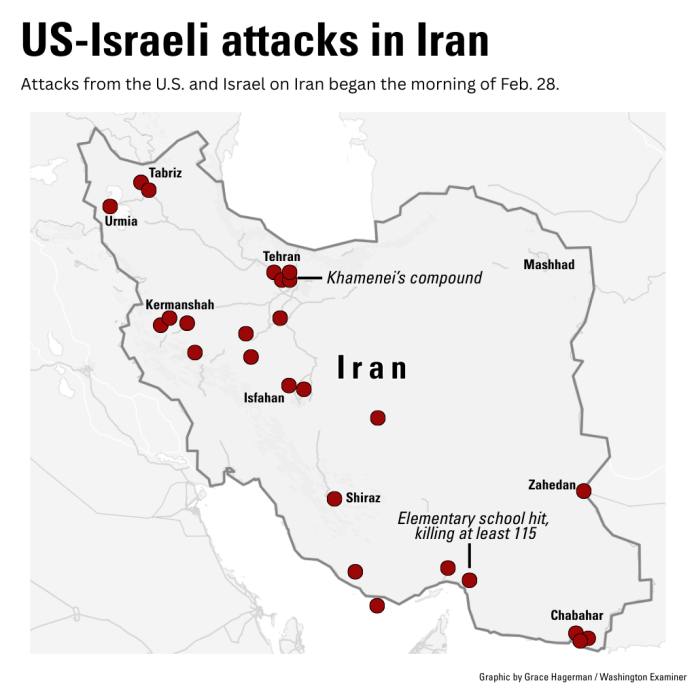
Iran
At least 555 people have died in Iran so far, according to the Iranian Red Crescent Society. The nongovernmental humanitarian organization, which operates under state influence, is known for failing to distinguish between civilian and military casualties in its death tolls.
The deadliest incident occurred in Minab, where an all-girls elementary school was targeted. At least 175 people, most of them likely children, were killed.
Israel
At least nine people in Israel died on Sunday after Iran struck a synagogue and bomb shelter underneath the religious site in Beit Shemesh, a city about 18 miles west of Jerusalem.
At one point on Monday, a funeral gathering for two of the victims was disrupted by air sirens that were triggered by explosions overhead as Israel intercepted drones and missiles. The funeral proceeded several minutes after the immediate threat was gone.
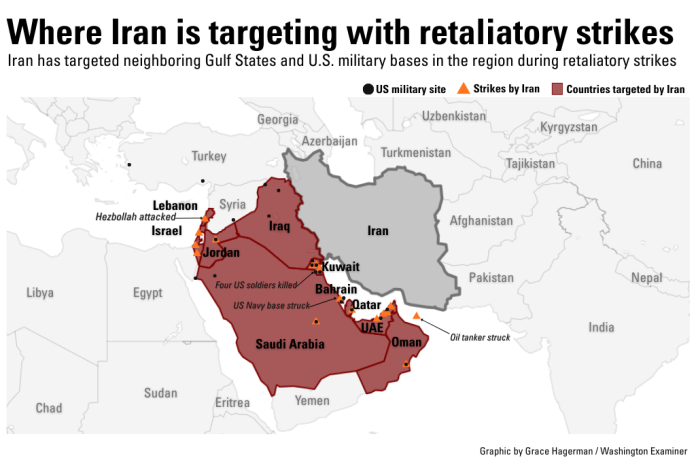
HOW GULF STATES ARE RESPONDING TO IRAN’S RETALIATORY STRIKES
Neighboring Middle Eastern states
Several Persian Gulf nations that host U.S. bases or forces are dealing with their own losses from retaliatory strikes.
In Lebanon, at least 50 people died in Israeli strikes. The United Arab Emirates, Iraq, Bahrain, Kuwait, and Oman all recorded deaths in the single digits following Iran’s strikes. Meanwhile, there have been significantly more wounded casualties in certain nations, especially the UAE. Saudi Arabia and Qatar recorded no fatalities so far.