
President Donald Trump would prefer to settle his dispute with Iran diplomatically, but U.S. officials and Israeli allies are increasingly concerned that there is no way forward without military intervention.
Trump’s son-in-law Jared Kushner and special envoy Steve Witkoff met with Iranian Foreign Minister Abbas Araghchi in Geneva, Switzerland, for three hours on Tuesday.
Senior U.S. officials reportedly told Israeli outlet Channel 12 that those talks amounted to a “nothing burger” and speculated that Trump is “very close” to ordering a strike on Iran.
Vice-President JD Vance half-heartedly reported that in some regards the talks went “very well” but said “it was very clear that the president has set some red lines that the Iranians are not yet willing to actually acknowledge and work through.”
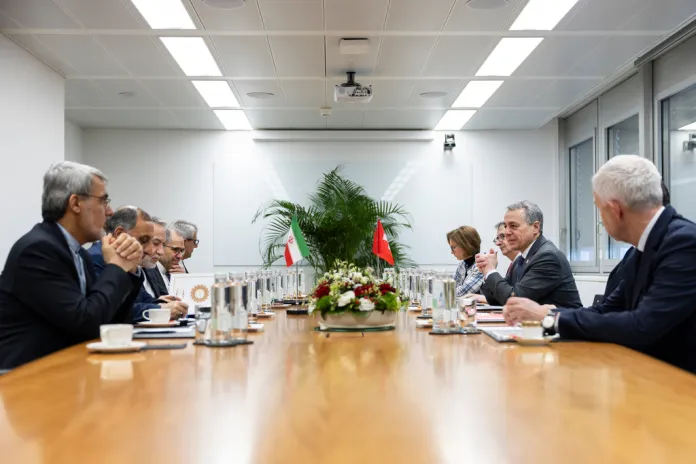
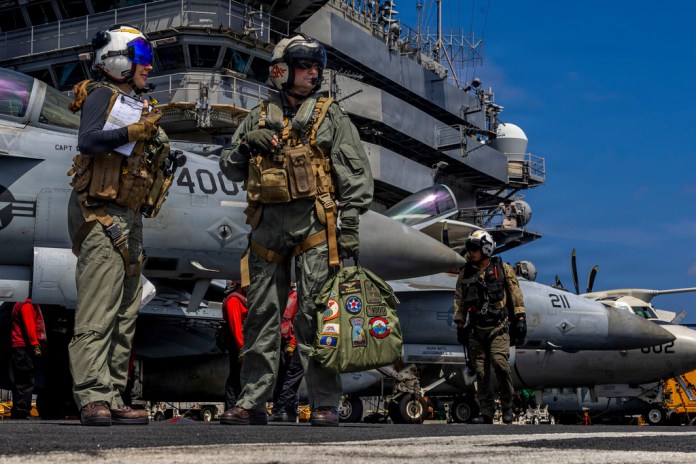
The administration has reportedly given Iran a two-week time frame to get aligned with Washington’s perspective — the threat of kinetic action against the Islamic Republic looming as U.S. military assets pour into the region.
“Iran will try to keep the talks going forever, but Trump won’t fall for that,” Elliott Abrams, senior fellow for Middle Eastern Studies at the Council on Foreign Relations, told the Washington Examiner. “Once all our forces are in place, he won’t wait long for them to compromise or bear the consequences.”
US faces longer battle than previous ‘Midnight Hammer’ strikes
At the heart of the possible conflict is the Iranian nuclear program, the perennial source of concern for Western powers who fear what the Islamic regime is capable of if it acquires nuclear weapons.
Last June, amid Israel’s war with Iran, the U.S. Air Force bombed three underground nuclear facilities in Iran that the Israelis were not capable of hitting. Dubbed “Operation Midnight Hammer,” it was a quick and effective campaign that severely damaged the nation’s nuclear infrastructure.
Iran responded limply with a strike on a U.S. base in Qatar, warning the United States ahead of time in order to prevent casualties while saving face with the token strike.
Now, the U.S. is ramping up the pressure on Iran — demanding the Islamic Republic cease all uranium enrichment operations and forfeit its stockpiles of already enriched uranium, which the regime claims is solely for use in civil energy.
Additionally, the Trump administration is demanding that Iran cease development of ballistic missiles and end funding to its Islamist militant proxies across the Middle East.
Enforcing these demands — which explicitly aim at neutering the Islamic Republic and ending its role as the primary state-sponsor of terrorism in the world — would require extensive military strikes far beyond what the White House authorized last year in terms of scope and risk to the public’s lives.
Failing to permanently address the Iranian nuclear question or settling for a weak agreement that fails to end nuclear enrichment would echo the disastrous Iran Deal struck by former President Barack Obama in 2015 — an agreement that Trump has repeatedly admonished as an asinine arrangement.
Additionally, the stakes were raised over the last few months as protests inside Iran began to threaten the regime’s hold. As thousands of demonstrators were mowed down by the Islamic Revolutionary Guard Corps and state authorities, Trump thrust himself into the conversation by urging dissidents to continue their bloody struggle — assuring them that “help is on its way.”
“If [Trump] agrees to a deal that is time limited and nuclear-only, he is agreeing to the kind of deal President Obama made in 2015 and which Trump rightly denounced and got out of,” Abrams told the Washington Examiner. “Moreover, this would entail lifting sanctions, which would enrich and reward the regime weeks after it murdered thousands of peaceful protesters. All of that makes me think some kind of strike is more likely than not.”
Operation Midnight Hammer benefited immensely from the frantic circumstances of the war raging between Israel and Iran at the time. The Israelis had already taken out Iran’s air defense systems, allowing U.S. fighter jets to fly unimpeded into Iranian airspace. The Air Force also had a very specific mission, and the operation lasted only a couple of hours.
This time around, however, the president could choose a much more difficult operation that could require a sustained and possibly open-ended battle, which is something Trump has refused to do thus far in his tenure.
Both the Operation Midnight Hammer, the U.S. operation targeting the Fordow, Natanz, and Isfahan facilities, and the mission to arrest former Venezuelan dictator Nicolas Maduro were events that the president could announce after their completion, only hours after the operations began.
If Trump opts to take more drastic options — such as trying to remove the regime in Tehran — it would likely take a sustained battle, in which Iranian leaders would be fighting for their very existence, and as a result, could be more likely to carry out intended attacks on U.S. forces in the region or Israel.
No U.S. service member has been killed in either Operation Midnight Hammer or the mission to capture Maduro, though multiple troops were shot during the latter.
Rosemary Kelanic, director of the Middle East Program at the think tank Defense Priorities, told the Washington Examiner that Trump could face serious political consequences if he opts the U.S. into a hot war with Iran that gets U.S. servicemen killed.
“Even if the Iranians won’t agree to a stronger nuclear deal, it is still better that Trump offramp the U.S. from the current standoff than start a war with Iran merely to save face or ‘preserve credibility,’” Kelanic told the Examiner.
She continued: “There’s no imminent threat from Iran that justifies a major war that could cost the lives of U.S. soldiers. American voters are tired of unnecessary wars in the Middle East and could punish Trump in the midterms for starting a new one, particularly in the tragic case that U.S. military personnel are killed.”
Iran prepares for the worst
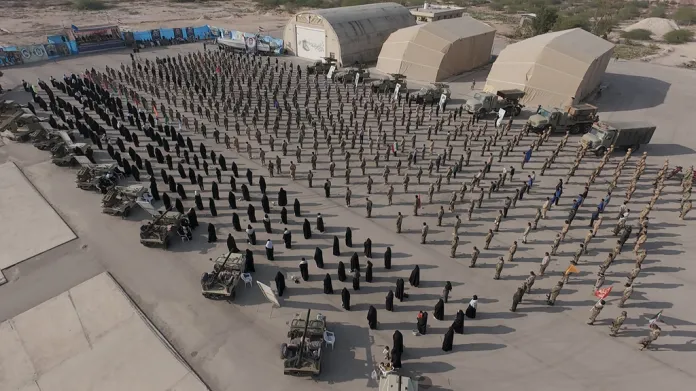
The Iranians seem aware of the growing possibility of a hot war with the U.S. and are frantically working to prepare themselves.
Satellite imagery shows the military has begun trying to fortify and hide some of its more important facilities to defend against possible U.S. or Israeli strikes.
They have effectively tried to bury the Parchin military complex over the last couple of weeks, according to the Institute for Science and International Security. The facility has been under construction since May 2025, before the Israel-Iran 12-day war, though it is being repaired after reportedly being struck in an Israeli airstrike in October 2024.
“Still visibly pouring fresh concrete at the end of January, Iran’s course of action means once the concrete sarcophagus around the facility was hardened, Iran did not hesitate to move soil over large parts of the new facility,” the Institute for Science and International Security said in its ISIS report on Tuesday. “More soil is available on the hillside above and the facility may soon become a fully unrecognizable bunker, providing significant protection from aerial strikes.”
The ongoing U.S. efforts to resolve the current tension diplomatically have also simultaneously afforded Iran the opportunity to harden its military facilities ahead of a possible attack.
Roughly half of the approximately two dozen locations struck by Israel or the U.S. during the 12-day war have undergone some amount of reconstruction, though the amount each has been rebuilt remains an unanswered question, according to a New York Times analysis.
The Trump administration’s recently released National Defense Strategy said, “Although Iran has suffered severe setbacks over recent months, it appears intent on reconstituting its conventional military forces. Iran’s leaders have also left open the possibility that they will try again to obtain a nuclear weapon, including by refusing to engage in meaningful negotiations.”
Israel says it’s ready for the crossfire
Israel, which is urging the U.S. to be aggressive in dealing with the Iranian regime, simultaneously knows that it will be among the chief targets of a counterattack from Tehran.
IDF Home Front Command chief Maj. Gen. Shay Klapper, in a briefing to the Knesset Foreign Affairs and Defense Committee, warned that Israel is expected to be the “central arena” of a multilateral clash with Iran.
Prime Minister Benjamin Netanyahu has ordered the Israeli military’s Home Front Command to prepare itself for possible confrontations with the Islamic Republic, which officials anticipate could be initiated at any time.
“I will not hide from you that I express my skepticism of any deal with Iran, because, frankly, Iran is reliable on one thing — that they lie and they cheat,” Netanyahu said on Sunday at the 51st annual Conference of Presidents Leadership Mission to Israel.
IDF Col. Nir Neuman, who serves as the commander of the Rishon Lezion Local Emergency Unit in the Home Front Command, said Monday in a podcast interview that the Israeli military is equipped to field an attack.
“I say first of all that in terms of fortification, we are prepared,” Neuman said. “We are trained to respond in the event of an incident. Ultimately, any citizen who knows where to go to a protected space and receives sufficient warning will be protected, even against the most severe threats that may reach us.”
IRANIAN SUPREME LEADER CALLS NUCLEAR INDUSTRY ‘OUR UNDENIABLE RIGHT’ IN SERIES OF THREATS AGAINST US
A U.S. official reports that Iranian negotiators “said they would come back in the next two weeks with detailed proposals to address some of the open gaps in our positions.”
Whether those two weeks will be deemed a last chance or if partial progress could prolong negotiations remains to be determined.