
Acting Venezuelan President Delcy Rodríguez this week floated a visit to the United States to advance the relationship between the two countries, despite reiterating criticism regarding Washington’s sweeping military intervention in Caracas.
Rodríguez slammed the Trump administration for ousting former Venezuelan dictator Nicolas Maduro, pushing back against accusations from democratic countries that he was a sham leader, and saying he remains “the legitimate president.” At the same time, Rodríguez expressed a willingness to “cooperate” with the U.S. after meeting with Energy Secretary Chris Wright on Wednesday.
“I have been invited to the States,” Rodríguez said during an interview with NBC News published Thursday. “We’re contemplating coming there once we establish this cooperation, and we can move forward with everything.”
Rodríguez added support for “diplomatic dialogue” following her conversation with Wright on energy policy.
“Let diplomatic dialogue … and energy dialogue be the appropriate and suitable channels for the U.S. and Venezuela to maturely determine how to move forward,” she said.
The Trump administration is in the middle of seeking to rebuild Venezuela’s once-thriving energy infrastructure, after it suffered a massive decline under Maduro’s rule. Officials have framed the work as an effort both to benefit the Venezuelan people and restore the country’s wealth, and capitalize on Washington’s national security strategy to protect the world’s largest oil reserves from being under the control of “illegitimate leaders” and “a handful of oligarchs.”
President Donald Trump has allowed Rodríguez to assume the reins in Venezuela, despite her close alliance with the Maduro regime.
Wright said Wednesday that Rodríguez has so far proved to be a cooperative partner in Washington’s demands for certain reforms, despite her at times publicly hostile statements against the administration.
“She’s delivered information. Everything we know so far has turned out to be true. She’s made enormous positive changes, including already changing the hydrocarbon law in the country in the first few weeks,” he said. “So I would say that cooperation is off to a tremendous start.”
The U.S. has begun to ease some sanctions on Venezuela’s energy that were previously put in place to target the Maduro regime. Washington is seeking to entice energy firms still skeptical about investing in the country to launch operations through various incentives, while U.S. companies such as Chevron look to return to or expand operations there. Rodríguez’s administration last month bolstered Washington’s agenda by allowing further reforms that moved the oil sector away from socialist economics and opened it to private investment. The changes to Venezuela’s hydrocarbon law mean the state-run oil company, PDVSA, no longer has a monopoly over oil production, sales, or pricing.
Wright told reporters that the reform “is a meaningful step in the right direction,” but “probably not far and clear enough to encourage the kind of large capital flows” the U.S. would like to see. There has now been more than $1 billion in Venezuelan oil sold, and another $5 billion in oil sales are expected in the coming months, he said. Wright plans to travel with Rodríguez on Thursday to observe oil production operations firsthand.
“The idea is to use leverage to drive progress,” Wright said, adding that he wants Venezuela’s government to go much further in opening its economy to foreign energy companies.
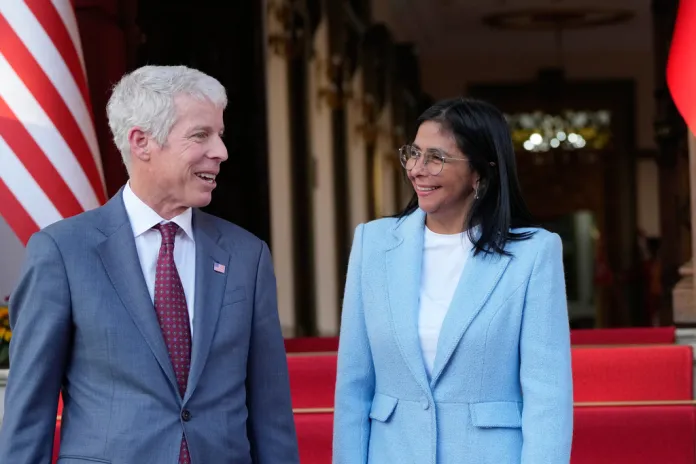
“The Venezuelans are in charge here in Venezuela, but the United States has enormous leverage over the interim authorities in Venezuela — the largest revenue source that funds the government, that funds the government of Venezuela is now controlled by the United States,” the energy secretary said in comments to NBC.
WHAT IS THE DELTA FORCE? THE US MILITARY UNIT BEHIND THE VENEZUELA RAID TOPPLING MADURO
Chevron CEO Mike Wirth said in late January that the company could increase production in Venezuela by up to 50% over the next 18 to 24 months if the company receives authorization from the U.S. government.
“We see Venezuela taking steps in a positive direction to address those issues, which will encourage investment, not only from a company like ours, but from others that I think are also considering the opportunities there,” Wirth told CNBC’s “Squawk on the Street” in an interview.