
It is a testament to the hilarious strangeness of actress and comedian Catherine O’Hara that she could plausibly portray a suburban mother who, upon embarking on a transcontinental trip, neglects to bring her young son along with the rest of the family.
In the 1990 John Hughes-scripted megahit Home Alone, Macaulay Culkin was the featured attraction as the child who fails to join his family on vacation and causes a ruckus on the homestead. At the time, Culkin garnered all the attention, but it was O’Hara who gave the movie much of its humor and all of its heart. By then a well-known comic performer, O’Hara was so believably off-kilter, so plausibly distracted, that the moviegoing public could imagine her neglecting to pack her rambunctious, obnoxious son along with the rest of her possessions. We forgive O’Hara for her lapse in parental oversight in a way we might not a more grounded, naturally maternal actress. A degree of delirium was part of the O’Hara signature.
O’Hara, who died on Jan. 30 at age 71, enlivened numerous films and TV shows through her distinctive sense of humor. She seemed unique among her contemporaries in her capacity to authentically channel the weirder sides of human nature. It is difficult to imagine another actress who could bring gravitas to both the part of an ice cream truck proprietress with vigilante instincts in Martin Scorsese’s After Hours (1985) and that of a supercilious urbanite sculptress in Tim Burton’s Beetlejuice (1988). Is it any wonder she could not be trusted to keep Culkin from being left home alone?
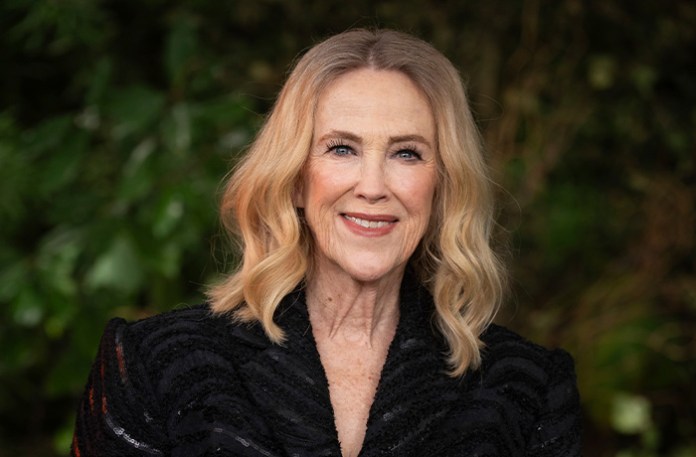
Like Bill Murray, O’Hara offered convincing evidence that to spring from a large family may be a recipe for future comic greatness. Born in Toronto, O’Hara was one of a septet of children, and she was the only one who made comedy her life’s work. Sizing up the opportunities in her home country, she charted a course to the Toronto offshoot of Second City. The comedy troupe soon publicized her antics to the wider public by hiring her to appear on its television iteration, the legendary SCTV, on which she induced laughter from the mid-1970s through the early 80s.
Around that time, Hollywood started to seize on her manifold talents. Following a handful of undistinguished Canadian productions, Scorsese cast her in his first real comedy, After Hours, in which Griffin Dunne stars as a mundane worker bee plucked from his natural habitat and dumped into 80s-era SoHo, which, in Scorsese’s vision, was brimming with weirdos. In a cast that included Verna Bloom, Teri Garr, Dick Miller, and Cheech and Chong, O’Hara, as the avenging ice cream truck lady, was perhaps the chief weirdo.
O’Hara’s strident oddness was part of the joke in Beetlejuice, in which her character is presented as the opposite of nearly everyone else in the cast: As the sculptress Delia Deetz, she is benignly tolerated by her husband (Jeffrey Jones), treated with contempt by her stepdaughter (Winona Ryder), and royally condescended to by Dick Cavett. In between the extremes of After Hours and Beetlejuice, O’Hara had a slightly more ordinary but no less delightful role as a gossip-prone Washington housewife in the Mike Nichols-Nora Ephron comedy-drama Heartburn (1986), one of the great films about domestic life as it exists inside the Beltway.
Her role in Home Alone confirmed that she was among the great featured players of her era. Although she was never asked to carry a movie, she was increasingly relied upon to spice up an ensemble: She was always among the liveliest members of the large casts in such films as The Paper (1994), Tall Tale (1994), and Orange County (2002); in the last, an underrated college comedy, she played yet another lovable but unreliable mother, this time to star Colin Hanks.
Along the way, O’Hara was absorbed into the stock company of Christopher Guest, who furnished her with some of her funniest and most eclectic material in Waiting for Guffman (1996), Best in Show (2000), and A Mighty Wind (2003). O’Hara never grimaced at the cringeworthy characters she created under Guest’s game direction; instead, there was an implicit recognition that, in her attraction to eccentrics and losers, she was admitting her closeness to such people. There was nothing snooty about O’Hara’s vision of a character.
Unlike some supporting actors whose popularity peaks at a certain point, O’Hara never ceased to be appealing to casting directors. She made striking impressions in movies as recent as Beetlejuice Beetlejuice (2024), in which she proved the durable daffiness of Deetz, and on shows as well-loved and widely watched as Schitt’s Creek and The Studio. Perhaps confirming her kinship to her characters, her one marriage was to the man who designed the sets for Beetlejuice, Bo Welch.
Coming on the heels of the death four months ago of Diane Keaton, who, in some ways, was simply an earlier version of O’Hara, had she attained legitimate stardom and pursued straight dramatic parts, the death of O’Hara has rendered Hollywood a whole lot blander.
Peter Tonguette is a contributing writer to the Washington Examiner magazine.