
As Antropic’s relationship with the White House oscillated between warm and cold in 2025, the artificial intelligence giant’s spending on lobbyists skyrocketed.
Anthropic’s monthly lobbying expenditures have increased by roughly 511% over the course of President Donald Trump’s second term in office, rising from $180,000 at the end of the first quarter of 2024 to $1.1 million during the final quarter of 2025. Even as Anthropic publicly butted heads with the Trump administration, the firm has been eager, in private, to pay Republicans and Democrats alike to win over those in power.
The final quarter of 2025 saw conflicts between the Trump administration and Anthropic over the former’s approach to AI regulation. The tensions came to a head when Anthropic cofounder Jack Clark penned an essay criticizing some in the tech world for dismissing concerns that AI could threaten humanity’s existence.
“What we are dealing with is a real and mysterious creature, not a simple and predictable machine,” Clark wrote of AI. “And like all the best fairytales, the creature is of our own creation. Only by acknowledging it as being real and by mastering our own fears do we even have a chance to understand it, make peace with it, and figure out a way to tame it and live together.”
Venture capitalist David Sacks, the White House’s special adviser for AI and crypto, hit back shortly after Clark published his essay, accusing Anthropic of hijacking concerns about AI development to construct a regulatory environment favorable to its bottom line.
“Anthropic is running a sophisticated regulatory capture strategy based on fear-mongering,” he wrote. “It is principally responsible for the state regulatory frenzy that is damaging the startup ecosystem.”
The trading of blows between Sacks and Clark fits into a broader policy conflict over the regulation of AI. On one side of the issue are voices such as Sacks, who view the advancement of AI as a powerful engine for economic growth and fear that the United States could be left behind by global competitors if it over-regulates the industry. Those in Clark’s camp, meanwhile, maintain that while AI is incredibly promising, unchecked development could wreak havoc on human civilization through economic upheaval or even extinction.
While the Trump administration has generally been friendly toward the former perspective, the latter won a major victory in July 2025 when the Senate advanced a version of the One Big Beautiful Bill Act without a provision that would have effectively barred state-level AI regulation. Subsequent efforts to ban state-level regulation have also fallen short.
Firms such as OpenAI and Google had pushed for the provision, arguing that a hodgepodge of state laws could create an uncertain legal environment, thus stifling innovation. Anthropic, meanwhile, opposed the moratorium on regulation, citing what it believed was a pressing need for regulation to argue that the U.S. cannot afford to wait for Congress to act.
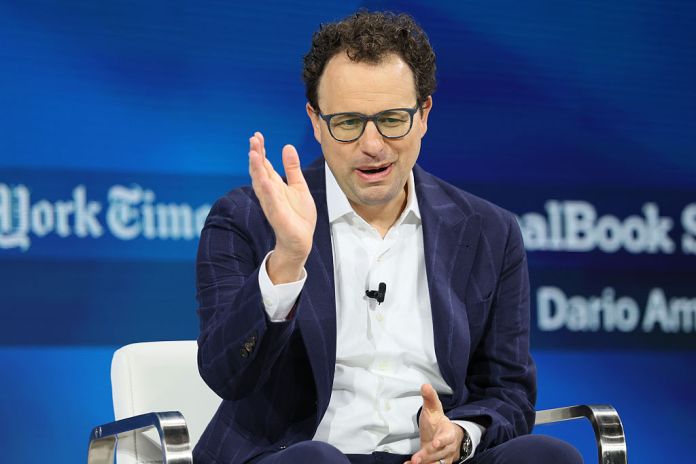
Anthropic’s legislative victories are likely due in part to its high-powered and expensive bipartisan team of lobbyists.
Rachel Appleton, Anthropic’s first in-house lobbyist, previously served as an attorney in the Biden administration’s Department of Justice, Democratic counsel on the Senate Judiciary Committee, legislative counsel for Rep. Derek Kilmer (D-WA), and as a fellow on former Vice President Kamala Harris’s 2016 Senate campaign. Mary Croghan, another in-house lobbyist for the firm, was a senior GOP staffer on the judiciary committee and held various positions in other House offices and the White House before joining Anthropic.
In-house influencers aside, Anthropic has also spent considerable funds to retain both Republican and Democratic-aligned firms to lobby on its behalf.
Acquia Group and Continental Strategy, which Anthropic has collectively paid nearly $1 million since 2023, were founded by Republican lobbyists. Tower 19, which Anthropic has paid roughly a quarter of a million dollars so far, and Avenue Solutions, which just registered to represent the AI giant, meanwhile, are aligned with Democrats.
Avenue Solutions cites its “well-established relationships with Democratic Members and their staff on Capitol Hill” that it has accrued “over three decades” as evidence of its effectiveness in swaying members of Congress in ways beneficial to its clients.
Sacks has accused Anthropic of adopting a media strategy that portrays itself as a “target” of the Trump administration — a move likely to improve its reputation among those in the tech world — despite working with the administration. The venture-capitalist-turned-White-House-adviser also accused the firm of retaining liberal staffers to “lobby for the old Biden AI agenda.”
The Pentagon awarded Anthropic a transaction agreement with a $200 million ceiling in July 2025. The firm went further, offering access to two of its flagship products, Claude for Enterprise and Claude for Government, to all three branches of government for just $1 in August of last year.
After the spat with Sacks, Anthropic CEO Dario Amodei published a blog post highlighting the company’s cooperation with the Trump administration.
TECH DONORS FUND MEDIA FELLOWSHIP SHAPING COVERAGE OF THEIR PET ISSUE
Anthropic’s lobbying ramp-up has been ongoing for some time.
Since launching its lobbying operation in 2023, Anthropic has spent just over $5.1 million on lobbyists, of which $210,000 was disbursed in its initial year. Anthropic increased its lobbying spending every quarter since the end of 2023, with the exception of the fourth quarter of 2025, when it reduced its spending from $1.18 million to $1.1 million.
While OpenAI and others in the industry have seen similar upticks in lobbyist spending, the scale of Anthropic’s expansion has been comparatively significant.
Anthropic did not respond to a request for comment.