
The Department of Veterans Affairs is facing its first-ever net workforce loss, with more than 40,000 employees leaving in fiscal 2025, nearly 90% of them healthcare workers, a Democratic watchdog report warns.
The report, released by Democratic staff on the Senate Veterans’ Affairs Committee, finds the staffing decline has left an estimated 1.2 million veterans without primary care providers, pushed mental health wait times beyond legal limits in more than a dozen states and contributed to rising errors in benefits decisions as claims processors are pressured to prioritize speed over accuracy.
Sen. Richard Blumenthal (D-CT), the committee’s ranking Democrat, said the workforce losses mark a historic reversal for the VA and amount to a breach of the government’s obligation to veterans during a press call with reporters on Thursday.
“This is the first year ever that the VA has experienced a net loss of employees,” Blumenthal said. He noted that in a typical year, the department adds roughly 10,000 workers and said the departures have been concentrated in “critical areas where VA healthcare is at stake,” including physicians, nurses, mental health providers, schedulers, and claims processors.
Blumenthal said VA lost more than 40,000 employees during the fiscal year but hired roughly 21,000, resulting in a net loss of about 28,000 workers. Many of the new hires, he said, were not brought on to replace departed clinical staff and lacked the experience needed to offset the losses.
The Connecticut senator tied the staffing reductions to policies launched under the Trump administration’s Department of Government Efficiency, or DOGE, arguing that cuts initiated under the initiative continue to shape VA operations through firings, contract cancellations, and reorganization plans.
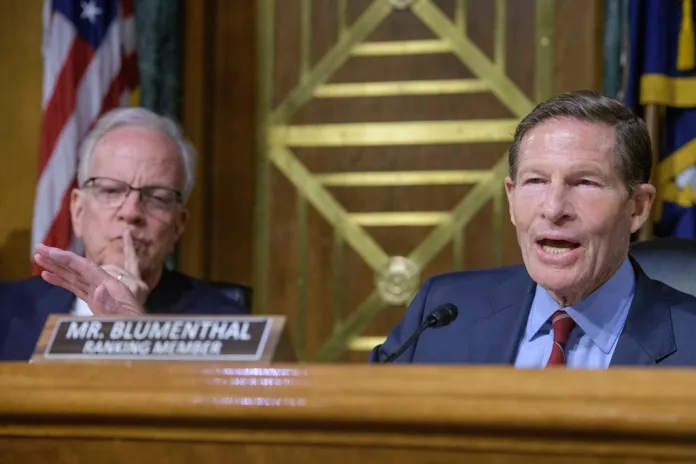
“DOGE is still alive and well in the VA,” Blumenthal said, describing the workforce reductions as arbitrary and warning the impact is compounding as remaining staff face heavier workloads and burnout.
Advocates representing veterans said the staffing losses are being felt at the patient level. Lindsay Church, executive director of Minority Veterans of America, said clinics are struggling to maintain stable care teams.
“Clinics can’t keep care teams staffed,” Church said. “Appointments are being canceled or delayed, and veterans who rely on consistent trauma-informed care are being forced into instability.”
She said wait times for new mental health appointments now average 35 days nationwide, exceeding VA standards, with some clinics reporting waits of 40 to 60 days and at least one California facility reporting a 121-day wait.
Union leaders also warned that the workforce losses are compounding burnout among remaining staff. MJ Burke, president of the National VA Council at the American Federation of Government Employees, said the department is struggling to retain clinicians and support personnel as workloads increase.
“These just aren’t statistics,” Burke said. “These are broken promises to our veterans.”
The report also raises concerns about benefits processing, finding that errors are increasing as claims processors face higher production quotas with fewer staff. According to the report, requests for higher-level review of benefits decisions have surged as mistakes become more common.
Republicans have not endorsed the report’s findings. Sen. Jerry Moran (R-KS), the Republican chairman of the Veterans’ Affairs Committee, said in an interview he was not familiar with the report but would review it.
“I do not know about the report that Senator Blumenthal either developed or is referring to, but I’m happy to take a look at it and have a better response when I see what the facts are,” Moran said.
The VA pushed back on the report and defended its recent reforms.
“While Blumenthal stages political theater, VA is making major improvements for Veterans under President Trump,” Pete Kasperowicz, a VA press secretary, said in a statement provided to the Washington Examiner.
He said the department has reduced the backlog of veterans waiting for benefits by 57% since January 2025 and is processing record numbers of disability claims, reaching a fiscal-year high of 3 million processed claims. He also said VA has opened 25 new healthcare clinics, expanded appointment hours through early-morning, evening, and weekend visits, and permanently housed more than 51,000 homeless veterans in fiscal 2025.
He added the department has brought tens of thousands of employees back to the office, redirected funds previously spent on union contracts and diversity, equity, and inclusion programs toward veteran services, accelerated deployment of its electronic health record system, and committed an additional $800 million to facility infrastructure improvements.
VA LAYOFFS SPARK CONCERNS ABOUT VETERANS’ CARE: ‘THIS COULD BE LIFE OR DEATH’
Blumenthal rejected that characterization and said the department has failed to provide basic data to Congress about staffing levels, contract cancellations, and the impact of its restructuring plans. He accused the VA of resisting oversight and downplaying the consequences of workforce losses.
VA Secretary Doug Collins is scheduled to testify before the Senate Veterans’ Affairs Committee at a hearing examining efforts to restructure the Veterans Health Administration.
“We’re seeing an institution dismantled in real time,” Blumenthal said. “There’s nothing partisan about the numbers in this report, and there’s nothing partisan about caring for veterans.”