
Gov. Josh Shapiro (D-PA) got a glimpse of the White House this week as speculation continues to grow he is eyeing a 2028 presidential campaign.
Alongside fellow possible 2028 Democratic presidential candidate Gov. Wes Moore (D-MD), Shapiro was at the White House on Friday to help President Donald Trump’s administration put pressure on PJM Interconnection, the country’s largest electrical grid operator, to hold an auction for tech companies and data centers to bid on 15-year contracts for new electricity generation capacity.
The aim of the pressure campaign is to compel tech companies to pay for new power plants as the acceleration of artificial intelligence, in turn, mounts pressure on energy prices for everyday consumers — Trump’s latest attempt to address affordability and cost-of-living concerns, which are likely to be central to this year’s midterm elections.
But it was the attendance of Shapiro, who this week announced his reelection campaign to remain Pennsylvania’s governor, that piqued the interest of political pundits before the 2028 presidential cycle.
According to early 2028 Democratic presidential primary polls, Shapiro only averages 5% support, compared to Gov. Gavin Newsom (D-CA)’s 24%, former Vice President Kamala Harris’s 22%, former Transportation Secretary Pete Buttigieg’s 11%, Rep. Alexandria Ocasio-Cortez’s (D-NY) 8%, and Gov. J.B. Pritzker’s (D-IL) 5%, per RealClearPolitics.
Gov. Andy Beshear (D-KY) has an average of 3% support, while Sens. Mark Kelly (D-AZ) and Cory Booker (D-NJ) have 3% apiece.
Pennsylvania Republican strategist Christopher Nicholas told the Washington Examiner his church prepared “for a 30-40% increase in our electric rates” when it compiled its budget this year.
“That and groceries are top of mind for people, given the regularity in which we purchase energy and food,” Nicholas told the Washington Examiner. “Shapiro seems to relish campaigning against the president without going to war with him, so this is an intriguing development.”
“PA makes and exports a lot of electricity,” the strategist added. “Politicians don’t stay in office long without understanding the changes in public opinion, and nascent data centers are a big and easy target.”
For Franklin & Marshall College Center for Opinion Research director Berwood Yost, Shapiro “has talked a good bit about energy during his tenure” so Friday’s event provided him with another platform to underscore the issue.
“More importantly, this meeting is tied to personal budgets and affordability, so it also allows him to talk about an issue that will be important in his reelection bid,” Yost told the Washington Examiner. “On top of that, he probably sees the meeting as an opportunity to show voters he can work outside of his party to establish policies that will help them. This is the centerpiece of his brand.”
To that end, even before 2028, the Lancaster, Pennsylvania-based pollster, emphasized that Shapiro “being on the same stage” as Trump aids his reelection campaign because it could undercut Republican opponent Stacy Garrity’s support among the president’s supporters.
“Many people do not realize how well Shapiro did in his first election with voters who have shied away from Democrats in recent elections,” Yost said. “Despite all the coverage of [Sen.] John Fetterman‘s successes among rural voters in 2022, Shapiro actually did better.”
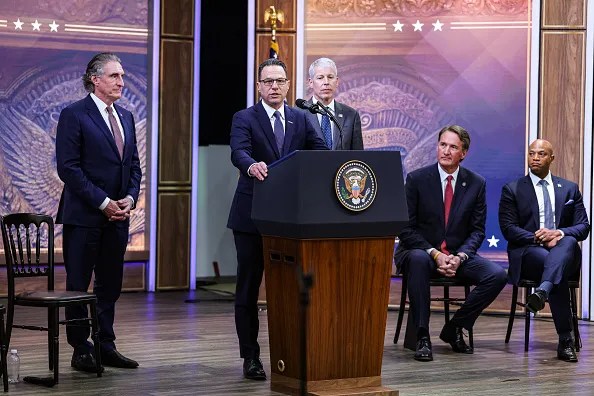
Democratic governors with presidential aspirations are grappling with when and how to work with Trump as they simultaneously plot how they could replace him.
Some, including Gov. Gretchen Whitmer (D-MI), have taken a bipartisan, more conciliatory approach, though Whitmer was surprised last April during a trip to the White House to discuss federal funding to assist Michigan’s recovery from an ice storm when Trump brought reporters into the Oval Office.
Photographers captured Whitmer trying to hide her face from them with a folder, an instantly meme-able image.
“This is one of those moments where, as a public servant, you’re reminded your job is to put service above self, and that’s what it was all about,” Whitmer told Pod Save America at the time.
Others, including Newsom and Pritzker, have been more adversarial, with Newsom, in particular, being almost aggressive online as he and his staff troll Trump and the White House on social media.
Even when Trump traveled to California last January to survey the devastation wreaked by the 2025 deadly wildfires, Newsom ensured photographers caught him pointing his finger at the president as he greeted him at Los Angeles International Airport.
“As Donald Trump cancels free admission to National Parks on MLK Day, California will be offering FREE entry at more than 200 participating state parks. Honor MLK,” Newsom wrote on X on Friday. “Get outdoors. And stick it to an old man with a fragile ego.”
At the same time, Newsom has been conducting outreach to conservatives as he seeks to change perceptions of him as a liberal caricature to try to appeal to more centrist voters, hosting prominent right-leaning personalities on his own podcast.
Democratic strategist Andrew Bates contended that state and local leaders need to work with the president “at times, even if they disagree with the White House on almost everything.”
“In Shapiro’s case, he’s fought PJM for years, beating them in court and saving 65 million Americans billions of dollars on their utility bills,” Bates told the Washington Examiner. “The White House is following his lead. He’s also fighting against Washington Republicans’ clean energy cuts, which are jacking up costs just to lower taxes for the rich. Shapiro and the other governors there [on Friday] are right to be involved, especially to stop the Trump administration from doing even more harm or building more corporate backdoors into their approach.”
Although a spokesman for Shapiro did not immediately respond to a request for comment from the Washington Examiner, a spokesman for Moore cited Friday’s event after a separate meeting Thursday between his governor and Transportation Secretary Sean Duffy on how to best rebuild Baltimore’s Francis Scott Key Bridge following the 2024 tanker collision.
“@GovWesMoore and I have worked together for years to hold PJM accountable and lower energy bills for Pennsylvanians and Marylanders,” Shapiro wrote on Friday. “We stand together again today to sign an agreement between bipartisan PJM states and the federal government to extend our price cap and save consumers billions. Governors are leading the way — and together, we’ll continue fighting for the 67 million Americans who rely on PJM to keep the lights on.”
TRUMP ADMINISTRATION PROJECTS UNITED FRONT AS PRESIDENT WEIGHS IRAN OPTIONS
Friday’s event on PJM Interconnection punctuates a week of bipartisan outreach from Trump after he telephoned Sen. Elizabeth Warren (D-MA) on Monday regarding capping credit card interest rates and met with Sen. Minority Leader Chuck Schumer (D-NY) on Thursday related to the Gateway tunnel project between New York and New Jersey, not to mention reporting that he and New York Mayor Zohran Mamdani now text message one another following their sit-down in November.
“President Trump has always been willing to work across party lines to deliver for the American people,” White House spokeswoman Taylor Rogers told the Washington Examiner. “The latest examples of President Trump’s bipartisan efforts should reemphasize to officials in blue states like Minnesota and Illinois that working alongside the president will make America safer and more affordable.”