
The Virginia man accused of planting pipe bombs outside the Democratic and Republican National Committee headquarters ahead of the Jan. 6, 2021, Capitol riot says President Donald Trump’s sweeping clemency for Jan. 6 offenders should apply to his case.
Defense attorney Mario Williams, who represents Brian Cole Jr., said the charges against his client fall squarely within the scope of Trump’s pardon language, which covers offenses “related to events that occurred at or near the United States Capitol on January 6, 2021.”
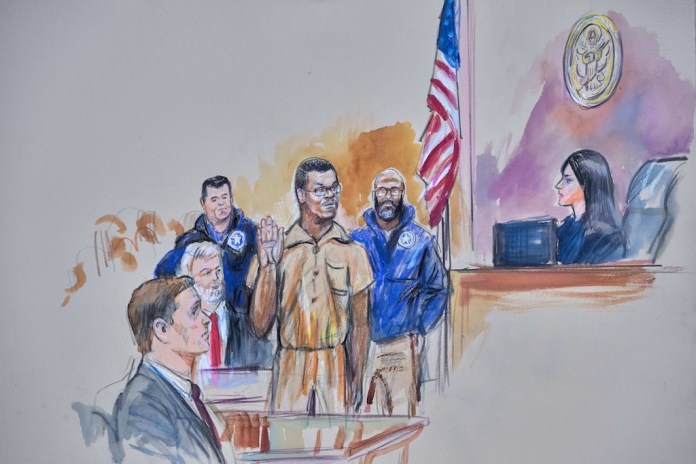
Williams said the defense plans to file court papers soon, asking a judge to dismiss the case or otherwise apply the pardon.
“I think you have to employ some kind of common sense as applied to the allegations,” Williams told Fox 5 DC on Monday. “If the allegations are that he went out there and he set down these components and that they were found on January 6th, the judge says that it’s a part of January 6th.”
U.S. Magistrate Judge Matthew Sharbaugh, who handled Cole’s arraignment earlier this month, previously described the case as “Jan. 6–adjacent,” a characterization Williams said strengthens the defense’s argument.
Cole was arrested in December and charged with interstate transportation of explosive devices and malicious attempt to use explosive devices. He pleaded not guilty to both counts on Friday, and a hearing is slated for Jan. 28 as the court plans to reconsider whether to release Cole and appoint his grandmother as a third-party custodian ahead of his trial.
Federal prosecutors allege Cole placed two homemade explosive devices outside the RNC and DNC headquarters in Washington, D.C., on the night of Jan. 5, 2021, the evening before Congress met to certify President-elect Joe Biden’s 2024 victory. The devices were discovered the following day and safely rendered inoperable. Prosecutors also say Cole confessed after his arrest, describing how he built the devices and where he placed them. Those allegations were laid out in a public court filing used by the government to argue that Cole should remain detained pending trial.
Williams has sharply disputed the government’s account of that interview. He said he has now reviewed the recorded interrogation and claims that prosecutors omitted key context and made inaccurate representations of the interview in their filings to the court.
“Some of the government’s statements about the interview are incorrect and, in some instances, false,” Williams said, adding that the defense demanded access to the evidence after the government summarized the alleged confession in court papers.
Williams also noted that Cole voted for Trump twice before his arrest, pushing back on any suggestion that the alleged conduct was disconnected from the events surrounding Jan. 6.
According to a Jan. 20 proclamation from the White House last year, Trump directed the attorney general to seek “dismissal with prejudice” of all pending indictments against defendants “related to the events at or near the United States Capitol on January 6, 2021.” At least one Jan. 6 defendant, Dan Wilson, has received a secondary pardon after he was also convicted of illegally possessing firearms at his Kentucky home, a matter unrelated to his alleged conduct on the day of the riot.
The proclamation did not specify that it applied only to defendants charged or convicted as of the date of issuance, nor did it exclude offenses discovered through later investigations.
Legal analysts have noted that, under long-standing Supreme Court precedent, presidents have broad authority to issue pardons for past conduct even if charges have not yet been filed. Courts have also interpreted the phrase “related to” expansively in a variety of legal contexts.
A recent Politico analysis by former federal prosecutor Ankush Khardori argued that the breadth of Trump’s pardon language could create serious problems for the Justice Department if Cole is ultimately convicted. Khardori noted that prosecutors have already applied Trump’s pardon to some defendants whose cases were still pending at the time of issuance and warned that courts may focus on the text of the pardon rather than the Trump administration’s intent.
The magistrate judge who ordered Cole detained pending trial previously noted that Cole was “charged with placing the two [improvised explosive devices] in the immediate vicinity of the U.S. Capitol the night before U.S. lawmakers were set to gather to certify the results of the 2020 election,” a factual framing that could become central if a court decides to take up the pardon issue.
DC PIPE BOMB DEFENDANT PLEADS NOT GUILTY TO FEDERAL CHARGES
So far, the Justice Department has not publicly addressed whether it believes Trump’s Jan. 6 clemency applies to Cole’s case. The White House has brushed off questions on the issue, and a prosecutor involved in the case declined to answer a request for comment from the Washington Examiner.
Williams said the defense will press the issue soon, arguing that the allegations that devices were placed ahead of Jan. 6 and discovered on that day mean Cole’s case falls within the pardon’s scope “100%.”