
President Donald Trump last fall acknowledged that the Constitution bars him from running for a third term. But more recently, he’s seemed to open the door a bit, from posting an AI image with him holding a sign that read, “TRUMP 2028, YES!” to talking to Alan Dershowitz about the upcoming book by the Harvard Law School professor emeritus, Could President Trump Constitutionally Serve a Third Term?
Only one president has ever been elected to more than two terms — Democrat Franklin D. Roosevelt, who was sworn in for his third term 85 years ago this month. And although FDR won his 1940 election handily, he provoked an intense backlash from members of both parties, as well as newspaper editorial pages. His decision to buck the two-term tradition led to the ratification, a decade later, of the 22nd Amendment, which banned presidents from being elected more than two terms.
“If you read it, it’s pretty clear. I’m not allowed to run. It’s too bad,” Trump told reporters last October.
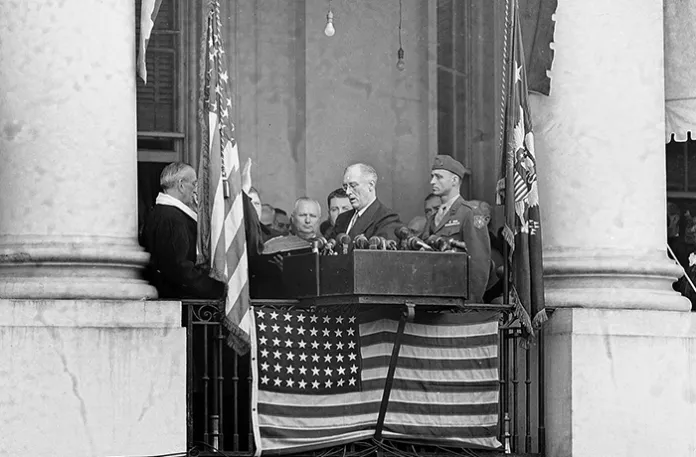
Americans were more receptive to a president like FDR to serve a third term, given his role in shepherding the nation through the Great Depression with his New Deal. Still, people across the political spectrum accused him of endangering the country’s democracy. Although there was no restriction on how many terms a president could serve back then, the country’s first president, George Washington, had established an unwritten two-term limit by stepping down after serving for eight years.
FDR’s Republican opponent, Wendell Wilkie, warned in a speech kicking off his 1940 campaign that if Roosevelt won the election, people would be “serving under an American totalitarian government before the long third term is finished.”
“He has lost his grip on our American principles,” Willkie said later in the campaign. “He gives lip service to them but does not know how to preserve them. He has put our democratic system in danger of its life.” Willkie even claimed the president was siding with fascists in Europe, alleging that Roosevelt “telephoned Hitler and Mussolini and urged them to sell Czechoslovakia down the river.”
But this went beyond partisan politics. Even FDR’s own vice president, conservative Democrat John Nance Garner, decided to run against him for the nomination that year, in part because of the president’s choice to seek a third term.
Meanwhile, the New York Times, which had endorsed Roosevelt in 1932 and 1936, sided with his Republican opponent in 1940.
“We believe that at a time when the traditional safeguards of democracy are falling everywhere,” the newspaper wrote in its Wilkie endorsement, “it is particularly important to honor and preserve the American tradition against vesting the enormous powers of the presidency in the hands of any man for three consecutive terms of office.”
“The doctrine of one man’s indispensability is a new doctrine for this country. It is a doctrine which less scrupulous men in Europe have used to root themselves in power,” the New York Times said, referencing the rise of fascism across the Atlantic.
The editors noted how the powers of the presidency had expanded (if they only knew what was coming down the pike after World War II), and expressed concern about what FDR would do with a third term:
These considerations are especially relevant when the particular President who now chooses to remain in office for a third term is the same President who has never surrendered voluntarily a single one of the vast “emergency” powers which Congress has given him. He is the same President who has shown himself so impatient of constitutional restraints that he was willing to circumvent the Supreme Court itself by adding enough members to it to give his own opinions a majority. In the defeat of Mr. Roosevelt and the election of Mr. Willkie, there is an opportunity to safeguard a tradition with the wisdom of long experience behind it.
(The Supreme Court plan the newspaper referenced was FDR’s ill-fated 1937 attempt to “pack” the Supreme Court with additional justices to get around rulings that had struck down key elements of the New Deal.)
Willkie wound up winning many other newspaper endorsements that year, but Roosevelt still soundly defeated him, with 449 electoral votes and 54.7% of the popular vote. Still, the margins were lower than his 1932 or 1936 victories.
A solemn inaugural
Two months later, when FDR took the oath of office on Jan. 20, 1941, war was looming. Although the president had pledged to keep the United States out of World War II, the country was playing a bigger role in helping Great Britain ward off a relentless attack by Nazi Germany. And Willkie, who had warned Americans that FDR would drag America into the war, soon became an FDR ally, playing a role as the president’s emissary to Britain shortly after the election. By the end of the year, the U.S. had joined the war following Japan’s attack on Pearl Harbor.
So, when FDR delivered his inaugural address on a sunny but blustery and bitterly cold Washington day, the parade featured processions of soldiers, tanks, and jeeps. In a newsreel showing him taking the oath of office, an announcer intones, “Thus the anti-third term tradition passes from American life,” as FDR “accepts with confidence and grace the honor which George Washington refused.”
In his inaugural speech, the president rallied Americans to defend democracy — the very institution opponents had accused him of undermining.
“There are men who believe that democracy, as a form of government and a frame of life, is limited or measured by a kind of mystical and artificial fate that, for some unexplained reason, tyranny and slavery have become the surging wave of the future — and that freedom is an ebbing tide,” he said. “But we Americans know that this is not true. Eight years ago, when the life of this republic seemed frozen by a fatalistic terror, we proved that this is not true. We were in the midst of shock—but we acted. We acted quickly, boldly, decisively … No, democracy is not dying.”
He used the word “democracy” nine times in his 16 ½-minute speech.
Ten months before the U.S. would enter the war, Roosevelt put Americans on notice of the challenges they faced.
“In Washington’s day, the task of the people was to create and weld together a nation,” he said.
“In Lincoln’s day, the task of the people was to preserve that nation from disruption from within. In this day, the task of the people is to save that nation and its institutions from disruption from without.”
The large crowd “listened today to President Roosevelt’s speech in grave silence, with only a few interruptions for cheers,” the New York Times reported. “The packed throng was sympathetic, but the display of enthusiasm which usually marks such an event was lacking.”
Having broken the two-term tradition, FDR ran again in 1944, this time as a wartime president. But he served less than three months of his fourth term, dying at the age of 63 in April 1945. It was left to Harry Truman to steer the country through the final months of World War II.
Bypassing the 22nd Amendment?
At the end of a Cabinet meeting last July, Trump talked about the presidential portraits he personally chose to hang in the Cabinet room. When he got to FDR’s, Trump expressed admiration for his longevity in office. “He was not a Republican, to put it mildly. But he was, you know, a four-termer,” Trump said.
The president, who has teased about the possibility of seeking a third term himself, seemed to rule that out with his Shermanesque comment to reporters in October: “I’m not allowed to run.”
But Alan Dershowitz, a constitutional scholar who served as defense lawyer during Trump’s 2020 impeachment trial, came bearing a gift for Trump at the White House Hanukkah party last month — a draft copy of his book, scheduled to be published in March.
“Most Americans are convinced that the 22nd Amendment to the US Constitution categorically prohibits a two-term president from serving a third term,” the book’s Amazon page says. “Professor Alan Dershowitz provides objective, nonpartisan, and astute constitutional analysis that not only challenges this belief but lays out exactly how Trump could become the forty-eighth president of the United States.” The book cover features a “TRUMP 2028” logo.
According to the Wall Street Journal, Dershowitz spells out in the book a plan for Trump to win a third term in which he’s declared the winner, and then members of the Electoral College abstain rather than vote for the next president, sending the election to Congress. “They then select, and not elect, the president,” the Wall Street Journal quoted him as saying.
At the same party, he showed a draft of the book to Miriam Adelson, an Israeli-American philanthropist and top Trump donor. Speaking at the podium with Trump on her side, Adelson said, “I met Alan Dershowitz. He said the legal thing about four more years. And I said, ‘Alan, I agree with you.’ So, we can do it!” At that point, a smiling Adelson turned and pointed to Trump and implored him, “Think about it.” A few people started chanting, “Four More Years,” but it was far from a full-throated roar.
Trump leaned in to hug Adelson, then told the crowd with a mischievous grin, “She said, ‘Think about it, I’ll give you another 250 million.’” Adelson replied, “I will give.”
If Trump does attempt a 22nd Amendment workaround, he’d be bucking his Republican predecessors from 75 years ago. It was the GOP that pushed the amendment in direct response to FDR’s third and fourth terms.
SAN FRANCISCO’S EMPTY REPARATIONS PROMISES
“The new amendment is a real victory for those who feared perpetuation of a president would lead only to dictatorship, tyranny, or worse,” Republican National Committee chairman Guy George Gabrielson said after it was ratified in February 1951. “This means that no president henceforth will decide all by himself that he is the indispensable man and therefore should run for a third, or even a fourth term. It means that the time-honored tradition set by George Washington will not be flouted again by personal ambition.”
“There is no place for kings or dictators in our republic.”
Frederic J. Frommer is a writer and sports and politics historian. He has written for the Washington Post, the New York Times, the Atlantic, History.com, and other national publications. He is the author of several books, including You Gotta Have Heart: Washington Baseball from Walter Johnson to the 2019 World Series Champion Nationals. He is working on a book about 1970s baseball.