
Secretary of State Marco Rubio revealed further insight into the United States’s plans for the decapitated government of Venezuela, which is intended to ultimately culminate in transition.
Speaking to reporters on Wednesday, Rubio said the “three-fold process” will amount to “stabilization” under the current regime headed by acting President Delcy Rodríguez, followed by “recovery,” and finally, a change in leadership.
“Step one is the stabilization of the country; we don’t want it descending into chaos,” Rubio said.
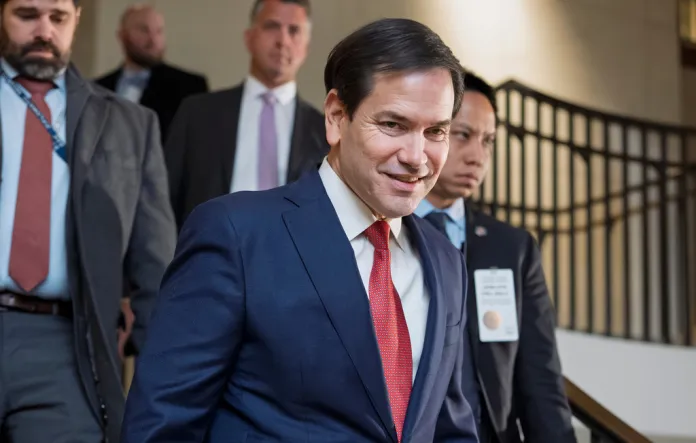
Citing the quarantine of Venezuelan imports and exports, Rubio said the seizure of “between 30 and 50 million barrels of oil” and sale thereof at “market rates” will be “dispursed in a way that benefits the Venezuelan people — not corruption, not the regime.”
Former Venezuelan dictator Nicolas Maduro, who is currently being held for trial in New York, is accused of holding his country hostage through corrupt and inefficient oil sales to sanctioned regimes such as Russia and Iran — enriching himself and wounding the oil-centric economy.
The hypothetical second phase of “recovery” aims toward “ensuring that American, Western, and other companies have access to the Venezuelan market that is fair.”
It would also begin the “process of reconciliation” within the country, so that “opposition forces can be amnestied and released from prison or brought back to the country to rebuild civil society.”
After these steps are accomplished, Rubio said, the U.S. can begin overseeing the process of “transition.”
“Some of this will overlap. I’ve described this to them in great detail,” Rubio said, referencing Rodríguez’s government. “We’ll have more details in the days to follow, but we feel like we’re moving forward here in a very positive way.”
Rubio did not clarify what a change of leadership would entail.
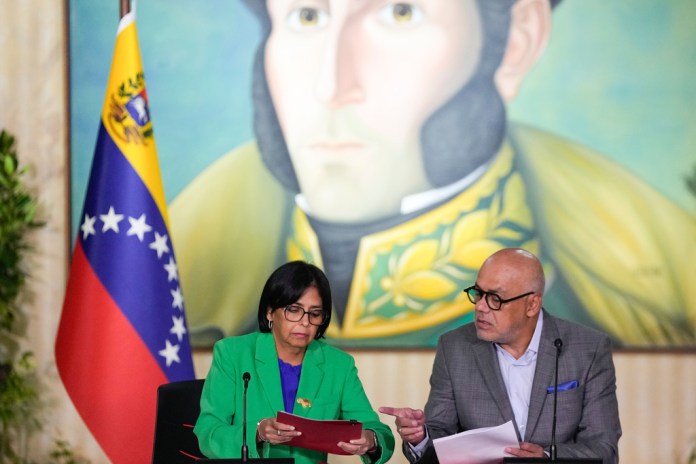
President Donald Trump has indicated that he will allow Rodríguez to continue as Maduro’s successor in the short term, saying she is “essentially willing to do what she thinks is necessary to make Venezuela great again.”
“She really doesn’t have a choice,” he said earlier this week.
Meanwhile, European leaders have distanced themselves from Maduro’s abduction and called for an immediate transition to democratic rule.
“It’s worth recalling that Nicolás Maduro lacked the legitimacy of a democratically elected leader, and therefore the events over the weekend provide the opportunity for a democratic transition led by the Venezuelan people,” European Commission Chief Spokeswoman Paula Pinho said Monday.
Pinho seemed to reference Edmundo González, widely believed by international bodies to have been the legitimate victor of the latest Venezuelan elections, when she endorsed the “possibility for those who have been democratically elected in Venezuela to actually be running the country.”
González, who lives in Spain in exile, has not publicly demanded to be installed as president. However, his priorities do seem to match those expressed by Rubio, as he previously called for “all Venezuelans who have been deprived of their freedom for political reasons” to be released.
Fellow opposition leader María Corina Machado, a former National Assembly member who won the Nobel Peace Prize in 2025 for her advocacy toward Venezuelan democracy, also appeared to be an obvious pick for the presidency until Trump shut the idea down.
“I think it would be very tough for her to be the leader,” Trump said, calling her a “very nice woman” who “lacks the support” necessary to lead Venezuela.
Energy Secretary Chris Wright indicated on Wednesday that the U.S. plans to maintain control over Venezuelan oil sales for the long term.
THE MAIN PLAYERS IN VENEZUELA’S GOVERNMENT AND WHO COULD BE TARGETED NEXT
“We’re going to market the crude coming out of Venezuela, first this backed up, stored oil, and then indefinitely, going forward, we will sell the production that comes out of Venezuela into the marketplace,” he said at Goldman Sachs’s Energy, CleanTech & Utilities Conference.
His comments followed the U.S. capture of an oil tanker earlier in the day that originated out of a Venezuelan port. The tanker, known as the Bella 1 or the Marinera tanker, was sailing under a Russian flag.