
EXCLUSIVE — The Trump administration on Tuesday began laying a wall of buoys in the Rio Grande, which serves as the international boundary between the United States and Mexico.
The Washington Examiner was the only news outlet on the ground in Brownsville, Texas, on Tuesday morning as contractors laid the first of 538 miles-worth of massive, floating cylinders down the center of the river.
The endeavor is one no other administration has attempted and represents a bold effort to prevent all illegal attempts by foreigners to pass through the dangerous waters of the river into the U.S.
Border Patrol Chief Michael Banks said the White House is dramatically changing how federal law enforcement approaches border security by preventing, rather than allowing, migrants to enter illegally.
“This is a huge game changer,” Banks said in an interview as construction crews lowered the first three buoys into the river. “We want to take away that initial entry point, right? You can’t come here and make false asylum claims if you can’t get here. And so our intent is to stop anything from crossing this border illegally.”
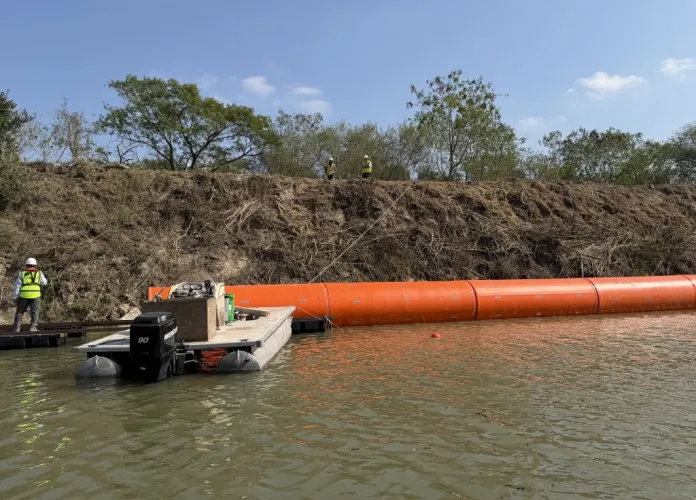
The Trump administration completed more than 450 miles of border wall projects on land during President Donald Trump’s first term in office. However, much of the wall that was erected, particularly in flood-prone southeast Texas, was placed hundreds of feet to more than a mile north of the border because land near the river was unsuitable for the wall.
By law, Border Patrol agents must apprehend, detain, and either release into the country or tee up for removal any person who illegally crosses the border. The buoys will prevent those illegal entries in the first place.
Once fully installed, the buoys could have long-term effects by reducing the number of people entering federal custody, being detained, appearing in immigration court, and being involved in deportation proceedings.
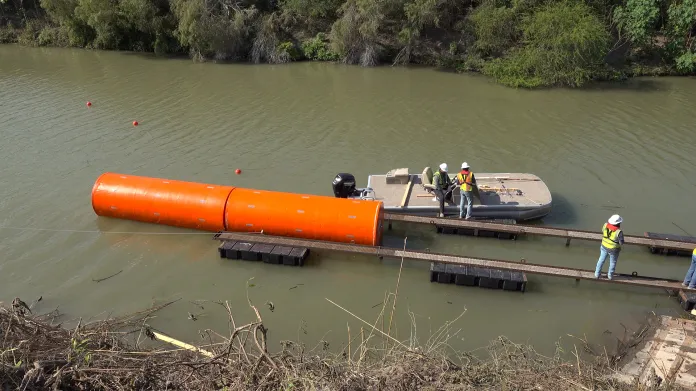
A floating wall
Banks first disclosed in December that the federal government would soon employ a water-based defense system resembling an existing mile-long buoy project that the state of Texas decided to install in the same river during the Biden administration.
Currently, the Border Patrol has 538 miles of buoy barrier, funded through congressional appropriations made in 2025. Of that figure, 130 miles have been contracted out, including the 17-mile stretch of buoys going in along Brownsville, according to Banks.
Brownsville is located several miles west of where the Rio Grande meets the Gulf of America. For decades, this part of Texas has seen more illegal immigrant arrests by Border Patrol than any other part of the nearly 2,000-mile border.
The buoys, Banks said, will prevent such situations in the future. The buoys are anchored deep in the soil beneath the river, preventing people from swimming under. Should someone still manage to breach them, the buoys have tamper devices to alert agents. Border Patrol also still has a wall on land that serves as a second barrier, preventing violators from making quick escapes.
“These are 15-feet-long buoys, and they connect to each other, and they sit on a ratchet system,” Banks said. “So what happens when someone tries to climb onto that buoy? They can’t. It rolls back on them, right? It prevents them [from] coming in.”
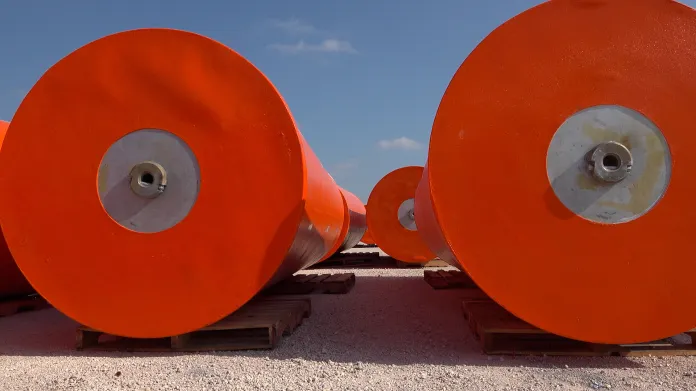
How the buoys came to be
The buoys are not a new concept. In January 2023, Gov. Greg Abbott (R-TX) tapped Banks, a recently retired Border Patrol agent, to oversee the state’s border security efforts as illegal crossings surged during the Biden administration to as high as 250,000 arrests per month.
Border Patrol was already looking into a floating barrier during Trump’s first term in office, but the plans never took hold because former President Joe Biden opposed continuing any type of barriers.
Texas independently financed a 1,000-foot string of buoys between the city of Eagle Pass and the Mexican city of Piedras Negras, Coahuila, in 2023. As illegal crossings soared in that region, so did rescues and drownings.
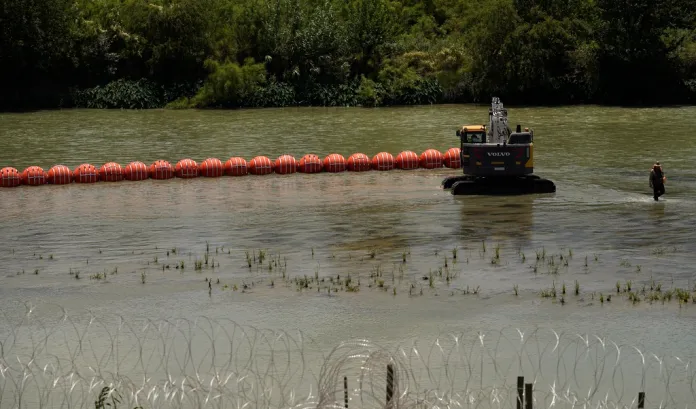
Banks and Abbott met with Trump in February 2024, when the then-presidential candidate visited Eagle Pass, and showed him the buoys.
“[Trump] got to witness them firsthand,” Banks said in a December interview. “He’s been impressed with them.”
Trump moved Banks into his administration as the head of Border Patrol in January.
Trump is “very aware” of the buoy project and has endorsed the massive expansion, Banks said.
Rep. Tony Gonzales (R-TX), who represents Eagle Pass, said the existing and additional buoys are a way to prevent illegal crossings and, in turn, drownings.
TRUMP ADMINISTRATION QUIETLY PURGES ICE LEADERS IN FIVE CITIES: SOURCES
Although nearly all House and Senate Republicans voted to fund the buoys in the One Big Beautiful Bill Act last summer, no Democrats supported the funding. The top Democrat on the House Homeland Security Committee said taxpayer money should be appropriated for other items.
“Obviously, the money for this vanity project would be better spent reducing healthcare premiums for Americans,” Rep. Bennie Thompson (D-MS) said in a statement.