
Global powers aligned against the Western bloc, led by the United States, see President Donald Trump’s implementation of the Monroe Doctrine as a glaring indicator that the rules-based world order is crumbling.
The Monroe Doctrine, named for and implemented by President James Monroe in 1823, established that the U.S. would take action to prevent colonization of foreign nations in North and South America. Trump has resurrected this imperative since taking power in his second term, with his State Department explicitly declaring: “This is OUR Hemisphere, and President Trump will not allow our security to be threatened.”
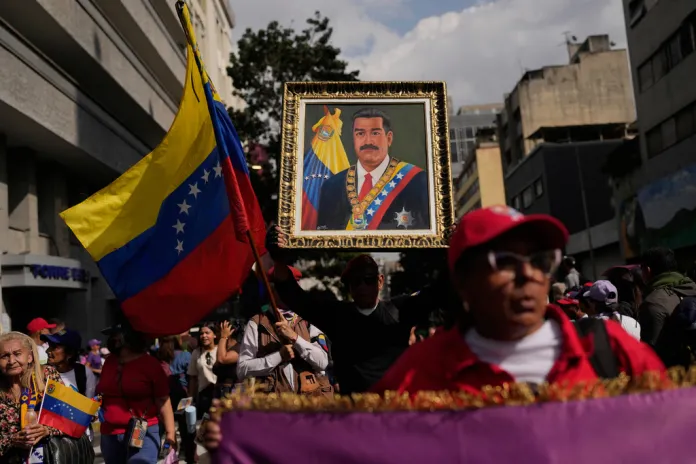
Chief among the administration’s move in embracing the focus on the Western Hemisphere: Capturing and arresting former Venezuelan dictator Nicolas Maduro.
Russia and Iran have been among the most prominent critics of Trump’s operation against Maduro, undoubtedly due in part to their vested interests in sustaining an allied regime so close to the U.S.
“We had Russian and Iranian interests that were looking to diversify, to be able to beat sanctions — whether it’s by the ghost fleet delivering the oil, or the money-laundering exercises that would get around the sanctions that were meant to put penalties in place for the rogue activity of the Venezuelan regime,” Steven Yates, a senior research fellow for National Security Policy at the Heritage Foundation, told the Washington Examiner.
“And to a degree, the Russians and Iranians, they were violating international norms and face sanctions themselves. So this does strike a blow to the sort of axis of do-no-gooders that were trying to seek advantage in our own hemisphere,” Yates continued. “And also seeking to skirt responsibility for the things they were doing — whether it’s Russia versus Ukraine, or Iran versus a number of different counterparts […] in the Middle East.”
The Atlantic Council asserted in a November 2025 report that Russia has been a “vital source of military and economic aid for Venezuela” since coming to Maduro’s aid in 2000.
“In return for arms and money, Russia gains a significant foothold in South America, helping to fulfill Putin’s ambitions of making Russia a great power and challenging the United States in its own hemisphere,” the Atlantic Council explained. “Russia’s support for Venezuela furthers the Kremlin’s ability to act as a spoiler for U.S. interests, and it has the potential to pull U.S. attention and resources away from opposing Russian aggression in Ukraine and elsewhere in Europe.”
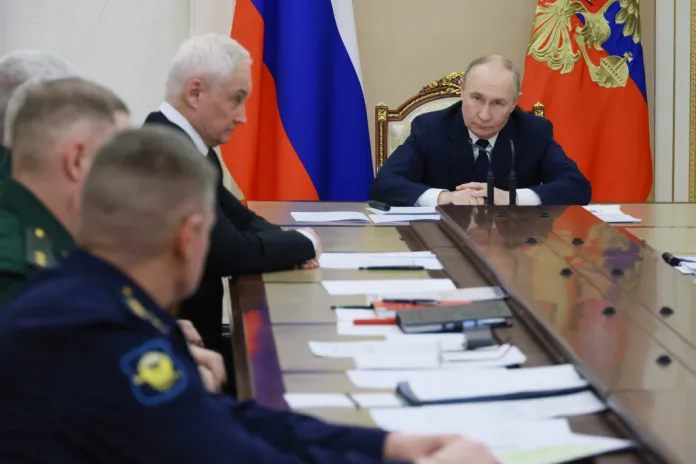
The Kremlin has voiced outrage at the abduction of Maduro, characterizing it as evidence that “there is basically no international law.”
The question in Russian strategists’ minds is whether the U.S. will allow other world powers to implement similar policies of regional domination.
“There is only the law of force — but Russia has known that for a long time,” former Kremlin adviser Sergei Markov told Reuters on Tuesday. “Is the United States really ready to recognize Russia’s dominance over the former Soviet Union, or is it simply that the United States is so strong that it will not tolerate any great powers even close to it?”
The Chinese are similarly upset by the resurrection of the Monroe Doctrine.
“The U.S.’s move is in clear violation of international law, basic norms in international relations, and the purposes and principles of the UN Charter,” Ministry of Foreign Affairs spokesman Lin Jian told reporters on Monday. “China calls on the U.S. to ensure the personal safety of President Nicolás Maduro and his wife, release them at once, stop toppling the government of Venezuela, and resolve issues through dialogue and negotiation.”
China has been the primary purchaser of Venezuelan oil since 2016, buying up approximately 80% of the country’s gross production at highly discounted prices. It is not a foundational cut of the Chinese oil economy, but the full extent of its impact is difficult to trace due to the laundering of oil through Chinese “teapot” refineries that rebrand it as outside oil.
Beijing has lambasted the Trump administration for decapitating the China-friendly government, scolding its U.S. counterparts in moralized, legalistic messages characteristic of the Chinese Communist Party.
“As the US military reinforces its deployments in the region and tit-for-tat interception operations become normalized, the risk of miscalculation or accidental incidents involving frontline personnel on both sides will rise sharply,” Cui Shoujin, the director of Renmin University of China’s Institute of International Development Studies, warned in the Beijing-operated news outlet Global Times on Wednesday.
Observers have speculated that the invasion of Venezuela could invigorate paramount leader Xi Jinping’s timeline to act on his own goal of annexing the island of Taiwan.
Jack Burnham, an analyst for the China Program at the Foundation for Defense of Democracies, told the Washington Examiner that the Communist Party is unlikely to take drastic action in response to a display of American intervention.
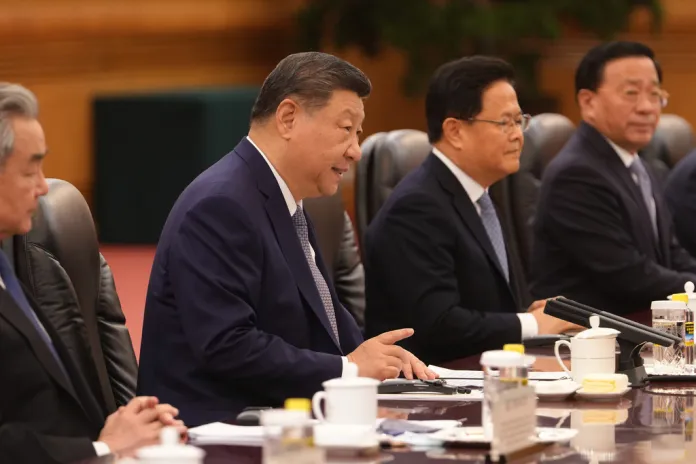
“China’s perspective on the international system is fundamentally revisionist, rooted in power over principle,” Burnham told the Washington Examiner. “Across its foreign policy, Beijing speaks the language of strength, building up its military, safeguarding its economic self-sufficiency, and increasingly preparing for the possibility of conflict within its own region.”
He continued, “Trump’s moves towards Venezuela won’t move up Xi’s timeline for Taiwan; rather, Beijing will treat it as a reminder of the underlying righteousness of its perspective and a call to prioritize its capacity to project power.”
While Trump’s National Security Strategy does place a heightened focus on the western hemisphere — calling for “a Hemisphere whose governments cooperate with us against narco-terrorists, cartels, and other transnational criminal organizations” — the administration’s policy doesn’t turn a blind eye to interests in other regions.
Iran, another major partner of Maduro, is currently suffering a groundswell of popular protest against their ruling Islamic regime.
Trump has explicitly threatened to “come to [protesters’] rescue” if Supreme Leader Ali Khamenei’s military resorts to violence against the demonstrations.