
The Venezuelan government reasserted its control over Caracas with military and paramilitary troops after the United States snatched its head of state on Saturday.
Caracas has been in disarray since the U.S.’s daring operation on Saturday, which saw U.S. aircraft and special forces bomb the capital, seize Venezuelan President Nicolas Maduro from one of the most heavily fortified positions in the country, then fly out without suffering a single death. The crippled government is seeking to regain its footing, deploying large numbers of military and paramilitary personnel to secure the capital.
VENEZUELA OPPOSITION LEADER MARIA MACHADO SAYS US ‘FULFILLED ITS PROMISE’ AFTER MADURO CAPTURE
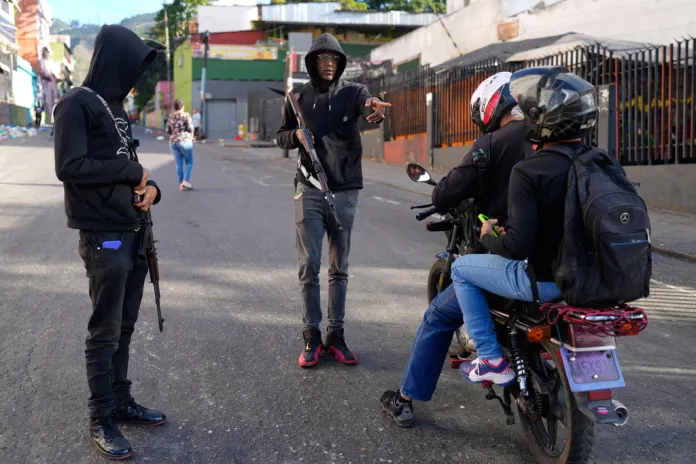
Videos of Venezuelans pouring into the streets to celebrate were broadcast on social media, but most of these took place among the diaspora. Much of Caracas itself resembled a ghost town on Saturday and Sunday, with mostly government-aligned forces patrolling the streets.
Some of the most omnipresent were colectivos, pro-government paramilitaries who play a key role in keeping the government afloat. Many Venezuelans skipped work on Saturday out of fear of harassment from the colectivos, the Financial Times reported.
MADURO ABDUCTION COINCIDES WITH ANNIVERSARY OF NORIEGA RAID IN PANAMA
A motorcycle taxi driver told the outlet that colectivos were harassing everyone they found outside, especially in working-class neighborhoods, forcing many people to return home.
The heavy-handed response is intended to maintain the decapitated government’s fragile hold on power as confusion reigns as to who is in charge and what comes next. It’s likely intended to discourage any popular uprising from opposition forces looking to take advantage of the chaos.
The relative desertion of the streets shows the strategy has paid off. Though embroiled in chaos and uncertainty, having suffered one of the greatest humiliations possible, Maduro’s government is in a much better position than the early hours of Saturday, exercising full control over the nation’s main power center.
Most shops were closed in the days following the attack, while small crowds clamored to stock up on goods at supermarkets.
The primary means of transportation in Caracas, the metro, was out of service after the attack, while buses also ceased operation, El Spectator reported.
Vice President Delcy Rodriguez took de facto power after Maduro’s capture, though she insisted that the imprisoned dictator is still in charge of the country. Contradictory statements from her and Washington have only added to the confusion.
TOM ROGAN: CAPTURING MADURO WAS THE EXTRAORDINARILY CHALLENGING BUT EASIER PART
“There is only one president in this country, and his name is Nicolás Maduro,” she said in a televised appearance, flanked by Maduro’s Cabinet. “We will not be anyone’s colony; what is being done to Venezuela is barbaric.”
Her comments are a far cry from President Donald Trump’s characterization of her on Saturday, during which he said the U.S. would “run” Venezuela “until such time as we can do a safe, proper, and judicious transition.”
“She is essentially willing to do what we think is necessary to make Venezuela great again,” Trump said of Rodriguez at a press conference.
Rodriguez is a rare figure in the Venezuelan government with widespread respect, having stabilized the country’s oil industry during its unparalleled economic crisis. Washington’s comments implied that she would serve as a de facto puppet ruler, but even if she’s sympathetic to such an arrangement, she must tread carefully so as not to anger the security establishment, which controls most levers of power.
Washington is betting that the shock and awe of Saturday’s operation and the threat of further action will force her to kneel to U.S. demands, senior U.S. officials told the New York Times.
“I’m not claiming that she’s the permanent solution to the country’s problems, but she’s certainly someone we think we can work at a much more professional level than we were able to do with [Maduro],” an official told the outlet.