
A federal judge said Tuesday he expects to decide within “the next day or two” whether Brian Cole Jr., the Virginia man accused of planting pipe bombs outside the Democratic and Republican National Committee headquarters on the eve of Jan. 6, 2021, should be released to home detention as he awaits trial.
“I’m going to take this matter under advisement,” U.S. Magistrate Judge Matthew J. Sharbaugh said at the close of a lengthy detention hearing. “I am sensitive to the urgency of this issue, and I do intend to get a ruling out expeditiously.”
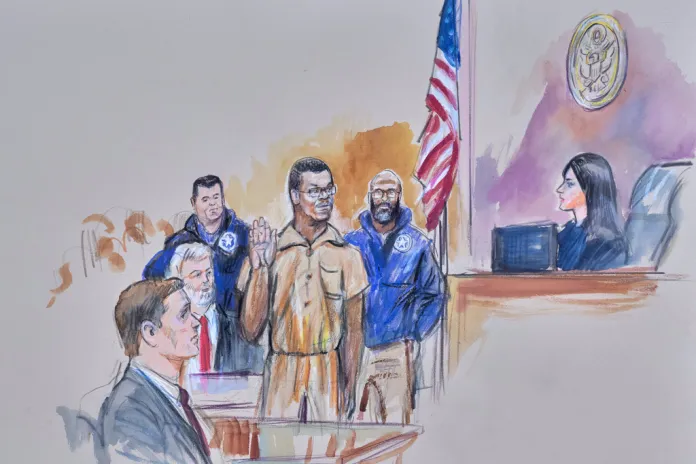
Sharbaugh indicated that the case likely requires Cole’s detention under federal law, given the nature of the charges, but repeatedly pressed both sides on whether stringent release conditions could adequately address public safety concerns.
Prosecutors urged the court to keep Cole, 30, detained, arguing that he confessed to the offenses, planned political violence, repeatedly destroyed possible evidence, and concealed his activities from those closest to him for years. Cole was present in court on Tuesday, wearing khaki-colored prison clothing, and sat alongside a four-person defense team at his table.
Representing the government, prosecutor Charles Smith said Tuesday in court that Cole “wiped,” or factory reset, his cellphone hundreds of times, including the morning of his arrest, and continued purchasing materials consistent with explosive components for more than a year after the alleged Jan. 5, 2021 offense.
The government warned that releasing Cole would effectively place him back into circumstances similar to those in which prosecutors say he planned and carried out the alleged offenses, raising doubts about whether he could be trusted to comply with monitoring conditions.
Cole’s lead defense attorney, Mario Williams, countered that Cole has no criminal history, lived openly in Virginia for years without incident, and never caused property damage or physical harm. Williams said Cole has “Level 1” autism and disputed the government’s reliance on cellphone deletions as evidence of Cole’s guilt, arguing prosecutors have not identified any additional devices, communications, or conspiratorial activity.
As part of the defense’s bid for release, Cole’s grandmother, who was addressed in court as “Ms. Loretta,” testified about her ability to supervise him as a third-party custodian if he were allowed to live with her in Gainesville, Virginia, around 25 miles from where Cole was arrested at his family’s home in Woodbridge earlier this month.
The defendant’s grandmother told the court she lives in a gated community with 24-hour security, exterior surveillance cameras, and a home alarm system. She said Cole has lived his entire life in Virginia and would remain with her under home confinement, with a designated space inside the house to work if permitted.
“I would definitely check up on him,” she said. “He would be with me.”
Sharbaugh questioned Cole’s grandmother closely about her willingness to act as the “eyes of the court,” including whether she would report violations involving her own grandson. She said she understood the responsibility and would notify the court if she believed Cole was doing something wrong.
The judge also asked whether firearms were present in the home. She said her husband, a former law enforcement officer, may own one and agreed it could be removed if required.
During cross-examination, prosecutors asked Cole’s grandmother whether she was familiar with online platforms such as Reddit and Discord, both of which were frequented by Cole. She said she was not, underscoring the government’s concern that Cole previously engaged in online activity unknown to family members.
Sharbaugh acknowledged Cole’s lack of criminal history as a “significant distinction” from many defendants who appear before the court, but emphasized the seriousness of the alleged conduct, noting the Department of Justice’s argument that the pipe bombs’ failure to detonate was “more a matter of fortune than favor.”
The detention hearing unfolded alongside a separate procedural dispute in Washington, D.C. courts surrounding whether the court can accept a two-count indictment returned this week by a D.C. Superior Court grand jury — an issue tied to an unresolved appellate case unique to the District of Columbia. Sharbaugh said he has not yet decided whether to accept the indictment and plans to resolve that question promptly.
Earlier in the hearing, the judge denied a defense motion seeking to compel exculpatory materials and other evidence, finding the request premature and stating that the information sought is material he would expect the government to provide in due course.
Cole is charged with transporting an explosive device in interstate commerce with the intent to kill, injure, or intimidate, and attempted malicious destruction by means of fire or explosives. The pipe bombs were discovered on Jan. 6, 2021, and did not detonate, a key distinction that was on Sharbaugh’s mind Tuesday when making his consideration of whether to grant Cole’s supervised release.
JAN. 6 PIPE BOMB SUSPECT FIGHTS DOJ DELAY IN TURNING OVER EVIDENCE
“They didn’t detonate, thankfully,” the judge repeatedly said, while asking the government to speak about whether the bombs would have caused any damage. Cole’s defense team stressed their belief that the bombs were “not viable.”
Sharbaugh did not rule from the bench on Cole’s release, leaving him in custody as the court considered whether home detention and strict supervision would be sufficient pending trial.