
Secretary of State Marco Rubio on Friday offered his most explicit appeal yet for European nations to stop the “erasure” of their cultural inheritance via mass migration, warning that importation of millions of foreign nationals could undermine NATO.
Rubio told the Washington Examiner at a press conference that NATO, sometimes referred to as the “Western Alliance,” could be hollowed out if Europe does not stay culturally Western.
“You go to these NATO meetings, what they will tell you is — ‘our shared history, our shared legacy, our shared values, our shared priorities.’ That’s what they talk about as the reason for this alliance,” Rubio told the Washington Examiner. “Well, if you erase your shared history, your shared cultures, your shared ideology, your shared priorities, your shared principles — then you just have a straight-up defense agreement. That’s all you have.”
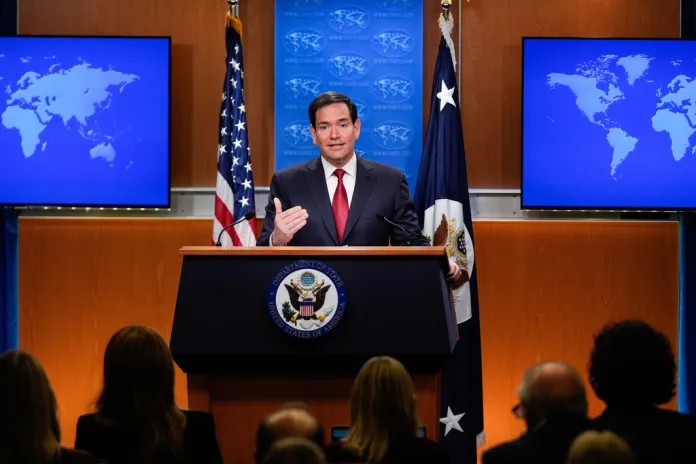
“What we’re pointing to here is that we are concerned, and particularly in parts of Western Europe, those things that underpin our alliance and our tie to them could be under threat in the long term,” Rubio explained. “And by the way, there are leaders in those countries that recognize that as well. Some say it openly, some say it privately. In the eastern and southern part of Europe, they’re much more open about it. Nonetheless, it is a factor that needs to be addressed.”
President Donald Trump’s administration has been frustrated for months in its efforts to court European nations into a more comprehensive agreement on shared Western values.
In a somewhat carrot-and-stick approach, Trump and his officials have characterized the United States as “sentimentally attached to the European continent” and concerned about “loss of national identities and self-confidence,” while also being outraged at the countries’ unwillingness to address their societal ills.
In the White House’s latest National Security Strategy, the administration stated bluntly that it fears the prospect of “civilizational erasure” in Europe, believing that “should present trends continue, the continent will be unrecognizable in 20 years or less.”
An Australian reporter asked the state secretary earlier in the conference for comment on the suspected Islamic terrorists who have been charged with perpetrating the Bondi Beach massacre, citing the references to “civilizational erasure” in the NSS.
“Mass migration is a negative thing … and it’s very difficult for any society to absorb and assume hundreds of thousands, if not millions of people over a short period of time — especially if they come from halfway around the world,” Rubio told the reporter. “There are cultural and assimilation issues related to that.”

Rubio spoke at length about his belief that America is the “interior” of “shared culture, a shared civilization, a shared experience, and shared values and principles — on things like human rights, on freedom, on liberty, on democracy, and … on the rights of the individual” — principles first birthed in Western Europe.
Stretching all the way back to classical history, Rubio said, “Anyone who doesn’t recognize, for example, that many of the features of our system of government find their root in Roman and Greek history is a fool.”
Rubio refused to weigh in on “whatever internal politics causes people to dispute this,” but warned that those shared values are “at the core of these special relationships we have” in Europe.
“If you take that away, if that’s wiped out because, for whatever reason, it’s no longer a priority — I do think it puts a strain and threatens the alliance in the long term and in the big picture,” Rubio warned.
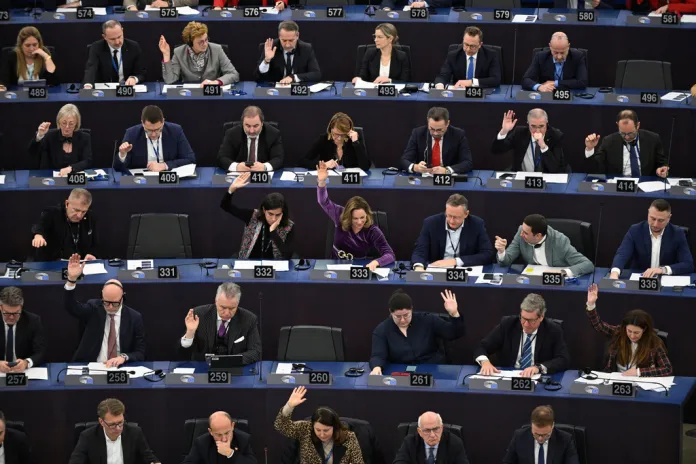
European leaders have been outraged by rhetoric from the U.S. regarding its long-term stability and lack of “civilizational self-confidence.”
German Chancellor Friedrich Merz called portions of the NSS “unacceptable … from the European point of view,” saying the document showed him Europe “must become much more independent from the U.S. in terms of security policy.”
EUROPE TURNS ON FREE SPEECH AND THE WEST
European Council President António Costa said European leaders “cannot accept” the “threat of interference in Europe’s political life.”
Rubio’s Friday press conference proved to be a marathon as the state secretary tried to answer at least one question from each outlet present, going reporter by reporter through the seats. The conference, the first held by the department in months, lasted approximately two hours.