
When President Donald Trump issued an executive order in May that would expedite the approval of nuclear reactors and loosen some regulations surrounding them, Ernest Moniz — who was energy secretary during the Obama administration — was quick to criticize.
“Reorganizing and reducing the independence of the [Nuclear Regulatory Commission] could lead to the hasty deployment of advanced reactors with safety and security flaws,” Moniz said in a statement published in Reuters and the Washington Post. “A major event would, like those in the past, increase regulatory requirements and set back nuclear energy for a long time.”
In their coverage of Moniz’s criticism, however, Reuters and the Washington Post did not mention the possible conflict of interest stemming from the former energy secretary’s extensive financial ties to the oil and gas industries — direct competitors to nuclear power.
Moniz has, since his 2017 departure from the federal government, found himself deeply entangled with oil and gas through an array of business and philanthropic ties, as well as personal investment holdings. Even before his ascent to energy secretary, Moniz was controversial among progressives owing to his prior advisory work for energy companies such as British Petroleum and General Electric.
The former secretary of energy’s links to the fossil fuel industry strengthened quickly after he left his government post.
In early 2018, Southern Company invited Moniz to join its board of directors, an offer he promptly accepted. At the time of Moniz’s joining, Southern Company was providing customers in the American Southeast with power, 76% of which was generated by coal and natural gas, according to corporate records. Between 2018 and his departure in May 2024, Moniz collected an annual six-figure salary, as well as a large sum of stock in the company.
Per a company document, Moniz held 21,665 shares at the time of his departure in 2024, which would have been worth about $1.7 million at the time. If Moniz has held on to his stake, it would be worth approximately $1.9 million today. This represents a strong interest in the proliferation of fossil fuels, as Southern Company’s most recent corporate filing available shows that the firm generated 58% of its power using natural gas, 18% with coal, and just 20% with nuclear during 2024.
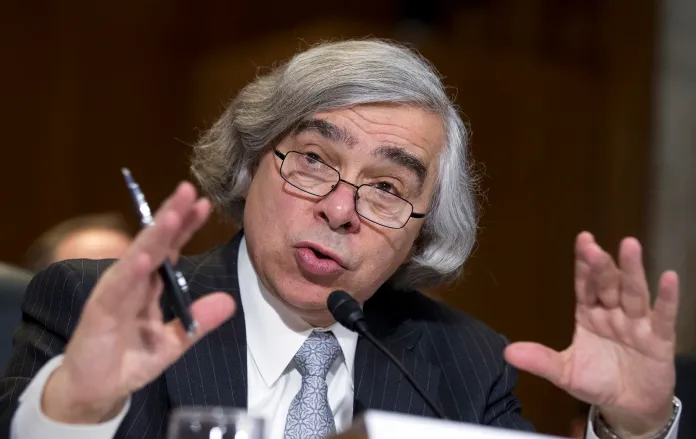
Some viewed Moniz securing a job with the Southern Company with skepticism, given that his Department of Energy had approved a $6.5 billion loan guarantee for the firm just a few years before he would go on to accept a leadership position within it.
Salary and stock aren’t the only ways Southern Company has ingratiated itself with Moniz. Between 2019 and 2023, tax filings show that the firm’s charitable arm pumped $400,000 into the Nuclear Threat Initiative, a nonprofit organization where Moniz has served as CEO since 2017.
The oil and gas industry has taken an explicit and public interest in Moniz’s philanthropic work.
In April 2024, the EFI Foundation — which Moniz founded in 2017 and leads to this day — released a report titled “The Future of Natural Gas in a Low-Carbon World,” arguing that natural gas is a sustainable resource that will play an important role in achieving lower global emissions. It enjoyed a high-profile release event on Capitol Hill, where it was presented by Moniz, flanked by Sen. Lisa Murkowski (R-AK) and then-Sen. Joe Manchin (D-WV), the former representing a state with an economy heavily dependent on natural gas and the latter having been the largest recipient of the industry’s money in Congress.
The report came at a pivotal time, as the Biden administration had just paused approvals for new natural gas exports to give the Department of Energy time to weigh the climate effects of the fuel source, sending shockwaves throughout the industry.
Moniz’s conveniently timed report, it so happens, was paid for by oil and gas companies.
The report’s “sponsors” section lists natural gas giant Chesapeake Energy, the American Petroleum Institute, Venture Global LNG, and the Cynthia and George Mitchell Foundation — a charitable foundation that takes its name from the “father of fracking” — among its funders.
While the report stresses that the EFI Foundation maintained “editorial independence from its public and private sponsors,” representatives from Chesapeake Energy and Venture Global LNG both provided subject matter expertise for the study.
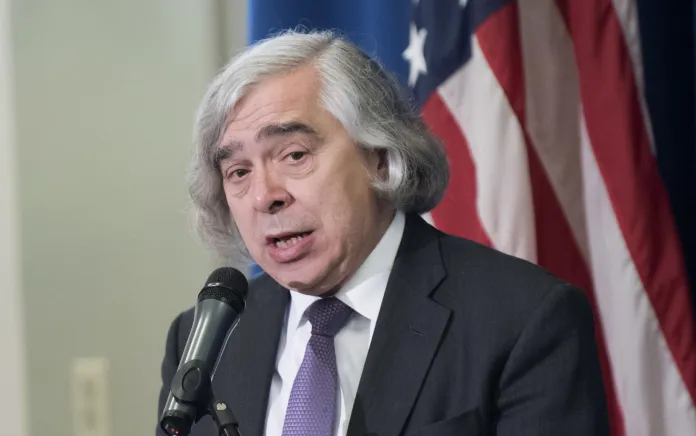
Nonprofit groups and publicly traded companies are required by law to disclose reams of information about their finances. The activities of privately held companies, meanwhile, are far more opaque.
Enter EJM Associates.
EJM Associates is an environmental consulting firm founded and led by Moniz that provides consulting services for players within the energy sector. By virtue of being a privately held firm, its client list isn’t publicly available. Some clues, however, can be pieced together from scouring press releases.
In 2017, Dentons and McLarty Associates, a pair of firms that do lobbying work, each announced that they would enter partnerships with EJM Associates so that it could provide their clients with advice on energy policy. Many of the clients that EJM Associates was being paid to be available for were in the oil and natural gas industry.
Dentons, for its part, has represented firms such as China National Petroleum, China National Oil and Gas Exploration Development Company, the Canadian Association of Petroleum Producers, British Petroleum, Spanish oil giant Repsol, and Keystone XL owner TransCanada. McLarty Associates, meanwhile, has worked with Russian state-owned gas conglomerate Gazprom, Shell, and French oil company Maurel & Prom.
Like some of the clients served by Dentons and McLarty Associates, some of the organizations Moniz has entangled himself with have links to state actors with a vested interest in the promotion of oil and natural gas.
Moniz, for example, sits on the board of the Cyprus Institute, a think tank backed by the Cypriot government. Cyprus has large natural gas reserves. He is also on the board of TAE Technologies, a nuclear power firm that received early funding from Rusnano Group, a state-backed Russian investment firm. Oil and gas account for roughly 20% of Russia’s gross domestic product.
CONGRESSWOMAN INTRODUCES PHARMA LEGISLATION THAT COULD BENEFIT HER FAMILY AND DONORS
“It is alarming that a former U.S. Energy Secretary has used his post-government career to build a foreign-linked consulting network that now shapes American energy policy from the shadows,” American Energy Institute CEO Jason Isaac told the Washington Examiner. “Moniz’s firms and nonprofits have taken funding tied to foreign adversaries, while advancing policies that weaken U.S. energy security and align with the interests of his political and ideological patrons. Despite being a nuclear physicist, Moniz has repeatedly promoted alternatives to nuclear power that mirror the financial interests of his clients. Policymakers deserve full transparency from anyone wielding this level of influence over America’s energy future.”
Moniz and EJM Associates did not respond to requests for comment.