
The FBI‘s decision to announce and then release a person of interest detained in the deadly shooting at Brown University has reignited criticism of FBI Director Kash Patel‘s public-facing leadership, even as law enforcement officials stress the bureau acted on a credible tip and followed standard investigative steps that often unfold behind closed doors.
Rhode Island authorities said late Sunday that a 24-year-old man detained earlier in the day would be released after investigators determined evidence “points in a different direction,” renewing the manhunt for the shooter who killed two students and wounded nine others during a review session for an introductory economics final exam on Saturday afternoon.
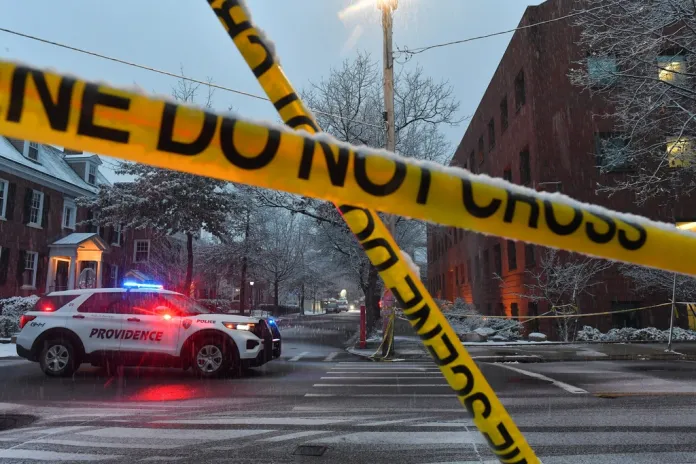
“Evidence now points in a different direction,” Gov. Dan McKee (D-RI) said at a Sunday night news conference, confirming that the individual initially held in custody was no longer connected to the attack.
Providence Police Chief Oscar Perez said the lead that prompted the detention was first fielded by the FBI before being acted on jointly with local authorities.
Wow the Providence Chief of Police just completely threw Kash Patel under the bus and revealed the FBI handled the person of interest (whose name was leaked to the press) before being released. https://t.co/qIcaC9Ejyy pic.twitter.com/qXUGIxIGJY
— CALL TO ACTIVISM (@CalltoActivism) December 15, 2025
“It was actually picked up by the FBI, and they followed through with it, and they ended up coming and locating this individual of interest,” Perez said.
Earlier Sunday, Patel touted the FBI’s response in a lengthy social media post, detailing the establishment of a command post, the use of cellular geolocation analysis, coordination with U.S. marshals and local police, and the deployment of forensic and victim-assistance resources. Patel said the FBI would continue a “24/7 campaign until justice is fully served.”
An update on the @FBI response at Brown University:@FBIBoston established a command post to intake, develop and analyze leads, and run them to ground.
We activated the FBI’s Cellular Analysis Survey Team, to provide critical geolocation capabilities.
As a result, early… pic.twitter.com/KONDEbrduR
— FBI Director Kash Patel (@FBIDirectorKash) December 14, 2025
However, within hours, officials acknowledged that the individual would be released, prompting criticism over the FBI’s public messaging.
Former FBI special agent Stuart Kaplan told the Washington Examiner that, in his view, the bureau’s mistake was not detaining and interviewing a person of interest, but broadcasting the development publicly before confirming it.
“People of interest are picked up all the time,” said Kaplan, who left the FBI in 2006. “We debrief them, we interview them, and if facts indicate this is the wrong person, they’re cut loose. That happens each and every day.”
Kaplan said the FBI’s increasing tendency to provide real-time updates during active investigations has eroded public confidence and created unnecessary backlash when early leads fall apart. For Patel, the Brown University investigation is not the first time his public commentary has gotten ahead of the FBI’s operations.
On Halloween, Patel announced that the FBI thwarted a possible terrorist plot in Michigan. The case later resulted in criminal charges but drew backlash after defense attorneys and local officials said the director’s initial description overstated the threat before prosecutors filed charges. Days later, two men were charged in connection with the alleged violent plot, and three more were arrested on Nov. 6, days after Patel made his announcement.
Kaplan, who began working at the FBI in 1995 for the New York FBI’s Special Operations Division, said in his “heyday, the director of the FBI would remain behind the curtain.”
“This play-by-play culture does a disservice to the agency. You tell the public the threat is over, and then suddenly you’re left with egg on your face,” he added.
Kaplan also criticized the decision to signal that the campus and surrounding community were no longer at risk following the detention, calling it a “bigger blunder” that compounded the embarrassment once the individual was released.
Some critics on social media argued that the FBI moved too quickly to claim progress while the suspect remains at large. Several pointed to Patel’s public post as emblematic of a broader pattern of premature announcements in high-profile cases.
Following the death of Turning Point USA co-founder Charlie Kirk, Patel posted to X that a “subject” responsible for the murder of Kirk was in custody. Hours later, he retracted the post and said the person was released after interrogation. Another 33 hours passed before law enforcement arrested 22-year-old Tyler Robinson, the defendant now facing a possible death sentence if found guilty by a jury in Utah for allegedly assassinating Kirk.
Law enforcement experts have cautioned that acting on tips that later prove incorrect is an unavoidable reality in fast-moving manhunts, particularly after mass-casualty attacks. Detentions based on evolving evidence are not unusual, but publicizing them can magnify missteps that would otherwise not garner as much attention.
Patel has not said whether the case has been resolved or minimized the reversal. His statement emphasized coordination with state and local partners and urged the public to continue submitting tips, images, and videos through the FBI’s digital intake portal. The bureau has established an online form for the public to submit tips that could become possible leads as the manhunt continues.
The recent shooting has shaken the Brown University community and drawn national attention in part because one of the victims, Ella Cook, 19, was vice president of the school’s Republican club. University officials canceled exams and moved classes online as authorities continue searching for the shooter.
WHAT WE KNOW SO FAR ABOUT THE BROWN UNIVERSITY SHOOTING
As the investigation continues, Patel faces a familiar challenge: balancing transparency with restraint while leading an agency under intense political scrutiny and proving that early missteps in messaging do not derail the pursuit of justice.
A spokesman for the FBI did not respond to a request for comment.