
Chinese authorities on Monday convicted a leading pro-democracy activist in Hong Kong on charges of publishing “seditious” material and colluding with foreign entities.
Jimmy Lai’s conviction marks Beijing’s intensifying crackdown on dissent in Hong Kong, which was a British colony until 1997. The Chinese territory had maintained a semblance of Western-style liberties and was noted for its semi-autonomous status, but it has in recent years been increasingly targeted by Beijing authorities.
Lai, 78, is a British citizen known for running the Hong Kong newspaper Apple Daily, which is recognized for being critical of China’s ruling Communist Party. He has already spent nearly five years in solitary confinement at a maximum security prison after initially being detained in 2020.
Lai, who pleaded not guilty, now faces life in prison after the landmark national security trial concluded he was guilty of two charges of colluding with foreign forces under the national security law, as well as a charge of conspiracy to publish seditious materials under legislation from Hong Kong’s time as a British colony.
The United Kingdom’s Foreign, Commonwealth & Development Office responded to Lai’s conviction by renewing calls for the law to be repealed as Britain condemned the “politically motivated persecution” of Lai, saying he had been targeted “for peacefully exercising his right to freedom of expression.”
The Committee to Protect Journalists said the ruling “underscores Hong Kong’s utter contempt for press freedom.”
“Jimmy Lai’s only crime is running a newspaper and defending democracy,” Beh Lih Yi, the group’s Asia-Pacific director, said in a statement. “The risk of him dying from ill health in prison increases as each day passes — he must be reunited with his family immediately.”
Among other matters, China said Lai’s protest in the United States against a controversial extradition bill proposed by the Hong Kong Special Administrative Region constituted a seditious criminal act that endangered national security.
Lai was among the critics who raised concerns that the Extradition Amendment Bill, proposed in 2019, eroded human rights protections by allowing Hong Kong to send accused offenders to mainland China to stand trial. At the time, the activist met with then-Vice President Mike Pence and Secretary of State Mike Pompeo.
The U.S. is worried that the “lack of procedural protections” in the bill could “negatively impact the territory’s longstanding protections of human rights, fundamental freedoms and democratic values,” a state department spokesperson said of the extradition proposal.
Judge Esther Toh was one of three judiciary officials who released the lengthy ruling this week, determining Lai’s actions amounted to efforts to “help bring down” the Chinese government by imposing sanctions, blockades, or other hostile measures, “with the excuse of helping the people of Hong Kong.”
There is “no doubt” that Lai “harboured hatred” for Beijing, Toh said, citing his “constant invitation to the US to help bring down the government of the [People’s Republic of China] with the excuse of helping the people of Hong Kong.” Lai’s “only intent” was to “seek the downfall” of the Chinese Communist Party, the government vetted judge added, “even though the ultimate cost was the sacrifice of the interests of the people” of China.
Lai’s family has warned that his health has rapidly deteriorated since the activist was arrested in 2020. Lai has lost some of his nails and teeth, in addition to monthslong battles with infections, back pain, diabetes, heart issues, and high blood pressure, they say.
Lai was detained after Beijing imposed a sweeping national security law to crack down on Hong Kong’s anti-government protests. The law, enacted without consulting the Hong Kong legislature, gave China broad powers to charge people whom it deemed a threat to the government’s stability.
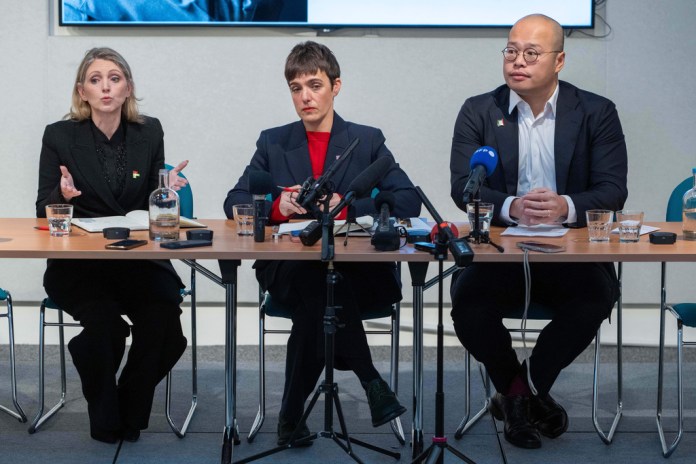
Lai’s son criticized the 800-page verdict on Monday, telling reporters in London that “nothing” incriminates his father and that the U.K. must “do more” to help the activist.
TROVE OF CRITICAL MINERALS DISCOVERED IN UTAH, AIDING EFFORT TO CURB CHINESE CONTROL
“This is a perfect example of how the national security law has been molded and weaponized against someone who essentially said stuff that they didn’t like,” Sebastian Lai said.
Before his arrest, Lai was recognized as the owner of Next Digital, which managed the Apple Daily and Next Magazine, among other publications. The Apple Daily was forced to shutter in 2021 after authorities raided its newsroom, arrested senior journalists, and froze the outlet’s assets.