
The nation’s redistricting battles are heating up as Republicans and Democrats scramble to redraw and pass congressional maps that tip the odds in their favor ahead of the 2026 midterm elections.
So far, the gains and losses appear to cancel each other out, but that has not stopped high-profile pressure campaigns, or billionaire donors and special interest groups, from muscling into the fight.
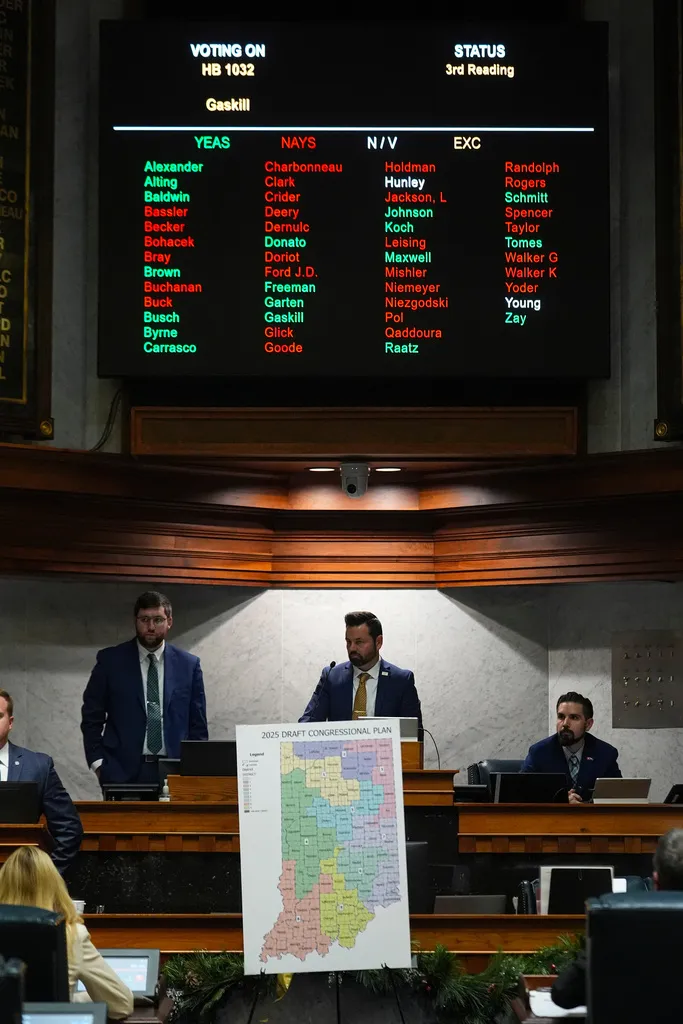
Indiana Republicans handed President Donald Trump a bruising defeat this week, voting 19-31 against a new map despite months of pressure by the White House, House Speaker Mike Johnson (R-LA), Gov. Mike Braun (R-IN), and their allies. Of the 31 “no” votes, 21 were from the Republican supermajority, and the other 10 were from all the chamber’s Democrats.
But Indiana is not the only state where mid-decade redistricting has taken center stage.
A coast-to-coast brawl broke out after Trump first publicly called on Texas to redraw its map to give Republicans a five-seat boost heading into the 2026 contests. Gov. Gavin Newsom (D-CA), who is eyeing a 2028 presidential run, countered with a new map for California, framing the fight as one for the very soul of democracy, a position lawmakers on both sides of the aisle have taken up.
At stake is control of the House of Representatives. Republicans have a 219-212 edge, with four vacancies. Trump has been able to enact his agenda on everything from taxes to immigration because the GOP controls the White House and both chambers of Congress. If Democrats flip the House, they could render Trump a lame duck during his last two years in office by blocking his legislation and launching congressional investigations. That prospect has led to an all-out campaign to keep Democrats from gaining power in the House.
So far, California, Missouri, North Carolina, Ohio, Texas, and Utah have implemented new congressional maps. Virginia is trying to draw new congressional boundaries that will help Democrats gain four seats. Lawmakers in Florida have taken some steps to begin the redistricting process, while other states could be forced to change theirs following the outcomes of court cases.
Here’s a look at where things stand nationally on redistricting.
California
California passed Proposition 50, which could allow Democrats to gain five House seats next year, on Nov. 4.
The ballot measure approved a new map passed by the state legislature in August that would redraw congressional district lines in favor of Democrats for the 2026, 2028, and 2030 elections. It overrides a map created by California’s independent redistricting commission to prevent election gerrymandering.
Seat shift: plus five for Democrats
Florida
Remapping Florida could be the electoral payout Trump has been waiting for, but there are a lot of things that have to fall into place before it can happen.
Florida’s constitution has anti-gerrymandering language, which bans lawmakers from redrawing the map with the intent of helping or hurting a specific political party.
Gov. Ron DeSantis (R-FL), a strong Trump ally, has encouraged lawmakers to redraw the map but has said the state should wait for the Supreme Court to rule in a Louisiana redistricting case that could erode a key provision of the Voting Rights Act. If the high court rules to weaken the Voting Rights Act, it would give Florida the ammunition needed to legally redraw its districts. The problem is that DeSantis and state Senate leaders said they would hold a special legislative session in April 2026 to take up redistricting, but that leaves only a couple of weeks for candidates interested in running to file.
Seat shift: plus two to four for Republicans
Missouri
Gov. Mike Kehoe (R-MO) signed a bill to create a new map in September that would dismantle one Democratic seat in Kansas City, giving the GOP the edge in seven of the state’s eight congressional seats. But the new map is “frozen” for now, said Richard von Glahn, executive director of People Not Politicians.
His group turned in 305,000 signatures this week, triple the necessary number, to stop the map from going into effect during next year’s midterm elections. The only way the new map can be used is if Missouri’s Republican secretary of state rules that the signatures the group gathered are insufficient or fraudulent.
Seat shift: none pending legal action
Ohio
Ohio is the only state in the nation that was actually due for a mid-decade redraw.
That is because the previous one was drawn in 2021 with no Democratic votes. The state’s redistricting commission unanimously approved a map in October that gives the GOP a shot at flipping two Democratic seats.
Had Republicans pushed harder for a more gerrymandered map, it might have been subjected to a voter referendum.
Seat shift: plus two for Republicans
North Carolina
In November, a federal three-judge panel gave North Carolina the go-ahead to use a redrawn map designed to flip one Democratic seat, giving Republicans control of 11 of the state’s 14 House seats.
The new map targets Rep. Don Davis’s (D-NC) district, which covers 20 northeastern counties. The district has been represented by a black member of Congress for the past three decades.
Seat shift: plus one for Republicans
Texas
Gov. Greg Abbott (R-TX) signed off on a new, Republican-leaning congressional map at the end of August, which is expected to give Republicans a five-seat boost.
The map was challenged in court on the grounds that it discriminated against racial minorities. However, a December ruling by the Supreme Court cleared the way for it.
Republicans already occupy 25 of the state’s 38 congressional seats.
Seat shift: plus five for Republicans
Utah
Republican lawmakers tried to buy themselves some time this week by postponing a filing deadline for congressional candidates for the midterm elections. This allows them to wait for the state Supreme Court to weigh in and, they hope, reinstate congressional boundaries that have long favored the GOP.
Republicans hold all four of Utah’s House seats and advanced a map to protect them, but a judge ruled the map “unduly favors Republicans and disfavors Democrats.”
Republican lawmakers passed a resolution condemning Third District Judge Dianna Gibson’s refusal to accept the map and rejecting the map she proposed.
Seat shift: plus one for Democrats
Virginia
Democrats are trying to draw a new congressional map that could help them get four new seats.
House of Delegates Speaker Don Scott said the move was in response to the president “bullying” other states to redraw their maps.
TRUMP INSISTS HE WASN’T ‘VERY MUCH INVOLVED’ IN INDIANA REDISTRICTING EFFORT AFTER BILL FAILS
“We didn’t want to have to do this,” he said. “This was done because Donald Trump told Texas, Indiana, North Carolina — our neighbors — to rig their elections.”
But in order to do it, Democrats are pushing a constitutional amendment that would require passage by the General Assembly in two different sessions and then go before voters via a referendum.
Seat shift: plus two to four for Democrats