
E. Jean Carroll‘s civil judgments against President Donald Trump should be vacated because she declined to pursue or permit DNA testing at trial that could have answered questions about what really happened decades ago, Trump allies argued in a new Supreme Court filing that sharply criticizes the trial court’s evidentiary rulings.
In an amicus brief filed with the high court on Thursday, America First Legal, a conservative legal group founded by senior Trump adviser Stephen Miller, urged the justices to review the U.S. Court of Appeals for the 2nd Circuit’s decisions upholding two New York jury verdicts that forced Trump to pay more than $88 million in fees to the former Elle magazine columnist. The Trump-aligned group told the justices that the lower courts allowed unreliable accusations to reach jurors while blocking rebuttal evidence, including details surrounding Carroll’s claims about DNA, in ways that denied Trump a fair trial.
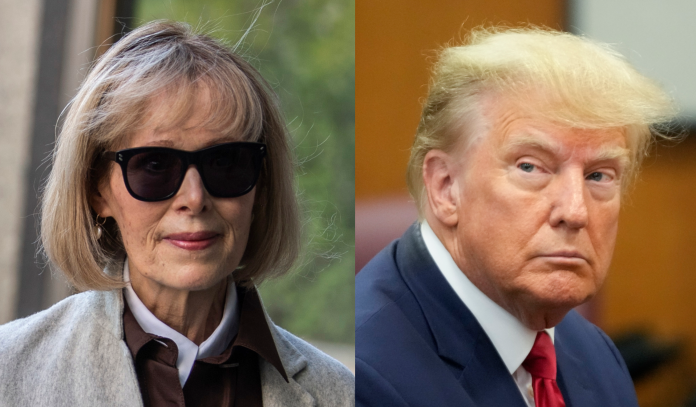
Laura Stell, counsel at AFL, said selective application of evidentiary rules threatens public confidence in the judiciary.
“Without equal application of the law, in both form and substance, the American justice system unravels,” she said. “The Supreme Court must intervene to preserve the integrity of our legal process and prevent future abuse.”
The filing zeroes in on Carroll’s repeated public assertions that a dress she said she wore during the alleged mid-1990s encounter contained Trump’s DNA. According to the brief, testing ultimately found no sperm cells on the dress, undercutting Carroll’s earlier suggestion that the garment constituted physical proof.
Despite that result, Carroll never moved to compel Trump to submit a DNA sample after the case entered its pretrial stages in early 2023, even though she had sought his DNA sample from 2020 to 2023. At that time, Trump’s lawyers repeatedly rejected her requests, arguing she had “not demonstrated a reasonable basis for such an intrusive request.”
During the pretrial period, Trump reversed course and offered to provide a DNA sample voluntarily in exchange for the full DNA report on the dress. Carroll refused, citing timing concerns. On Feb. 15, 2023, U.S. District Judge Lewis Kaplan sided with Carroll and ruled in a 21-page decision that Trump’s DNA offer came too late, while acknowledging the dress did not contain any sperm cells on it.
“The alleged rape could have occurred without a sufficient quantity or quality of Mr. Trump’s DNA to have remained on the dress since the mid-1990s,” Kaplan said.
AFL argued that those concerns rang hollow given that Carroll waited decades to sue. The group said the refusal to pursue DNA confirmation, combined with Carroll’s public claims that the dress proved her allegation, was powerful evidence bearing directly on credibility.
Jurors never heard any of that. At Carroll’s request, the trial judge barred discussion of DNA evidence altogether, reasoning it would be unfairly prejudicial for jurors to infer that the absence of DNA meant Trump’s DNA was not on the dress.
The amicus brief calls that ruling backward. According to AFL, the inference was not only reasonable but highly probative in a case that otherwise turned on decades-old allegations with no physical evidence or contemporaneous corroboration.
“Federal courts must apply the rules of evidence the same way in every case,” said Emily Percival, senior counsel at AFL. “What happened here was the opposite: unreliable allegations were admitted, critical rebuttal evidence was excluded, and the result was a verdict divorced not only from the standards that protect every litigant, but also reality itself.”
AFL President Gene Hamilton framed the case as an example of political lawfare.
“If the rules don’t apply equally to everyone, then they don’t protect anyone,” Hamilton said, urging the court to correct what he called serious errors and reaffirm that justice cannot be bent to fit political narratives.
Beyond DNA evidence, the brief attacks New York’s Adult Survivors Act, signed by Gov. Kathy Hochul (D-NY) in 2022, which temporarily revived time-barred claims and allowed Carroll to sue Trump roughly 30 years after the alleged incident. AFL argued that the law was effectively tailored to permit Carroll’s case and that its retroactive application undermined core fairness principles.
The filing also challenges the trial court’s admission of testimony from two other women describing alleged encounters with Trump from the 1970s and 2005. AFL argued that the courts diluted the traditional balancing required by the Federal Rules of Evidence, allowing decades-old, uncorroborated accusations to be used as propensity evidence despite their prejudicial effect.
The jury ultimately rejected Carroll’s rape claim, finding that she failed to prove penetration, yet still found Trump liable for sexual abuse and defamation, awarding $5 million. A second jury ordered Trump to pay an additional $83.3 million the following year based on a separate public remark he made denying her allegations.
AFL argued that the DNA evidence and related credibility matters were central to whether Trump acted with “actual malice” by denying her claims, a required element for alleging defamation by a public figure.
TRUMP ASKS SUPREME COURT TO TOSS VERDICT IN E. JEAN CARROLL CASE
Trump petitioned the Supreme Court last month after the 2nd Circuit affirmed both judgments and declined to rehear the case en banc. Carroll has said the dispute does not present issues warranting high-court review.
The Supreme Court extended the deadline for public responses on the docket from Dec. 15 until Jan. 14, signaling that the justices will decide early next year whether to grant the case for full merits briefing and argument.