
Senate Majority Leader John Thune (R-SD) questioned lawmakers’ ability on Monday to address expiring Obamacare subsidies before they lapse at the end of the year, but expressed cautious optimism that bipartisan negotiations could eventually restart.
Thune said he sees an impending legislative defeat for Democrats as a motivator to return to the negotiating table once the chamber votes down a Democratic bill later this week for a three-year extension of the enhanced premium credits. He cautioned against the prospect of any deal in the Senate’s final two working weeks of the calendar year.
“If there is going to be some meeting of minds on this, it is going to require that Democrats sort of come off a position they know is an untenable one and sit down in a serious way and work with Republicans,” Thune said.
The vote, likely to occur on Thursday, is part of a bipartisan deal last month to end the government shutdown, but it’s a nonstarter proposal for Republicans and will fall well short of the 60-vote filibuster threshold. The endeavor will offer Democrats their latest healthcare messaging opportunity ahead of the 2026 midterm elections as Republicans struggle to coalesce around a singular plan to address the subsidies for recipients with marketplace insurance.
“Republicans are nowhere on healthcare, and the clock is ticking,” Senate Minority Leader Chuck Schumer (D-NY) said. “Americans’ livelihoods are at stake. Our healthcare system is at stake.”
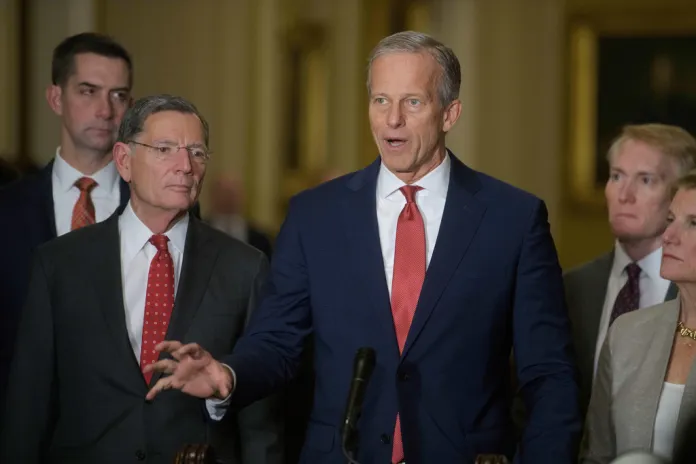
Thune indicated Republicans will not counter Democrats with a vote on a GOP alternative. He cited a perceived “political messaging effort” by Democrats, but Republicans also lack the unity to settle on a singular healthcare proposal. Most oppose a straight extension of the subsidies, which they said do more to line the pockets of insurance corporations and cause fraud than lower healthcare costs.
“This is not a real effort by Democrats. This is their political messaging effort,” Thune said. “And the question is, when that’s over with, will they really want a solution? Because I think we have some people that are really interested in a constructive outcome.”
Sen. Josh Hawley (R-MO), the most outspoken supporter among his GOP colleagues to extend the Biden-era subsidies, lambasted Republican leadership for not rallying around an alternative to Democrats. Hawley indicated that he was still considering whether to vote for the Democratic extension.
“What signal will it send if Republicans say, ‘Yeah, we’re going to say no to the Democrats’ plan, but we’re not going to offer anything.’ The message that will send is, ‘Good luck to the American people,’” he said. “I’m willing to try just about anything, but I’m not willing to sit back and do nothing.”
Thune rejected the notion of attaching any sort of healthcare measure to the must-pass National Defense Authorization Act that Congress is working to advance in the coming days. Lawmakers on both sides of the aisle have floated Jan. 31, the next government funding deadline, as another opportunity to address insurance subsidies, despite them lapsing on Jan. 1.
SENATE DEMOCRATS SETTLE ON THREE-YEAR OBAMACARE SUBSIDY BILL, DRAWING GOP JEERS
There are varying proposals from Senate Republicans, including a mixture of income eligibility caps, fraud prevention measures, and a multiyear phaseout of the subsidies. Yet others, such as a measure from Senate Health Committee Chairman Bill Cassidy (R-LA) and Finance Committee Chairman Mike Crapo (R-ID) that is modeled after President Donald Trump and supported by Thune, would give money directly to people for health savings accounts rather than to insurance companies.
“We’ll see whether the Democrats, when this is all sort of said and done on this political messaging exercise, want to have a serious conversation about how to fix it,” Thune said.