
The United States is questioning the future of its relations with the African nation of Tanzania following widespread violence against protesters this year that the national government has dismissed as necessary to keep the peace.
The Department of State issued a statement on Thursday acknowledging a lack of security and threats to U.S. interests in the country during “the days leading up to and following Tanzania’s October 29 elections.”
Citing “recent actions by the Government of Tanzania” that “raise grave concerns about the direction of our bilateral relationship,” State Department principal deputy spokesman Thomas Pigott announced the U.S. government “is comprehensively reviewing our relationship.”

“The Government of Tanzania’s ongoing repression of religious freedom and free speech, the presence of persistent obstacles to U.S. investment, and disturbing violence against civilians […] required this reconsideration of our ties,” Pigott explained. “These actions have put American citizens, tourists, and U.S. interests in Tanzania at risk, and threatened to undermine the mutual prosperity and security that have defined our partnership for decades.”
He added: “The United States cannot overlook actions that jeopardize the safety of our citizens, or the security and stability of the region. The future of our bilateral relationship with the Government of Tanzania will be based on its actions.”
Protests erupted in the city of Dar es Salaam on Oct. 29 among young people frustrated by what they claimed was corrupt, unitary rule over the country by Tanzanian President Samia Suluhu Hassan’s socialist Chama Cha Mapinduzi party.
Riots persisted for days as civilians clashed with the national police force. As violence escalated, the government implemented a near-total blackout of internet service. Leaders of the main opposition party, CHADEMA, were arrested and disqualified from standing for election.
An electoral commission eventually announced Hassan won the election with a highly dubious 98% of the vote. Internet access was reestablished on Nov. 4, and footage of the bloody clashes between civilians and police began to circulate on social media.
Democrats on the Senate Foreign Relations Committee celebrated the department’s move.
“@SenatorRisch and I called for this review a week ago, and I am glad to see the @StateDept take this step,” Sen. Jeanne Shaheen (D-NH) said Thursday. “Tanzania’s ruling party must be held accountable for its actions.”
The United Nations’s human rights office reported on Thursday that “the number of people extrajudicially killed in the aftermath of the elections is estimated to be at least 700 individuals, with other estimates pointing to thousands of potential victims.”
“Widespread arbitrary arrests and detentions of hundreds of protesters, human rights defenders and civil society activists followed the post-election protests,” experts with the U.N. office noted. “Many detained opposition leaders and protesters, that account for over 1,700 individuals, reportedly face serious offenses like treason, conspiracy to commit an offense, and armed robbery.”
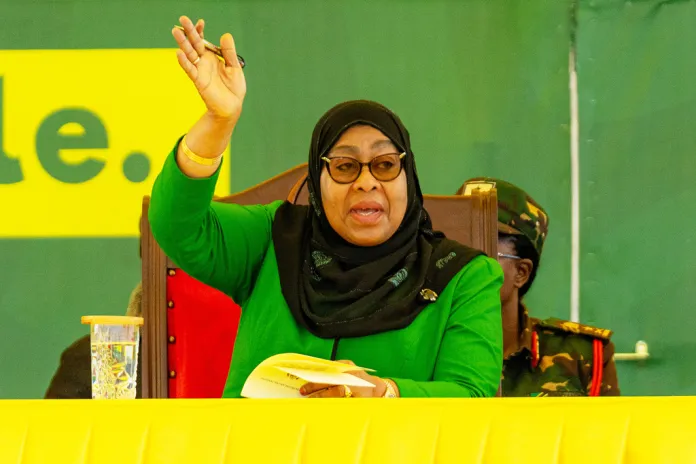
The State Department’s review of relations with Tanzania follows comments made by Hassan on Tuesday, defending her government’s actions against what she called “violence with malicious intentions.”
“What happened was a manufactured event, and those who planned it intended to bring down our government,” Hassan said in an address to the Tanzanian public. “In that situation, the government has a responsibility, and we swear to defend this country and its borders, to protect the safety of citizens and their property. And in that case, the force used is proportional to the event.”
She did not dispute the widespread use of violence by the police to suppress the riots, but justified the force as defense against an illegitimate mutiny.
“So when we’re told that we used too much force in that event, what was the smallest force?” she added. “Were we supposed to wait until the protesters — who had planned to overthrow the government — had succeeded?”

Tanzania is not the only country currently facing discipline from the State Department due to perceived oppression and lack of individual freedom.
Secretary of State Marco Rubio announced Wednesday that visas to Nigerian nationals will be subjected to intense scrutiny in response to mass killings and violence against Christians by radical Islamic terrorists, Fulani ethnic militias, and other violent actors in Nigeria and beyond.”
Rubio said the restrictions will apply to individuals “who have directed, authorized, significantly supported, participated in, or carried out violations of religious freedom” and possibly their family members.