
Everyone remembers their first episode of The Twilight Zone. As a child, something about this strange black-and-white show drew me in: to start with, there was the protagonist — a bespectacled bank teller whose desire to spend all day reading books was highly relatable. One afternoon, after taking his lunch in a vault (to read in peace), he emerges to discover an atomic bomb has obliterated the entire city. It is difficult to convey just how viscerally disturbing I found that twist. Is this the sort of thing grownups were watching after I went to bed? Perhaps it’s silly to avoid spoilers for a nearly 70-year-old show, but on the off chance you haven’t seen “Time Enough at Last,” I’ll omit the final horrifying moment.
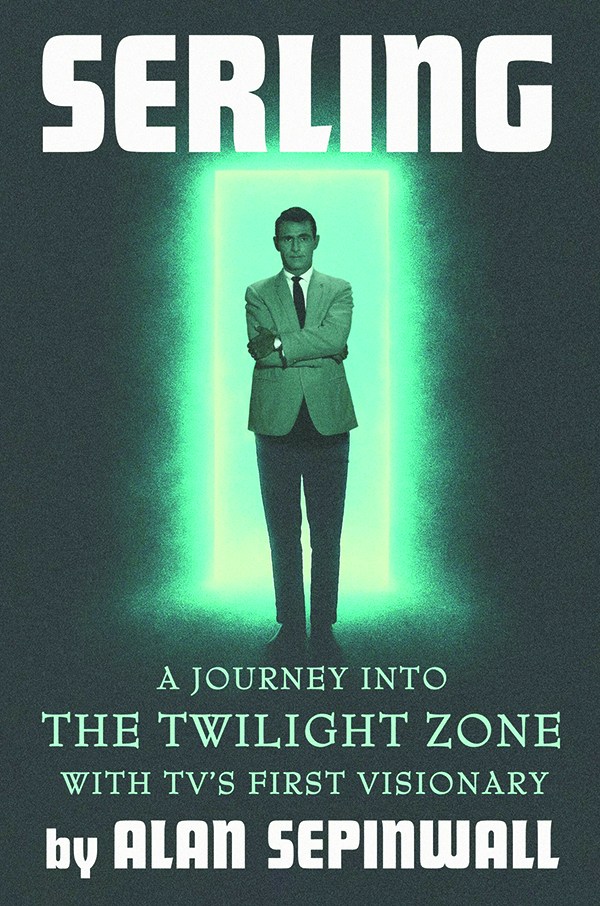
To answer my own question, no, this was decidedly not what grownups were watching, at least not before 1959, when Rod Serling and his science-fiction anthology first aired. Alan Sepinwall’s compulsively readable new biography claims that Serling was “TV’s first visionary.” He’s right.
Sepinwall sketches Serling’s happy childhood and busy adolescence, from playing intramural sports to editing the high school paper, the Panorama. “He was debate club vice president, Junior Red Cross secretary and later president, and eventually president of the student government,” Sepinwall writes. He maintained good grades, held a bevy of summer and after-school jobs, and “dated constantly.” The book indulges in some armchair psychoanalysis by positing this striving was a result of his diminutive stature — he stood only 5 feet, 4 inches — but I don’t buy it. Serling’s gregariousness, theatricality, self-deprecating humor, and general joie de vivre seemed baked into his personality.
Upon graduating from high school in 1943, Serling saw a newsreel about “airborne soldiers” and enlisted as a paratrooper (“a largely untested, incredibly dangerous specialty”). He would later describe World War II as “the sum and substance of my life — the most formulative, the most easily and vividly remembered, and probably the most important period of my entire life.” Sepinwall continues:
“This was not hyperbole. The war was the defining experience of Rod Serling’s life. It was where he made the harshest possible transition from childhood to adulthood, where he bore witness to senseless violence far darker than the scariest Twilight Zone or Night Gallery stories, where he developed various beliefs about the unfairness and preciousness of life that would be driving forces in all the work he did for the next thirty years.”
Of all the midcentury authors who wrote about the war — Joseph Heller, Norman Mailer, Kurt Vonnegut — Serling likely saw the worst combat. He and the 511th Parachute Infantry Regiment (nicknamed “The Death Squad” for their 50% casualty rate) were sent to the Philippines to recapture the island of Leyte. “The 511th spent thirty-three days trekking from the east coast to the west coast,” Sepinwall writes. “Along the way, they battled starvation, leeches, disease, snipers, and frequent banzai attacks from a much larger and more committed Japanese force than they had been expecting.”
Somehow, Serling survived the combat, diseases (including multiple bouts of malaria), and starvation. But, in a grim twist worthy of The Twilight Zone, Serling was, in a sense, killed by his own side: as the 511th slowly starved to death, they quelled their hunger pains with cigarettes. Serling remained a heavy smoker the rest of his life, and cigarettes were undoubtedly the primary cause of his death at age 50. Incredibly, Serling would see another year of combat, sustaining multiple injuries and earning a Purple Heart.
Life after the war follows a well-known script: Serling uses the G.I. Bill to attend college, meets a pretty girl, and gets married before graduating. The newlyweds live off-campus in a trailer, and to make ends meet, the young veteran — you cannot make this stuff up — gets a job testing parachutes, “earning $50 per jump, and one time reportedly earning $500 for a particularly hazardous test.” He even volunteered “to test a new ejection seat — one that Rod claimed had killed three other men before him — for $1,000.”
As is usually the case, Serling’s overnight success took years. He churned out hundreds of short stories, radio dramas, and teleplays throughout the next decade. He was neither a starving artist nor a celebrity author. That is, until Patterns.
Multiple things had to occur for Serling’s corporate drama about an aging executive to succeed. For one, people had to own TVs. Between 1945 and 1955, when Patterns aired, the number of homes with a television rose from 0.02% to 65%. Stations were eager to prove this new medium had artistic merit, which meant “there were nearly twenty different anthology dramas airing across ABC, CBS, NBC, and the DuMont Network.” These dramas would be filmed live and aired only once, so there was always work to be had. In fact, Patterns was so well-reviewed and popular it was the first teleplay to be aired twice. Rod Serling was now a household name.
Interestingly, this very acclaim meant The Twilight Zone was seen as a pulpy step backward for the writer. In one interview, a young Mike Wallace smugly tells Serling that “for the time being and for the foreseeable future, you’ve given up on writing anything important for television.” Wallace can be forgiven for underestimating the show’s potential, but Sepinwall highlights the many times Serling’s teleplays were censored by networks and sponsors. In one especially absurd example, the phrase “gas chamber” was removed from a script about the Nuremberg trials because the American Gas Company was a sponsor. The book makes a compelling case that, by attiring social issues in sci-fi garb, Serling was able to tackle otherwise taboo topics.
REVIEW: AN INFORMATIVE, IF PLODDING, LOOK AT BEES
If the book has a flaw, it’s that it ends with a whimper rather than a bang, but then, so did Serling’s life. The final two seasons of The Twilight Zone were produced under arduous circumstances and resulted in shows of varying quality. His subsequent series, such as Night Gallery, were occasionally brilliant but frequently awful.
But that’s merely a quibble. I went into the book thinking it would mostly be for Twilight Zone obsessives, but it’s worth a read just to play “spot the future star”: We encounter James Dean, Paddy Chayefsky, Carol Burnett, Robert Duvall, and Steven Spielberg, among others. It works as a biography of a singular man who led a fascinating life, as a history of America’s transition from radio to television, and as an exploration of what makes Serling’s most iconic show so good. I had a blast watching old episodes while reading Sepinwall’s book, and it’s still Serling’s staccato, hyper-articulate, baritone voice that creates the almost Pavlovian feeling that tells you: the next half-hour is going to be great.
Alexander Kaplan is a writer based in Richmond, Virginia.