
PITTSBURGH — Thirty-eight steps rise from the sidewalk at 1201 Wylie Avenue to the lobby of Citizens Live at the Wylie, and every one of them is watched over by Charles “Teenie” Harris.
Harris’s photographs line the grand staircase of the new $64 million concert hall on the Lower Hill. There are pictures of bandleaders and barbers, newlyweds and ballplayers. There’s Lena Horne, Louis Armstrong, Duke Ellington, George Benson and Ahmad Jamal. At the top of the stairs, a mirrored upright piano hangs upside down from the ceiling, catching the light like a disco ball. It’s a replica of the piano at the Crawford Grill, the club that made Wylie Avenue famous.
The staircase was not a designer’s whim. Tom Loudermilk, Live Nation’s market president for Western Pennsylvania, said the idea came from a resident at one of the many meetings the company held with Hill community groups. “Wouldn’t it be great if you could introduce the story of the Hill to people as they’re walking up the hill into the venue?” the resident asked. The project’s lead designer, Sara Silvestri of Live Nation’s Blueprint Studio, answered on the spot, “That’s a brilliant idea. That’s exactly what we’ll do.”
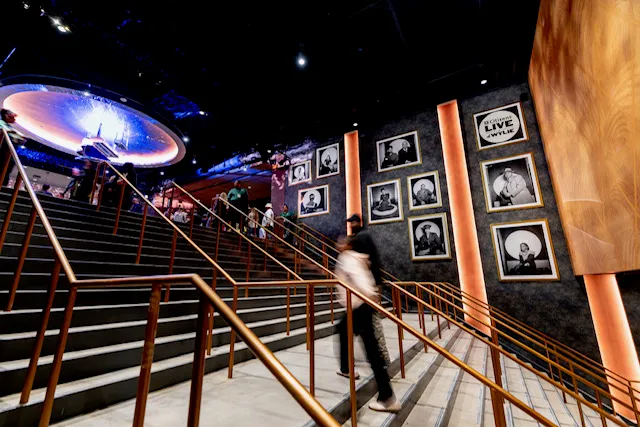
Wylie Avenue ran from downtown up to the heights, and it ran 24 hours a day, residents recalled in WQED’s documentary “Wylie Avenue Days.” The poet Claude McKay called the Hill the “Crossroads of the World.” And it was a crossroads in the most powerful sense. The Hill is remembered as the heart of black Pittsburgh, and it was. But for decades it was also home to Jewish families from Russia, Poland, and Romania and to Italian families along Wylie, Webster, and Bedford, alongside Syrians, Greeks, Slovaks, and the Irish. As late as 1930, Jewish and Italian shopkeepers still worked next to black-owned businesses on Wylie, and black families arriving in the Great Migration made their homes beside them.
William “Gus” Greenlee, the numbers baron who owned the Negro League Pittsburgh Crawfords, opened the first Crawford Grill at 1401 Wylie in the early 1930s. Its revolving stage drew Coltrane, Miles Davis, and Dizzy Gillespie. Even in an era of segregation, the Grill welcomed customers of every ethnicity, and white musicians came up the Hill to jam with black musicians from across the country. Ellington packed the Pythian Temple and the Roosevelt Theater nearby.
At Crawford Grill No. 2, farther up Wylie, steelworkers sat a few tables from Roberto Clemente, the Rooneys, and a young August Wilson. Patrons, black and white, rich and working class, sat in one room because of the music.
Teenie Harris saw all of it.
Born on the Hill in 1908, he spent four decades shooting for the Pittsburgh Courier, one of the most influential black newspapers in America, and left nearly 80,000 negatives. Mayor David L. Lawrence nicknamed him “One Shot” because he got the picture on the first try.
He photographed presidents, but mostly he photographed his neighbors. “We showed the productive side of our people,” a former Courier editor explained. The museum’s catalog of his work at the Wylie includes the Grill’s facade, his brother William “Woogie” Harris at the Grill’s piano, and the all-woman Four Jewels on the stand at Crawford Grill No. 2 in 1954.
Urban renewal arrived in the 1950s, promising to save the Lower Hill by bulldozing it. The arena and later Interstate 579 demolished 1,300 buildings and displaced 8,000 residents, most of them black. The Italian families largely scattered to Bloomfield and the Jewish families to Squirrel Hill. The black families had fewer places that would take them.
In the week after the Rev. Martin Luther King Jr. was killed in April 1968, local news reported that the Hill saw hundreds of fires. Businesses that burned never came back. For half a century, the Lower Hill was mostly asphalt, parking for an arena that was itself torn down in 2012. Crawford Grill No. 2 still stands, three stories of empty brick.
Loudermilk, raised just south of Akron, moved to Pittsburgh for Live Nation in 2017. He admits he did not know the street’s history at first. Then a colleague handed him Mark Whitaker’s “Smoketown.”
“The people who have been associated with this project have genuinely cared about having this venue be part of this community, not land in the community,” he said.
The clearest proof, he said, is Silvestri. She lived in Brooklyn when the project began. She lives in Pittsburgh now. “She loved the city. She loved the story,” he said. “I don’t know how to better say that she was bought in on the project than that.”
Loudermilk said her design is shot through with Harris. The palm trees behind one bar come from scenes in his photographs, and the wallpaper behind another matches the old Grill. The photographs come from the Carnegie’s Harris archive, and historian Kimberly Ellis of the Historic Hill Institute selected most of them. The original mirrored piano was lost with the first Grill, which burned in 1951 and came down for the arena. What survived was the image. “That’s something that we discovered while looking through Teenie Harris’ photos,” Loudermilk said.
Outside, a 90-foot mural shows a woman in a sequined dress at the same keys, a nod to Harris’s photograph of pianist Alyce Brooks.
“I live here,” Loudermilk said. It “did not take any arm twisting,” he said, to build that history into the building.
The commitments go beyond decor. When Live Nation opened hiring to Hill residents a day early, it filled a third of the staff in that one session. The company has pledged $2 from every ticket for 10 years to the Greater Hill District Reinvestment Fund, he said.
The early calendar runs from Sting and John Legend to country singer Charles Wesley Godwin to comedian Ali Wong, and “the diversity of the ticket buyer,” Loudermilk said, “has surprised even me. It’s truly, if you build it, they will come.”
The preview night, Sept. 28, belonged to Donnie Iris.
Born Dominic Ierace, Iris grew up in Ellwood City, a western Pennsylvania mill town that shared the Italian American roots of the Hill’s old walk-ups. He reached No. 2 with the Jaggerz’ “The Rapper” in 1970, then reinvented himself as a horn-rimmed rocker with “Ah! Leah!” and “Love Is Like a Rock.” He played nearly every room in the region, from six nights a week at the Club Naturale in Beaver Falls to sold-out New Year’s Eve shows at the Stanley Theatre, once with Bon Jovi as his guest. In 2023, he sold out the UPMC Events Center for his 80th birthday show.
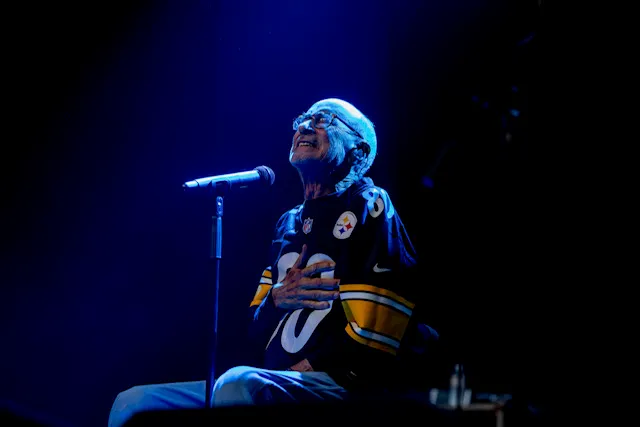
He had been fighting bladder cancer since 2023. On the day of the Wylie show, he had a radiation treatment and looked weak at sound check, bassist Paul Goll later recalled. Then he walked onstage without his cane and, for the first time in his career, sang from a chair.
Nonetheless, Donnie grabbed the mic, pulled it to him and sang his heart out. Those of us who were there knew we were seeing something special, something fleeting. He closed with “With a Little Help From My Friends.” “I love you,” he told them, “and I want to keep doing this.”
Days later, he announced he was done. “My final performance took place last Monday, September 28, at the grand opening of Citizens Live at The Wylie,” he wrote to his fans. “It was a meaningful and fitting moment to share with all of you in my hometown.” Within days, he was dead at 83.
“It was really important that we include him,” Loudermilk said. “I couldn’t be more proud that we were able to send him off the right way.”
On Nov. 9, hundreds lined up outside the Wylie in tour shirts for a memorial. They climbed the same 38 steps, past the faces Teenie Harris saved, to say goodbye to the last great voice of a different Pittsburgh. Wylie Avenue was always where the city’s tribes came to hear one another. For one night in September and one morning in November, it was again.