
To state what should be obvious, I never knew Jimmy Stewart — I was 14 when he died in July 1997 — but I sometimes feel as though I talked to him from time to time. And, in a way, I did: For the last 18 years of his life, I was a friend of director Peter Bogdanovich, about whom I am now writing a biography and whose virtuosity extended to his ability to summon the voice of Jimmy Stewart.
Bogdanovich — who knew and wrote, brilliantly, about Stewart — captured the star’s vocal habits with dismaying ease: the bewildered pauses, the self-effacing hemming and hawing, the basically benign temperament. Even more dismayingly, I noted that Bogdanovich impression of Stewart improved as Bogdanovich himself aged. I still remember a phone call when I asked Bogdanovich how he was doing, and he answered this way: “As Jimmy Stewart used to say, ‘After 70, it’s just patch, patch, patch.’” The voice was spot-on. (Bogdanovich was then 79.)
After Bogdanovich died in 2022, I never thought I would again hear someone incarnate Stewart so thoroughly. After all, despite the pleasing persistence in the popular imagination of It’s a Wonderful Life (1946) and Vertigo (1958), I harbor no illusions that the Stewart films to which I regularly return rattle around in the minds of Generation Z: The Mortal Storm (1940) and Rope (1948) and Bell, Book and Candle (1958) and such. In other words, Stewart is no longer a natural subject for impressionists or, for that matter, biopics.
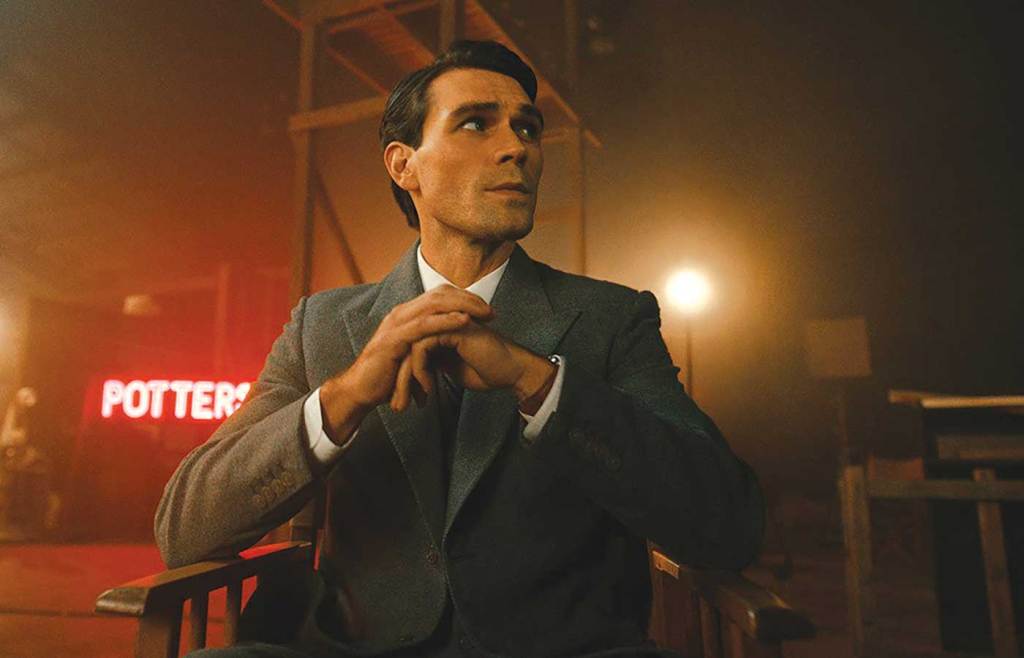
It is my happy duty to report that I was wrong. There walks on this Earth a fellow who can do an impression of Stewart that surpasses even that of the great Bogdanovich: one KJ Apa, a New Zealand actor wholly unknown to me before I saw him in the new Fathom Entertainment biopic of Stewart, Jimmy. Apa is so strikingly accurate as Stewart — and screenwriter Justin Strawhand so canny in dreaming up dialogue that sounds as though it would plausibly pass Stewart’s lips — that, at times, I felt I was watching a “new” Stewart movie, this one on the subject (according to the film) he adamantly refused to have depicted in a movie: his noble and notable service in the U.S. Army Air Corps in World War II. In an autumn movie season characterized by grim horror movies (Clayface) and grimmer studies of human weirdness (You Can See Everything), Jimmy is that rarest thing: a wholesome movie of sentiment, wit, and conviction.
In fact, having evidently judged Stewart’s personal saga to be far more interesting than that of most stars, director Aaron Burns seems in a hurry to get his hero out of Hollywood. Early scenes briskly establish that Stewart won an Oscar for The Philadelphia Story (1940) — and pursued a romance with Ginger Rogers (Jemma Donovan) around the same time — but this is not the sort of biopic that aims to impress with walk-on roles for various long-gone notables. That’s because Stewart, as shown here, seems largely unmoved by the hubbub that encircles him in southern California. (He frequently decamps to his father’s hardware store in Indiana, Pennsylvania.) Burns’s most perceptive comment on Stewart’s uneasy relationship with show business comes in a shot in which we see the actor’s shoes weave in and out of the pointe shoes of a bevy of ballerinas at Metro-Goldwyn-Mayer — presumably a musical is being made somewhere on the lot. Gossip columnist Hedda Hopper (Sarah Drew) is a supporting character, but she mainly serves as the recipient of Stewart’s gentle barbs.
Stewart is also eager to flee Hollywood: Upon receiving a card from the draft board, Stewart refuses an offer of assistance from studio boss Louis B. Mayer (Jason Alexander) to avoid going to war, and he chooses to block out the doubts of his father, Alexander (Neal McDonough), about his readiness to fight. “Make peace with the fact that you are what you are,” Alexander says, discouragingly. Even military brass advise against depositing the star into danger. “America cannot afford to lose Jimmy Stewart,” says Army Col. Terrill (Rob Riggle).
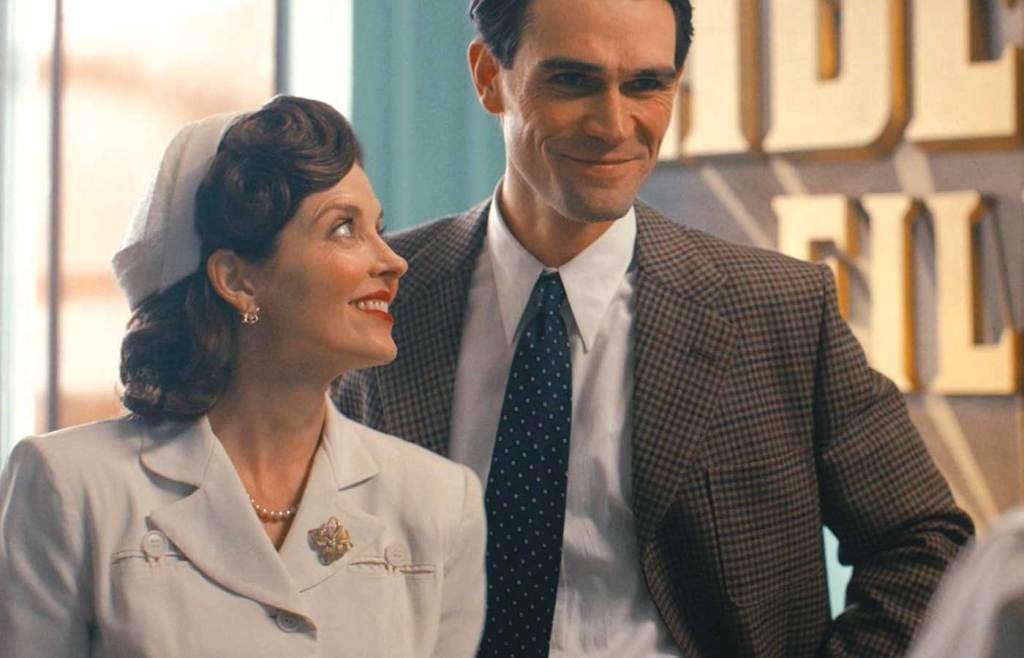
That is not to say that Stewart chose to fly missions in World War II because of an inflated sense of his own competence or virtue. To the contrary, Apa underscores the star’s self-doubt, especially over his ability to lead men who don’t consider winning an Oscar an asset in warfare. Stewart is simply persuaded that ducking his duty would be unacceptable. This movie depicts a world in which virtually the worst thing that could be said of someone was that he got a deferment.
Burns stuffs the movie with imagery that was once commonplace on American screens but has long since fallen out of fashion. There’s a touch of John Ford when Stewart spends a long moment at the train station with his mother, who squeezes his cheeks, and his father, who, having accepted his son’s decision to serve, slips an envelope in his coat pocket — an envelope that contains an edition of the Psalms, which Stewart, a believing Presbyterian, consults throughout the story. He needs the Psalms to gather strength to write letters of condolence to families of those who have perished. He also comes to rely upon periodic visits to a chapel in the countryside of England, where he is stationed and whose weather he commends. He says he likes the fog, but his faith is crystal clear.
In England, Stewart comes into the orbit of the fictitious Lady Julia Tyndall (Kara Killmer), a war widow with whom he embarks on a very chaste romance. Central to this film’s understanding of Stewart is his own rectitude: The actor was married once, after he returned from the war, and although the script demands female companionship for him while overseas, his conduct, as shown here, is entirely honorable.
The film’s battles, while clearly computer-reliant, are credible and involving, but the scenes on the ground are the best. When Stewart orders a group of soldiers to stand at attention, he comments, amiably, “I’ll be gosh-darned — it really works.” Later, Stewart makes a good case for the ruthless efficiency of civilization to his increasingly combat-weary men: The president may not care about each individual man, Stewart concedes, but that’s not so different than his men not caring about the farmer whose cow produces milk or the worker who helps construct a great skyscraper. Each man finds fulfillment in the execution of his duty. If Stewart, who attained the rank of brigadier general, was anything like this in real life, it is no wonder that he excelled as a leader.
‘A TALENT FOR MURDER’ STARS HELEN MIRREN AS PATRICIA HIGHSMITH
There are at least a half-dozen scenes sure to tug at the heartstrings, including Stewart standing in for Santa Claus (aka Father Christmas) at a Salvation Army event; Stewart counseling a comrade taking his last breaths; and Stewart, having returned to civilian life, being roused from his state of PTSD-tinged depression by the sight of Frank Capra acting out a scene from the script for It’s a Wonderful Life.
See Jimmy before it leaves theaters. Then watch It’s a Wonderful Life when it airs on television. And then go watch Bell, Book and Candle over Christmas.
Peter Tonguette is the Life & Arts editor of the Washington Examiner magazine.