
Alice Cooper is a rock ’n’ roll oddity. If you’re at all familiar with his macabre onstage persona, the notion that he’s not normal even by the standards of rock stars seems obvious enough. What’s not so obvious is the way his cultural influence has been felt. What makes him a true oddity is that he might be the only pop musician in the post-Elvis era whose aesthetic has been far more influential than his music. That’s not a knock on Cooper’s musical abilities. Hits such as “School’s Out” and “No More Mr. Nice Guy” have been radio staples for half a century for a reason.
But in Cooper’s new and richly deserved autobiography, Devil On My Shoulder, it’s noteworthy how much Cooper’s public persona and elaborate stage show shaped the look and feel, if not the sound, of rock in the decades to come. From the earliest days of Alice Cooper, when Vincent Furnier was fronting a popular high school band in Phoenix known as the Spiders, the band had a theatrical streak with elaborate lighting and onstage antics. (The name “Alice Cooper” originally referred to the whole of the band, years before Furnier eventually adopted it as a solo sobriquet.) By the time the band moved to Los Angeles, got signed by Frank Zappa, changed its name a couple of times, and eventually had some success, their stage show had evolved to include everything from wearing blood-spattered women’s clothing, a rigged gallows and electric chair where Cooper would pretend to kill himself onstage, as well as singing with a boa constrictor around his neck.
When their show finally hit London, David Bowie was there and purportedly told Mick Ronson, “This is what we should be doing.” Maybe Cooper was not the only influence on glam rock, but he was undoubtedly an outsize and ahead-of-his-time influence. Similarly, the darker, horror-movie-inflected themes Cooper leaned into had a profound impact on a different set of inchoate musicians. Lol Tolhurst, co-founder of the Cure, writes extensively about Cooper in Goth: A History, going so far as to declare “Alice Cooper figured in my thirteen-year-old psyche more than any other musical act.” Nothing really needs to be said about hair metal, which has obvious glam influences — just look at a picture of Cooper in the 1970s and then look at a promo photo of any band on the Sunset Strip a decade later. None of these genres would exist without Cooper pioneering them, and his impact has been so pervasive that not many people can remember a time when what Cooper was doing was unique, scary, or, as was often discussed in the press clippings back in the day, a sign that popular culture was being morally corrupted.
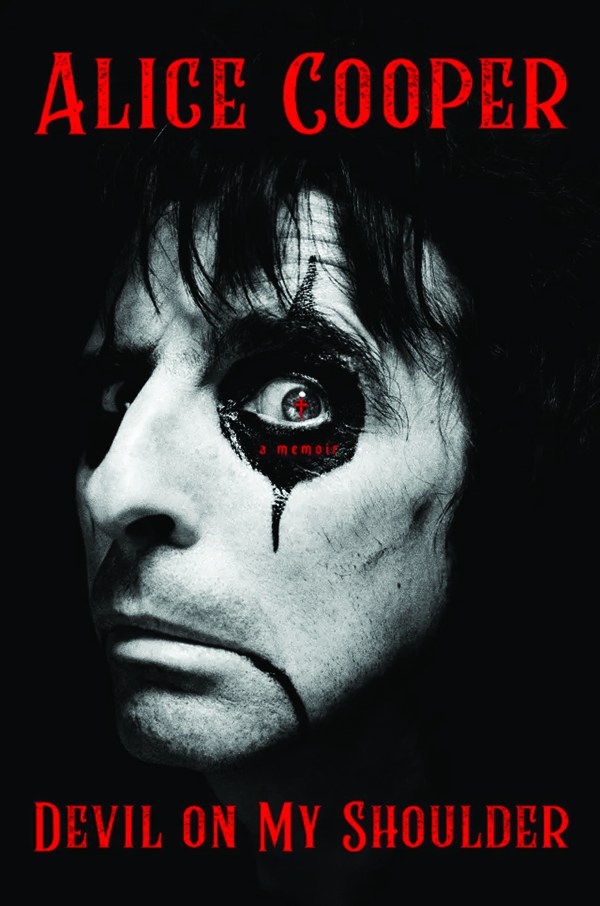
What makes Cooper’s autobiography so interesting is that he’s hyper-aware of this moral conundrum. The title comes from a device that pops up throughout the book, wherein Cooper has Screwtape-esque conversations with the titular devil about being honest with himself. To that end, not many artists will take on this argument:
“I went back to my old defense: What we’re doing is entertainment — art, even. In Hamlet, there are nine deaths, one by poison, another by drowning, two by execution, and five by stabbing, but I don’t hear Shakespeare being accused of inciting violence.”
But Cooper goes on to note that this argument isn’t “entirely honest.” He cites talk show host Jerry Springer, who once compared his program to what’s depicted in the Bible or Shakespeare but later admitted it had degraded American culture. Writes Cooper: “I think he realized that his original defense was inadequate because he could hardly say that The Jerry Springer Show was as morally complex as Shakespeare. I can go on about how the Alice Cooper show is a morality play, but let’s get real: Is it anywhere near as nuanced or psychologically motivated as Hamlet?”
And Cooper extends this argument to some pretty controversial areas. Because Cooper and his bandmates were known for wearing women’s clothes onstage for the shock value, there’s a fair bit of recounting about how they were aggressively harassed by drag queens in New York in the ’70s before he reaches the conclusion that drag is just blackface for women: “I get that the outrageous glamour, the too-fabulous RuPaul thing, can be an art form, yet here’s these guys that want to be not just female but an exaggerated, garish version with scarlet lipstick and huge hair,” he writes. “I’ve never understood why more women don’t think it’s making fun of them or insulting them at some level.”
There’s one obvious reason for the fact Cooper does more soul-searching than almost any other rock star you’ll ever encounter: He believes he has a soul. The book opens with his grandfather performing an exorcism on an Indian reservation in Arizona. Both his grandfather and father were Bickertonite preachers, an obscure Mormon sect that is distinct from and unaffiliated with the Latter-day Saints church in Salt Lake City that most people are familiar with. (Though his upbringing shaped him a great deal, Cooper himself is not Bickertonite. Since kicking his coke and booze habits in the ’80s, Cooper has regularly attended a conventional evangelical church in Phoenix.)
Still, he quotes Scripture with alacrity and is reverential toward his parents, righteous and loving people who alternately supported his career and helped him find a way out of his addiction and immoral lifestyle. Cooper is at pains throughout the book to explain that most of the ghastly stories about him being some Prince of Darkness are invented. In this way, Devil On My Shoulder is a corrective to his earlier autobiography, 1976’s Me, Alice, published at the height of his fame and which is largely fiction. And despite some exceptionally wicked imagery onstage, Cooper explains, more than once, that he has always very explicitly tried not to do anything Satanic, even if he hasn’t convinced himself that what he did wasn’t corrupting.
It’s enough of an endorsement to say that Devil On My Shoulder is a good autobiography because Cooper’s perspective is unique and interesting, but it would also be giving the book short shrift to omit that it is full of incredible stories. Cooper has collaborated with everyone from Salvador Dali to Kermit the Frog. He was friends with Pink Floyd when Syd Barrett was still in the band. His drinking buddies were Micky Dolenz, John Lennon, Keith Moon, Harry Nilsson, Ringo Starr, and Bernie Taupin. He was very close to Groucho Marx, who used to drag friends Mae West and Fred Astaire to Cooper’s shows, and they all enjoyed it “as loud, modern-day vaudeville.” Like any good celebrity bio, the book is also overstuffed with interesting anecdotes.
SALUTING AMERICA’S MOST AGREED-UPON BAND, TOM PETTY AND THE HEARTBREAKERS
At times, however, the book does feel like its ambitions outstrip its prose. If Cooper’s attempt at morally reconciling his career drives the book, there’s often little in the way of resolving the tough questions brought before the reader. (Perhaps unfairly, I had hopes for something a bit more elevated because Cooper’s co-author is Daniel Richler, adoptive son of famous Canadian novelist Mordecai Richler and son of Stanley Mann, the screenwriter who, appropriately enough, is credited on the Vincent Price classic Theatre of Blood and co-wrote William Wyler’s film version of John Fowles’s psychological horror novel, The Collector.)
Still, the book is never less than fun. As Cooper writes, “You just can’t take it that seriously. It’s only rock and roll, right?”
Mark Hemingway is a senior writer at RealClearInvestigations and the Books Editor at the Federalist.