
A nobleman lures his drunken rival into catacombs where he walls him up for all eternity. A recluse in a “mansion of gloom” entombs his living, breathing sister in a vault. A lunatic who insists he is sane kills and dismembers an old man, and only confesses to his crime when he purports to hear his victim’s still-beating heart beneath his floorboards. A man consumed by rage and “gin-nurtured” malevolence punishes his cat by gouging its eye out. And a prisoner of the Spanish Inquisition is tortured by the “most demoniac of men” and forced to choose between plunging into a pit or being sliced up by a razor-sharp pendulum.
Edgar Allan Poe’s fiendish tales have enthralled generations of readers who enjoy narratives tinged with the macabre or steeped in dread. The likes of Stephen King have drawn inspiration from Poe’s use of horror and the supernatural. Arthur Conan Doyle and other mystery practitioners acknowledged their debt to Poe after his seminal story “The Murders in the Rue Morgue” set the template for detective fiction.
But not everyone has warmed to Poe’s chills. W. B. Yeats mocked the writer’s artistic expertise by describing one of his stories as “an appeal to the nerves by tawdry physical affrightments.” Henry James derided Poe and patronized his admirers with his claim that “an enthusiasm for Poe is the mark of a decidedly primitive stage of reflection.” Then there was the critic Harold Bloom, whose disparagement of Poe flagged up a problem and paradox: “I cannot think of any other author who writes so abominably, and yet is so clearly destined to go on being canonical.”
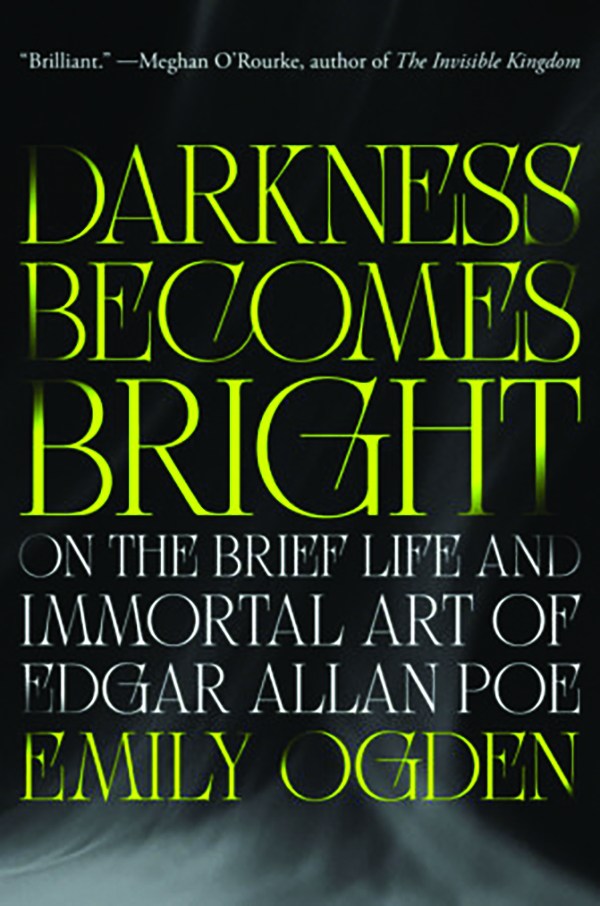
Emily Ogden, a professor of English at the University of Virginia, used to be a Poe detractor. “I found him lurid and puerile,” she admits in her new book, Darkness Becomes Bright. However, over time she changed her mind, realizing that Poe’s obsession with death did not stem from immaturity or morbidity, and that what motivated him was not a desire to shock or scare but rather “a determination to confront the greatest difficulties of human experience.” This is an innovative study of Poe, one that examines his agonized life and work, as well as other writers who have been captivated or influenced by his black magic.
Ogden opens with Poe in Philadelphia in 1841. Here we see a refreshingly different incarnation of the author than we are accustomed to. In that year, Poe was not flailing or spiraling downward but going places. He joined the staff of Graham’s Magazine as literary editor. He had already proved his literary credentials with the publication of three collections of poetry, one collection of stories, and his novel, The Narrative of Arthur Gordon Pym of Nantucket, not to mention a series of reviews. He was respected and in demand.
But Poe grew restless. He struggled to live by his pen. Graham’s was a fallback option. His main aim had always been to found, and write for, his own literary magazine. He tried to do so two years later by launching The Stylus, but after drinking too much and blowing his chances to obtain a government sinecure, he was denied much-needed financial support and the magazine failed to get off the ground. He was rocked by a different kind of disaster in January 1842. While singing, his young wife, Virginia, began dribbling blood. She was diagnosed with consumption, now known as tuberculosis. As her health declined, Poe’s drinking increased.
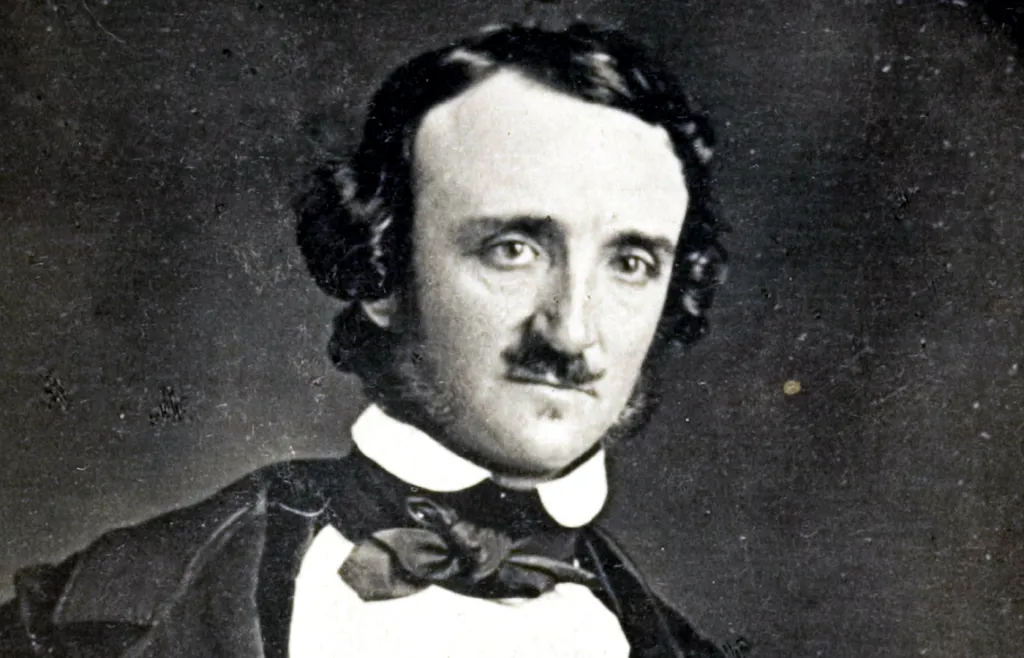
In her second section, Ogden rewinds to Poe’s time in Richmond, Virginia. It was there that his mother died in poverty in 1811, which resulted in him, at the age of two, being separated from his two siblings and taken into the foster home of tobacco merchant John Allan. Poe excelled in the study of languages at the University of Virginia but was forced to leave after becoming, in his word, “dissolute” and incurring gambling debts. His Army career also ended early when he was discharged from West Point due to bad conduct. Disinherited by Allan, Poe drifted, experiencing highs and lows. He wrote and secured work with the Southern Literary Messenger; he married Virginia, his cousin, when she was 13 and he 27; and he was floored by periodic bouts of despair. At one low ebb, he wrote to his patron, John Pendleton Kennedy: “Convince me that it is worth one’s while — that it is at all necessary to live, and you will prove yourself indeed my friend.”
A third and final section, set in New York in 1844, details the beginning of the end. Virginia’s health worsened, as did Poe’s financial situation, but his work benefitted from his trials. “Many of the best stories of Poe’s career are the pressurized result of his attempt to face life’s demands and death’s ultimatum at once,” Ogden writes. The period between Virginia’s death in 1847 and Poe’s demise in Baltimore two years later was filled with emotional upheavals and breakdowns. Poe pursued love affairs with two women that went nowhere. He was plagued by hallucinations and battered by booze — Ogden singles out letters that “show a man coming unglued” — and he tried to kill himself with laudanum. His cause of death and the days leading up to it continue to be sources of mystery (some Poe scholars believe he may have been a victim of “cooping,” whereby he and other inebriated down-and-outs were rounded up and sent off to vote multiple times for the right party). What is surely clear is that when death did finally come, it was a kindness that put him out of his extreme misery.
Slotted between these stages of Poe’s life are chapters on three of his famous readers. The Argentinian writer Julio Cortazar (1914-1984) was entranced by Poe’s stories as a child and grew up to follow his master (“our night watchman”) by writing, in Ogden’s words, “economical fables in which the eerie wedges its way through a gap in the ordinary.” In 1953, Cortazar moved to Italy to translate Poe’s work into Spanish, an undertaking that led him to occasionally wonder what possessed Poe when he concocted some of his sadistic scenes. “What process, what silent cyclone of the literary act, what vortex is in the pen Poe rests at this instant on the page?” he asked. Charles Baudelaire (1821-1867) felt what he called a “singular shock” of recognition on reading Poe, and went on to translate his kindred spirit into French. Marie Bonaparte (1882-1962), who wrote a groundbreaking biography of Poe, was terrified by Baudelaire’s translations as a young girl. In the summer of 1926, she reread Poe’s stories at night and recounted both her dreams and the tales the next morning during psychoanalytic sessions with Sigmund Freud.
Ogden brings in more of Poe’s “followers and fellow travelers,” together with darker episodes from her own life during which she wrestled with doubts and fears. Not all of these personal interpolations are effective. We can make the effort to read about Poe’s dreams and Bonaparte’s “night terrors,” but it is a tall order to take an interest in Ogden’s nightmares and “funny turns.”
For the most part, though, Ogden complements her literary history with all manner of astute evaluations, from assessments of Poe the man to close readings of his work to analyses of his “most despicable letters,” containing entreaties for money and suicidal threats. Ogden skillfully showcases Poe’s enduring appeal by illuminating his dark heart, his tormented soul, and his original art.
Malcolm Forbes has written for the Economist, the Wall Street Journal, and the Washington Post. He lives in Edinburgh.