
At one point, it was the campus of a small charter high school serving hundreds of students, but as the number of school-age children in Los Angeles continued to decline, the school could never break even. Now the building sits empty, marred by holes punched in the walls, widespread water damage, and char marks from fires. The Miramar campus cost $34 million to build, and the Los Angeles Unified School District spends $20,000 a month to secure it. It is both a monument to California’s decline and a preview of what is to come throughout the state.
The sports fields surrounding 1215 Miramar Street are decently maintained and used by other public schools in the area, but the angular, three-story modernist main building is an eyesore even from a distance and is even uglier up close thanks to the widespread graffiti.
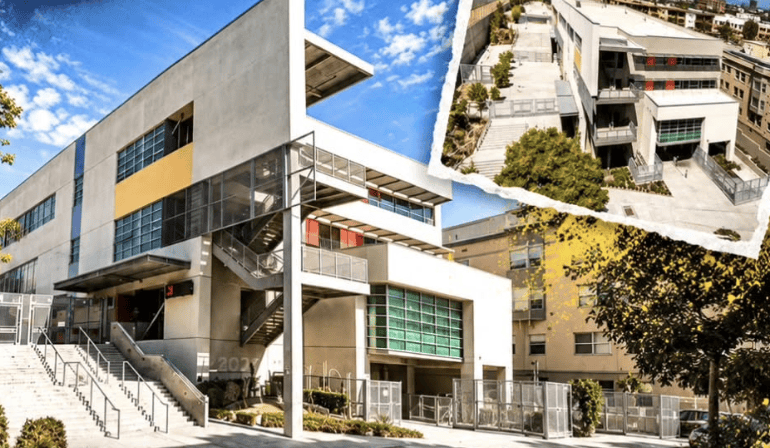
LAUSD leadership already knew that the number of school-age children was declining rapidly in 2011, when construction began on the Miramar campus, but they pressed ahead anyway, finishing the project in 2013. A charter organization, Camino Nuevo, used the campus through the end of the 2021 school year as a high school for its more successful network of middle schools. But the campus proved too far from the neighborhoods the Camino Nuevo middle schools served, and with 10 high schools within a 1-mile radius, the Camino Nuevo high school couldn’t attract enough students to pay the debt service on the building.
If California were a healthy, growing state, Camino Nuevo and its Miramar campus would have easily survived. But it’s not. According to Census Bureau estimates, the population of school-age children living within LAUSD’s boundaries fell from approximately 889,000 in 2004 to 643,000 in 2024. That is a loss of 245,000 children, more than a quarter of the school-age population in just 20 years.

The population of students enrolled in LAUSD has fallen right along with it, dropping from roughly 708,000 in 2006-07 to a projected 484,000 this school year, a decline of nearly a third even when independent charter schools are included.
But as the number of children has fallen, LAUSD spending has risen substantially. Annual general fund spending has climbed from $6.7 billion in 2006-07 to $11.4 billion budgeted this year, a 69% increase. Dividing that spending by district-operated enrollment shows that spending per pupil has nearly tripled, from approximately $10,200 to $30,100.
EDITORIAL: TRUMP’S CORRUPTION HAS COST REPUBLICANS DEARLY
Already, almost two-thirds of LAUSD campuses operate at or below 60% of capacity. Those numbers will only get worse as fewer and fewer Californians get married and have children, and many of those who do then head for more affordable destinations such as Texas and Utah.
If California’s past is any indication, spending on LAUSD will only continue to rise as the number of children shrinks. Democrats will then raise taxes to make up the difference, making California even less affordable and creating more Miramar mausoleums marking a once-great state’s decline.