
Racism has a bad reputation these days.
Deservedly so, I should say. If I were to discriminate against, say, Italians just because of all the Italian things they do and say, that would be deplorable. All men deserve to be treated with love and dignity, because all men are created in God’s image.
If I sound a bit defensive on the matter, it’s because my next-door neighbor Jeremy once accused me of racism. In this particular case, he was correct, but we weren’t talking about people. We were talking about trees.
Jeremy noticed a pattern in the trees I wanted to take down in my yard and his: They were all tulip poplars. Jeremy’s right that this wasn’t a coincidence.
Now don’t get me wrong — some of my favorite trees are tulip poplars. In college, my buddies and I used to play croquet and drink Miller High Life in the shade of Maryland’s Liberty Tree, a massive tulip poplar.
And Jeremy overstates the case: I don’t hate tulip poplars. I just don’t want them near my house. The tulip poplars can do just fine in their own neighborhood.
If you’re unfamiliar with this species, you may wonder what I have against tulip poplars. Let’s start small and work up.
First, they spread their seeds everywhere, and the seeds are horrible. I cannot walk onto my back deck barefoot this time of year without my feet getting stabbed by a dozen sharp tulip poplar samaras. Samaras are a type of seed pod. Maples and elms have them. You might call them “helicopters” by the way they spin as they fall. But the maple and elm samaras are harmless.
Tulip poplar samaras have sharp, rigid points perpendicular to the rest of the samara, so they stick straight up in the air. When it comes to the reproductive droppings of trees, tulip poplar samaras are second only to ginkgo fruits in their noxiousness.
Also, tulip poplars have caused me to double my annual budget on wiper fluid. You see, these trees are the only known habitat for tuliptree aphids, a species of insect that barely deserves the title of “animal,” because it reproduces asexually. These sexless bugs suck the moisture out of tulip poplar leaves, and then excrete a clear, sticky substance with the euphemistic name of “honeydew.” My driveway is sticky all summer, and my cars are covered in this stuff for half the year, because a tulip poplar sits next to my driveway.
Finally, tulip poplars grow very fast because they don’t grow very strong.
You know the saying “slow and steady wins the race”? Tulip poplars don’t care. They are the instant-gratification, short-attention-span trees. If any trees were to spend their days watching vertical short-form videos and placing prop bets on DraftKings, it would be tulip poplars.
As a result, they grow tall and brittle — and then they break. My in-laws’ kitchen and screen porch have both been assaulted by these impetuous trees.
You know how J.R.R. Tolkien’s ents are slow, deliberate, and wise? None of them was a tulip poplar.
And so whenever I can, I chop them down.
How do I do it? With my chainsaw and some prayers — and sometimes I bring some rope and a couple of buddies.
My ethnic cleansing started with a comment from my bride on an autumn night. Katie pointed out that one tree in our yard blocked her view of the foliage down below. It was a tulip poplar. I didn’t need any encouragement.
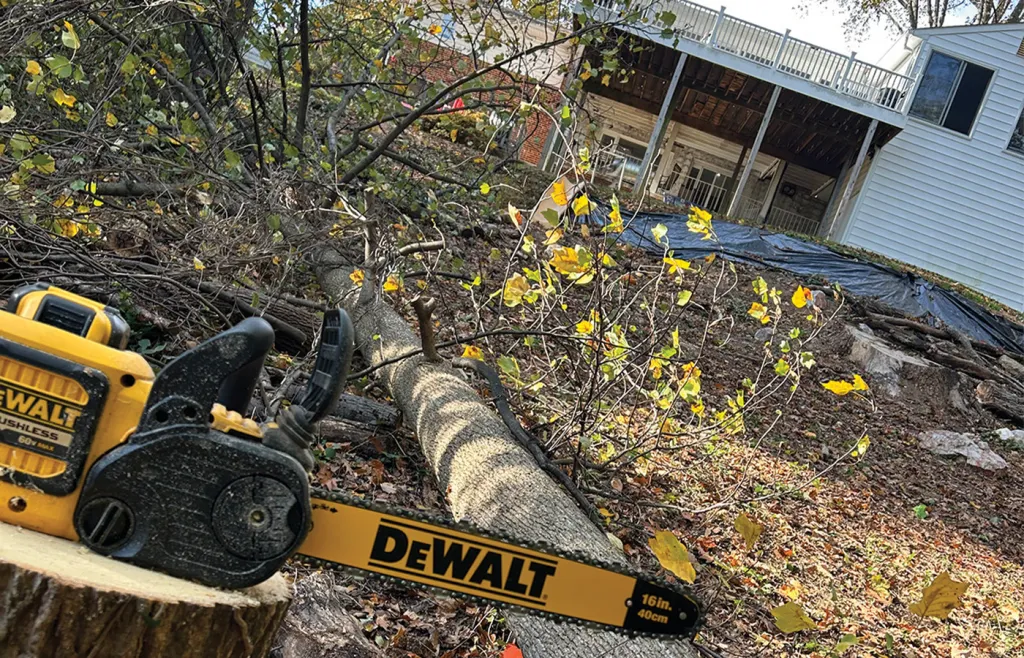
I busted out my 60-volt, 16-inch DeWalt chainsaw, made a face cut, made a back cut, and stepped back as a 50-foot poplar crashed into the middle of my yard.
Every time I’ve ever yelled “stop the presses,” it’s been a metaphor. Same with “and we have liftoff.” But that day, I got to yell “Timberrr!” and mean it.
Some say it’s foolish for an amateur outdoorsman to fell 50-foot trees. In my defense, that first tree was already leaning in the right direction. But more importantly: Are you really in love if you’re not willing to do something foolish for your woman, like become a lumberjack to improve her view?
It was also very fun to take down these hardwood monsters. So a couple of weeks later, my friends Luis and Arthur came over with some rope and their chaps, and we felled down three more tulip poplars.
WHEN GOOD ENOUGH IS GOOD ENOUGH
Had you been watching, you would have thought us professional lumberjacks — right up until the moment the tree landed exactly where we aimed it, rather than, say, on a neighbor’s roof. At that moment, each time, all of us hooted and hollered as if we had just bowled a strike.
And now the world has four fewer tulip poplars.
Timothy P. Carney is the senior political columnist at the Washington Examiner and a senior fellow at the American Enterprise Institute.