
Even the most neutral observer of international affairs can’t help but come to a glaring conclusion: President Donald Trump’s foreign policy is hurting right now.
At the time of writing, the eight-month-old war in Iran that was supposed to end in an unquestioned U.S. military victory soon after it was launched remains in the doldrums. Trump’s trade war with Canada, one of America’s biggest trading partners and, until recently, one of its closest allies, has alienated Canadians across the political spectrum. The Trump administration, on one hand, wants Europeans to take primary responsibility for their continent’s defense, yet, on the other, flirts with building a permanent U.S. military base in Poland. And while U.S. competition with China has cooled since the heyday of the COVID-19 pandemic, Trump and Chinese President Xi Jinping haven’t solved any of their systemic differences despite multiple face-to-face meetings.
But amid all of that bad news, there is one country where Trump is the indisputable winner: Venezuela. In the span of 10 months, the South American nation has transformed from one of Washington’s principal adversaries in the Western Hemisphere to a de facto puppet state. Delcy Rodriguez, the fire-breathing leftist who served former dictator Nicolas Maduro and his mentor, Hugo Chavez, loyally for decades, has gone through a capitalist-infused metamorphosis. Maduro, who during Trump’s first term managed to survive a coup attempt, U.S. sanctions, and diplomatic isolation, is now in a Brooklyn jail cell, waiting for the start of his trial on narco-terrorism, drug trafficking, and torture offenses.
None of this was inevitable on Jan. 3, when Trump ordered a snatch-and-grab operation in the dead of night to pluck Maduro and his wife, Cilia Flores, from the Tiuna military base. That operation was an act of such tactical brilliance that Trump continues to bring it up at nearly every campaign rally.
Yet Maduro’s demise also brought with it all sorts of hard questions that many, including this author, doubted the Trump administration thought through. Who would take over the Miraflores presidential palace in the interim? Would Venezuela’s entire political system collapse? How would the Venezuelan government’s different stakeholders, from the economic elites who squeezed the country dry to the security services who threw thousands into prison, react?
Nearly a year later, we have some answers to those queries. Venezuela, it turns out, wasn’t like Iraq — it could lose its central decision-maker in a U.S. military operation and still avoid descending into anarchy and civil conflict. This can be chalked up to early U.S. policy moves rather than dumb luck. Despite expectations from the Venezuelan political opposition, pleadings from Nobel laureate Maria Corina Machado, and grumblings from lawmakers in Florida who saw Maduro’s fall as a prelude to establishing a Western-style democracy in Caracas, the Trump administration chose a more conservative approach. Rather than pulling a Paul Bremer circa 2003 Iraq and firing everybody associated with the old Chavista regime, Trump kept the political structure in place with a new face at the top. The U.S. objective in the aftermath of Maduro’s extradition was all about preserving the country’s stability to the maximum extent possible, not immediately organizing a vote or transplanting Machado into Caracas on the back of a U.S. tank.
“What Trump built in Caracas … is managed authoritarianism, with the Chavista state intact and Delcy Rodriguez governing under American supervision,” Orlando Perez, a professor at the University of North Texas at Dallas, told me.
Indeed, it quickly became clear what the Trump administration was after: a sycophant who would take orders from Washington without complaint. Trump’s political opponents bashed this decision as nothing short of modern-day imperialism, but nobody could deny the shrewdness of the move. By choosing Rodriguez over an immediate return to democracy, the White House killed two birds with one stone: It maintained regime stability, buying U.S. officials some time for bigger things to happen down the line, and elevated an individual whose staying power was only as long as her ability to act as America’s personal genie.
Trump has done all of this through a traditional carrot-and-stick approach. The carrots include U.S. sanctions waivers that allow international oil companies to reengage with Venezuela’s oil sector, personal compliments from Trump about Rodriguez’s leadership abilities, and the signing of a comprehensive oil deal that’s supposed to net Caracas more than $200 billion in tax royalties. The sticks center on the U.S. Treasury Department’s control over Venezuela’s oil revenues, the still-active FBI investigations into senior-level Venezuelan officials for corruption, and the fact that all U.S. sanctions waivers can be revoked at any time with a stroke of the pen.
Regardless of the tools used, the result has been nothing short of surreal from Washington’s perspective. There was a time when Venezuela was off-limits to U.S. oil majors (although Chevron stayed put) after Chavez nationalized the country’s oil industry in 2007. Law enforcement cooperation with U.S. security agencies was a nonstarter. Venezuela was commonly viewed as an outpost in Latin America where Washington’s adversaries, from Russia and China to Iran, could set up shop and muck around in America’s sphere of influence.
This reality is now history. U.S. coercion has forced the same old Chavista system into a series of economic concessions that would have been utterly delusional a year ago. American oil executives and U.S. energy officials are flying to Caracas to talk turkey with Delcy Rodriguez and her ministers on a fairly regular basis. U.S. oil majors and smaller wildcatters are traveling around the country’s oil belt in search of projects. All of this culminated in the September oil deal between the Venezuelan government and North American Blue Energy Partners, a U.S.-backed private company, which gifts 65 billion barrels of oil, roughly one-fifth of Venezuela’s entire reserve, to American development.
The security benefits have been significant too. The Venezuelan security services were once trained to defend against the ruthless yanquis up north. Today, however, they’re working with those very same yanquis to catch the criminals that have long been on the FBI’s radar. In May, the Venezuelans extradited Alex Saab, Maduro’s former money man, to the United States to face charges. A month later, the Trump administration announced that the U.S., acting on intelligence given by Caracas, killed Hector Guerrero Flores, the leader of the Tren de Aragua gang. Another fugitive, Alvaro Pulido Vargas, was sent to the U.S. to face a bribery and money laundering case.
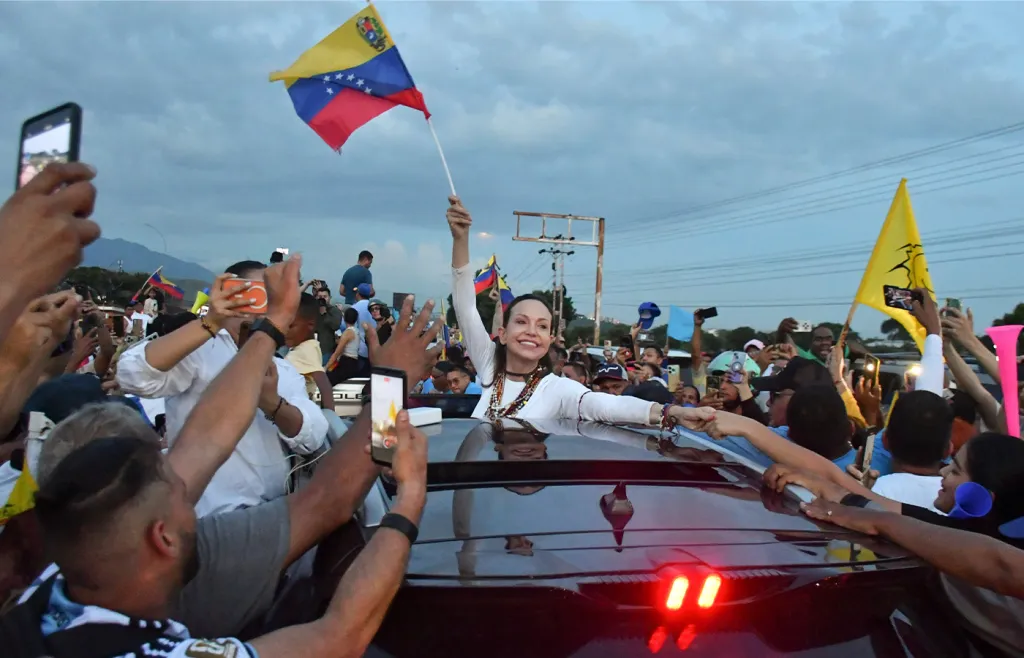
Despite those achievements, the million-dollar question hovering over Trump’s Venezuela policy remains the same today as it was in early January: When will the South American country hold new elections? The topic only increased in urgency when Machado reentered Venezuela on Oct. 25 and was greeted by thousands of adoring supporters after nearly a year of self-imposed exile. Having long been skeptical of the U.S.-sponsored intra-Venezuelan negotiations and concerned about the slow pace of the talks, the Nobel Peace Prize laureate is now back on the front lines and will attempt to use her credibility to accelerate the scheduling of free elections.
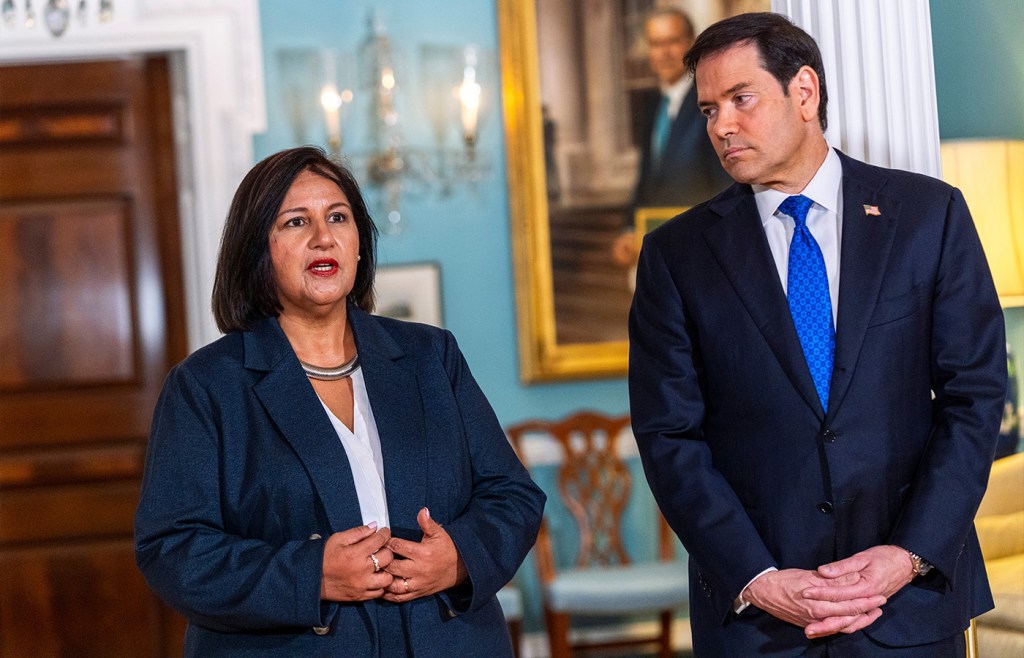
This may or may not complicate the Trump administration’s more cautious plans. According to the three-stage process outlined by Secretary of State Marco Rubio, a political transition toward democracy can only occur after the stabilization and recovery phases are complete. This includes rebuilding the country’s electoral and judicial institutions, addressing Venezuela’s gargantuan $200 billion in debt, reforming the security forces, and putting in place the mind-numbingly arcane procedures, like fixing the voter rolls, appointing non-partisan election watchers, and making sure every political party has an equal opportunity to campaign — all of which are critical to a fair democratic process.
At least on paper, the State Department, with Rubio at the helm, is fully on board with making presidential elections happen sooner rather than later. The Trump administration is supporting the intra-Venezuela political transition talks now underway between Rodriguez and Dinorah Figuera, the president of the 2015 Venezuelan National Assembly, which is considered the last democratically elected institution in the country.
Those negotiations have produced minor but encouraging agreements. Both sides, for instance, have agreed to reform the Supreme Court and establish a commission to screen prospective justices’ qualifications. More than 1,000 political prisoners have been released. Both sides have also committed themselves to reforming the National Electoral Council to administer future elections.
Geoff Ramsey, a longtime Venezuela watcher at the Atlantic Council who was recently on a research trip there, told me he was optimistic so far.
“These talks have real U.S. leverage behind them, something that previous dialogue efforts lacked, and the U.S. is using this leverage,” Ramsey said. “That is what gives me hope.”
Others aren’t so thrilled. For starters, the pace of negotiations is far too slow for Machado, who would have preferred to rid Venezuela of the Chavista system altogether, arrest everybody associated with the regime’s past abuses, and operationalize the results of the 2024 presidential election, which Maduro stole.
In his past life as a U.S. senator, Rubio would have been sympathetic to this outcome. On Aug. 1, 2024, as Trump was running for a second term, Rubio filed a resolution that would have formally recognized Edmundo Gonzalez Urrutia, the winner of the election after Machado was barred from running, as Venezuela’s president-elect.
Halfway through his tenure at the State Department, Rubio is treading a line between counseling patience and reiterating that the Trump administration ultimately wants to see a sovereign, free, and democratic Venezuela that is accountable to its people. The secretary reaffirmed those comments again a day after Machado returned to Venezuela.
“You’ve got to change the infrastructure of the elections — not in 10 years, not in five years, not in two years; it needs to happen quickly under the timelines that we’ve established,” he told reporters on Oct. 26. “But if anybody tries to derail that process, they’re doing great harm to Venezuela … we’re going to have a problem.”
The message from Washington these days is clear. First, if the interim government in Caracas thinks it can wait out the Trump administration, then it’s sadly mistaken. Second, if Machado thinks she can throw a wrench into the negotiations without consequences, then she ought to think twice.
On Venezuela policy, Rubio is doing most of the talking. But it’s the opinions and desires of Rubio’s boss that ultimately carry the day. Is Trump as committed to Venezuela’s re-democratization as his top diplomat? It’s not a hypothetical question. Unlike past U.S. presidents who spent half their time virtue signaling and preaching about the fundamental importance of spreading the “city on a hill” ethos around the world, Trump is more than happy to call autocrats friends if they hand Washington a bunch of goodies on a silver platter and pursue a pro-U.S. foreign policy. Rodriguez is proving to be the living, breathing version of Trump’s ideal foreign leader, one who is grossly unpopular with the people she represents but nevertheless at Washington’s beck and call. As even Rubio admits, Rodriguez has done everything the White House has asked for.
TRUMP AND RUBIO BRING VENEZUELA BACK INTO FOCUS AS MACHADO REENTERS COUNTRY
Therein lies the crux of the matter: U.S. policy in Venezuela is at odds with itself and pulling on two strings simultaneously. The first focuses on achieving core security and economic interests the U.S. deems essential, like icing its adversaries out of the Western Hemisphere, expanding its own geopolitical power, and increasing America’s pool of natural resources. The second involves satiating the U.S. desire to implant a freedom-loving democracy where none previously existed.
In between are the Venezuelan people, whose future is in the hands of a single individual thousands of miles away. “Nine months after the raid there is still no election date, and Maria Corina Machado, the country’s most popular opposition figure, has been left out of the U.S.-backed talks,” Perez reminded me. “For Venezuelans who wanted a real say in who governs them, that is a hard outcome to call a success.”
Daniel R. DePetris is a fellow at Defense Priorities.